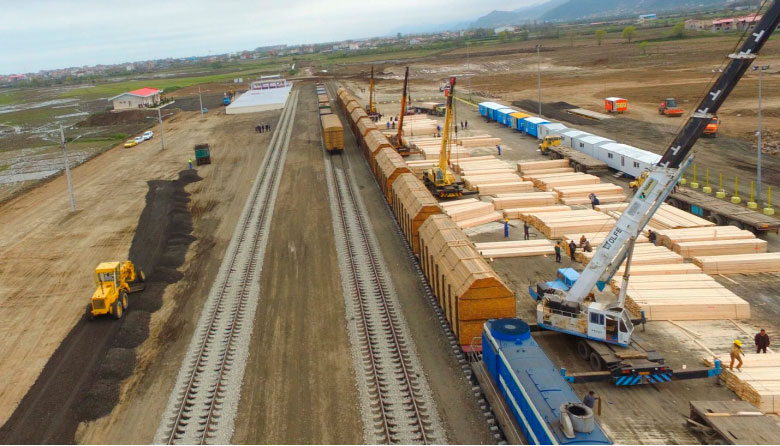
Iran’s Minister of Roads and Urban Development, Farzane Sadegh, announced that the Iranian authorities have purchased a 34-kilometer stretch of land for the construction of the Rasht–Astara railway line. This event has effectively signaled the start of work on a strategically important link of thцe international transport corridor.
It should be recalled that in May 2023 Russia allocated an interstate loan of €1.3 billion to Iran for the implementation of the project, with a target launch date by 2028. In addition, Iran committed to invest €300 million of its own funds. Upon completion, the route is expected to handle up to 15 million tons of cargo annually.
However, according to several sources, construction work will not be carried out by Russian Railways (RZD), but by Iranian contractors — pointing to a revision of Russia’s role in the project and possibly a downgrading of its priority on the Kremlin’s agenda.
Geopolitical necessity — restrained economic motivation
From a logistical and geo-economic standpoint, the western segment of the “North–South” corridor is objectively necessary. Yet in Moscow the question is posed differently: how actively, and more importantly, with what resources, should this route be developed?
In the Russian capital, it is not excluded that under Western sanctions targeting both Russia and Iran, Azerbaijan may gradually distance itself from the project. Moreover, amid cooling Russian–Azerbaijani relations, Baku’s interest in the corridor may correspondingly weaken.
It is telling in this regard that in June 2025 a decision was made to cut RZD’s investment in “North–South” infrastructure by 77.5% — from 40 billion rubles in 2024 to 9 billion in 2025. This is a more than obvious signal of Russia’s federal-level reassessment of the project’s priorities.
Three routes are better than two. But not always
Conceptually, having three independent “North–South” routes in the Caspian region looks beneficial and logical. Yet it should be understood that the corridor originally carried a military-economic meaning and was conceived as a strategic alternative in conditions of international confrontation.
As in ancient times, when armies built roads and trade followed them, 21st-century logistics is closely intertwined with geopolitics. Initially, the project was designed to serve two purposes at once: for Russia under sanctions, a “reserve exit” to the south, and at the same time a full-fledged international highway integrated into global supply chains.
However, such “reserve exits” may be marked on strategic maps, but often remain neglected for years, lacking infrastructure, operational management, or political will. Hence the paradox: the “North–South” corridor is equally important both in a scenario of heightened confrontation with the West (with blocked routes through Eastern Europe) and in case of gradual normalization, when the trade-economic model of the early 2010s could be revived.
Limited resources, limited ambitions
Despite political rhetoric and media activism, in investment and construction terms the project remains modest. Since 2020, no resources comparable to those of the “Eastern Polygon” — the large-scale modernization of the Baikal–Amur Mainline (BAM) and the Trans-Siberian Railway — have been allocated.
In 2023–2024, RZD’s total investments in “North–South” infrastructure amounted to around 60 billion rubles. By contrast, modernization of the eastern routes alone in 2025 is budgeted at 110 billion rubles, with total costs reaching 3.7 trillion rubles by 2030.
Thus, the “North–South” corridor is not a federal-level megaproject but rather a niche transport alternative, funded on a residual basis in line with current cargo volumes and real demand.
According to available information, reconstruction of the western route — including the Rasht–Astara section and the Baku–Astara segment — will be handled by the national railway companies of Iran and Azerbaijan. Russia, it seems, will be limited to the role of creditor and logistics partner. The eastern route, passing through Kazakhstan and Turkmenistan, is also developing without RZD’s dominant role, indicating a shift in Moscow’s strategic focus.
It should also be noted that the stated ambitions to increase cargo flow to 32 million tons annually by 2030 could theoretically be achieved today using existing infrastructure. The limitation lies not in logistics, but in the lack of a stable volume of goods.
Not a megaproject, but a geopolitical option
The “North–South” corridor will remain an important theme in the agenda of multilateral cooperation in the Caspian region. Yet as political and economic realities become clearer, it is evident that the project will not transform into a large-scale federal-level construction campaign, as many observers initially assumed.
Rather, it will continue to exist as a “geopolitical option” — a potential that can be activated if external conditions change. Until then, its development will remain managed and limited: restrained in investment, cautious in international alliances, and flexible in strategic calculations.
Ilgar Huseynov
Translated from haqqin.az