Armenian Prime Minister Nikol Pashinyan announced that Armenia plans to simplify border procedures not only at the Armenia-Azerbaijan border but at all border checkpoints across the country.
According to Pashinyan, the reform aims to make conditions for export, import, and transit as smooth as possible. He emphasized that traditional control methods, including the need for direct human interaction, are gradually being replaced worldwide by digital technologies and biometric passports.
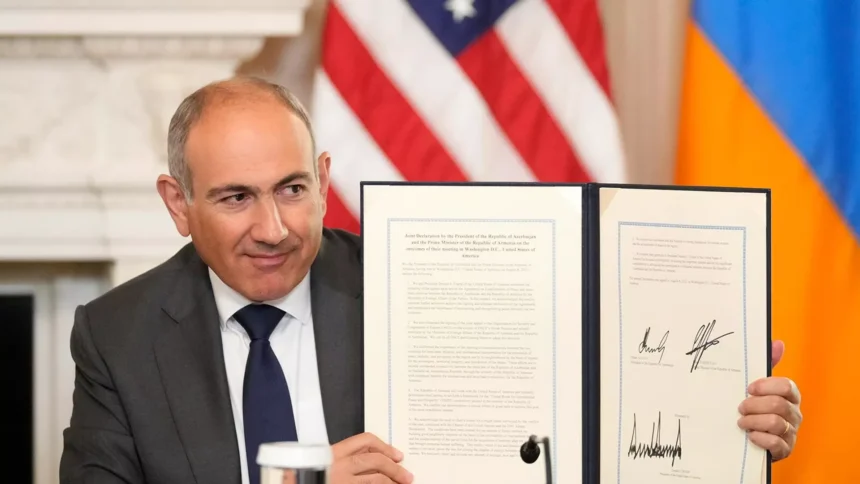
The Prime Minister also reminded that the Washington Declaration outlines five core principles underpinning the agreement between Armenia and Azerbaijan: territorial integrity, sovereignty, jurisdiction, inviolability of borders, and reciprocity.
“We are ready to simplify regulations based on these principles. This is also reflected in the ‘Crossroads of Peace’ project,” Pashinyan stated.
He added that Armenia intends to keep pace with global trends, where modern digital procedures are replacing traditional customs and border control methods.
Regarding the so-called “Trump Route,” Pashinyan clarified that a joint Armenian-American company will not control the road but will manage it from a business perspective.
The Prime Minister also addressed common questions about when the road would be built and whether Iranian trucks could use it. He cited the example of an existing railway in Armenia, operated under a concession by Russia, which is freely used by trucks from any country because the territory remains under Armenian jurisdiction.
Pashinyan stressed that Armenia has never intended to obstruct connections between mainland Azerbaijan and Nakhchivan. The Washington Declaration reinforces this, highlighting the benefits for both countries under the five agreed principles, as well as advantages for Armenia’s domestic and international transport.