In today’s multipolar world, Central Asia has gained a strategic place among the foreign policy priorities of both global and regional actors with its location, natural resources and rising geoeconomic potential, which has turned into an intersectional area of great power rivalries. Increasing external engagement in the region manifests itself in a wide range of areas, from economic investments to security cooperation, from digital infrastructure to normative influence. This makes Central Asian countries not only passive recipients but also active and multidimensional actors trying to balance external influences.
Today’s Central Asia is marked by complex power struggles beyond traditional influence, while its countries reshape their foreign policies with greater autonomy.
Long list of external actors
Firstly, we should look at China, one of the main actors influencing Central Asia. Beyond the transport and infrastructure projects under the Belt and Road Initiative (BRI), China has transformed its influence into a multi-layered influence strategy that penetrates into state structures through digital surveillance systems, cybersecurity solutions and public administration software. The most concrete indicator of this institutionalization is the China-Central Asia Secretariat announced at the 2025 Almaty summit. However, new vulnerabilities in the areas of digital dependency and data security raise serious concerns about the sovereignty capacities of the countries in the region.
Turning to Russia in this context, Moscow’s strategy of reasserting its historical sphere of influence clearly stands out. Having become relatively isolated from the West after the Ukraine War, Russia aims to maintain its influence in the region through its military bases in Central Asia, energy projects and security cooperation within the Shanghai Cooperation Organisation (SCO). However, the economic contraction and loss of international legitimacy have led regional capitals to develop a more cautious and opportunity-oriented attitude towards Russia. Russia’s recent recognition of the Taliban regime indicates that this strategy is being expanded through Afghanistan. This development, which holds a torch to the strategic future of the Turkic world through Turkmen and Uzbek communities, makes the security-oriented institutional capacity of the Organisation of Turkic States (OTS) visible and increases the importance of Türkiye’s multilayered balancing diplomacy on the Moscow-Taliban axis.
The India-Israel axis has the potential to create a new ideological polarization in Central Asia in the fields of defence, intelligence and cyber security. The reflection of India’s Prime Minister Narendra Modi’s “Hindutva” ideology on foreign and security policies, coupled with the harsh positions taken in the context of Palestine and Kashmir, may trigger socio-political sensitivities in Muslim communities living in Central Asia. This may indirectly weaken the security coordination centered on Türkiye-Pakistan-Azerbaijan. Yet, within these multidimensional external interactions, the Türkiye-Azerbaijan-Pakistan triangle offers a multilateral, identity-based alternative vision for Central Asia through the Trans-Anatolian Natural Gas Pipeline (TANAP), the Zangezur Corridor, the Gwadar line and the integration it has developed on the Commonwealth of Independent States (CIS) axis. Türkiye’s approach, balancing its NATO membership and Eurasian expansion, Azerbaijan’s active role in energy transit and the strategic relations between Pakistan and China make this line effective.
As far as the U.S. is concerned, it is increasing its strategic engagement in the region through the yearly C5+1 summits, the Critical Minerals Dialogue and soft power instruments. Washington’s investments in media, education and civil society signal not only short-term interests but also long-term settlement strategies. However, the asymmetric dependencies that this engagement may create should be carefully managed for the countries in the region. Because the increasing U.S. interest in the region raises the question of whether Central Asia will be the next target after the Middle East.
Another actor trying to be active in Central Asia is the European Union. Although raw material agreements and economic projects carried out in connection with the “Global Gateway” strategy strengthen cooperation with the region, the EU’s limitations in terms of military and diplomatic capacity cause this approach to be confined to the level of economic partnership.
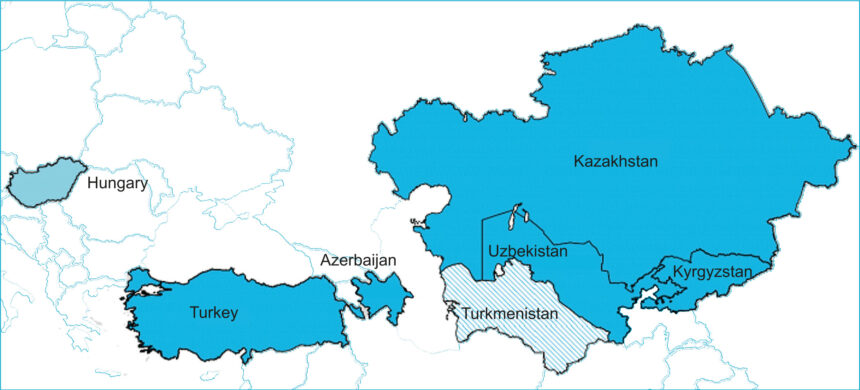
Last but not least, the orientation of Gulf capital toward the region in the fields of green energy, finance and logistics, the expansion of the China-Pakistan Economic Corridor (CPEC) through Afghanistan and the BRICS+ structure putting the countries of the region on the agenda make Central Asia a growing strategic intersection. In this environment, the OTS stands out as an element of balance that feeds on internal dynamics and institutionalizes identity-based solidarity.
Foreign policy reflex of Central Asia
Due to the strategic importance of their geopolitical position and environmental pressures, Central Asian countries have long shaped their foreign policies in line with the principle of “multi-vector balancing.” This approach is based on the strategy of simultaneously cooperating with a variety of actors without committing to a single power or alliance, thereby diversifying their political, economic and security interests.
This strategic reflex has been further institutionalized by the experiences of foreign intervention in the historical memory of the Central Asian countries. Central Asian foreign policy makers have been consciously pursuing a policy of pluralism against the risk of dependency that unipolarity may create, and have developed simultaneous economic, security and diplomatic engagements with different actors, creating a kind of insurance mechanism against external pressures.
At a practical level, this approach is shaped by the principles of diversifying partnerships in infrastructure investments, licensing agreements in energy projects, security platforms in the field of defense, and foreign aid. A balanced distribution of foreign trade, diversification of external financing sources and parallel membership strategies in multilateral organizations are concrete instruments implemented within this framework
Central Asian countries also tend to support this foreign policy reflex with reforms to increase domestic political resilience. Digital transformation, public administration reforms, energy supply security strategies, and human capital investments focusing on the young population have become part of the goals.
The quest for multi-vector balancing also necessitates the strengthening of regional solidarity mechanisms. This strategy aims to institutionalize common identity-based structures, develop coordinated strategies in the fields of security and transport, and increase intra-regional trade as efforts to create a regional basis. In this framework, the principles of intra-regional dialogue, cooperation and strategic autonomy come to the fore against the increasing polarization in the international system.
However, the sustainability of this multi-vector strategy is not limited to the diversity of actors. It also needs to be deepened in areas such as improving institutional risk management in foreign relations, making arrangements to prevent interdependencies from becoming asymmetrical and protecting decision-making autonomy against external pressures. Otherwise, the principle of versatility may be limited to a superficial appearance of diversity and may be insufficient to prevent the reflection of the conflicting agendas of the great powers on the region.