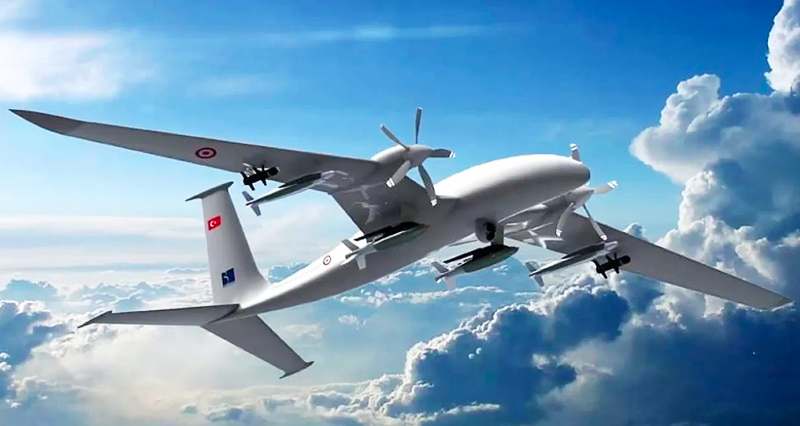
Let’s focus on just one of these key areas: technological change. Put simply, the rate of technological change in the 21st century has created dozens of new axes of warfare, many of which are insurmountable by conventional fighting forces.
Barring the cyber and information spheres, there few examples of where technology counts more than in the air. Nowadays, air-fighting is on the brink of a once in a lifetime strategic and technological transformation due to the symbiosis of manned and unmanned aerial vehicles, including suicide craft.
In a conventional sense, this was arguably observed for the first time during the recent Azerbaijan-Armenia conflict, in which Armenia’s conventional fighting forces were challenged – and considerably overwhelmed – by the technologically superior Azeris.
Indeed, Armenia’s expensive conventional weaponry was simply unable to compete on a different military axis, and was thus beaten by cheaper and more replaceable Azeri UAVs. The lesson is simple: no matter how robust one’s conventional army may be, the rate of technological change ensures that units, hardware and strategies are being superseded at an increasing rate – and that it is imperative for modern militaries to diversify their portfolio of resources. So how can Australia learn from this case study?
Firstly, let’s compare the ADF to the military of one of our closest neighbours to provide some perspective. While Australia counts some 80,000 active and reserve defence force personnel, Indonesia (for the sake of comparison) has 400,000 active military personnel bolstered by 400,000 reservists. Meanwhile, Australia’s arsenal of 59 tanks pale in the face of Indonesia’s 300-500 (numbers vary due to source).
Unfortunately for Australia, we are not only numerically disadvantaged, but also technologically. Indonesia acquired their first armed UAVs in 2019, and President Joko Widodo has already expressed his desire to expedite the domestic production of long-range military drones to 2022. While our wheels are in motion, we lag behind our competitors.
The rate of technological and strategic change affords smaller countries like Australia with a unique opportunity. Indeed, where Australia is unable to compete in population – we are able to firmly grasp onto the idiosyncrasies of modern war – and oppose our adversaries on axes which they are not able to win on.
This brings us to our case study. It is crucial for modern military theorists to look at the Azerbaijan-Armenia conflict to glean an understanding of how technology is eclipsing traditional military strategy and the conventional fighting force. In a theatre of war which is almost reminiscent of the Polish cavalry charges of the Second World War, the Armenian army and air-force did not appreciate the devastating impact of drones or how they tie into modern warfare.
Interestingly, at the beginning of the conflict Azerbaijan converted Soviet-era aircraft into UAVs which they slowly flew over Armenian airspace in order to lure the Armenian air defence into contact. Azeri UAVs were then able to identify, engage and destroy these Armenian air defence systems.
While neither side of the conflict will confess to the true scale of losses, it was reported that one of the Iskander missile defence systems – a system whose reputation allegedly “scares NATO” – was destroyed by a suicide UAV.
Not only was the simplicity of Azerbaijan’s UAV suicide tactics able to overcome the state-of-the-art Russian technology that was wielded by the Armenians, but it was also cheaper. Michael Kofman of the US based defence think tank CNA, noted that “drones offer small countries very cheap access to tactical aviation and precision guided weapons, enabling them to destroy an opponent’s much-costlier equipment such as tanks and air defense systems.”
This strategy was also seen last March when the Turkish military destroyed “hundreds of regime tanks, artillery pieces and armoured vehicles” in Syria’s Idlib Provence with UAVs that are “cheap, easy to make and clearly don’t miss”. These conflicts emphatically demonstrate the 21st century’s changing nature of war, and should encourage the Commonwealth Government to invest in technology that closes the gap of our numerical disadvantage.
Strategies and technology in war change, there are no surprises in this. However, the rate at which strategies and technologies are becoming obsolete in conventional fighting forces is growing at an unprecedented rate.
The seamlessness and simplicity of the Azeri drone strategy should be studied by military theorists as the gold-standard of employing cheap and new technologies into conventional war. We must employ these lessons to reverse Australia’s numerical disadvantage against her adversaries.
Liam Garman
Defence Connect