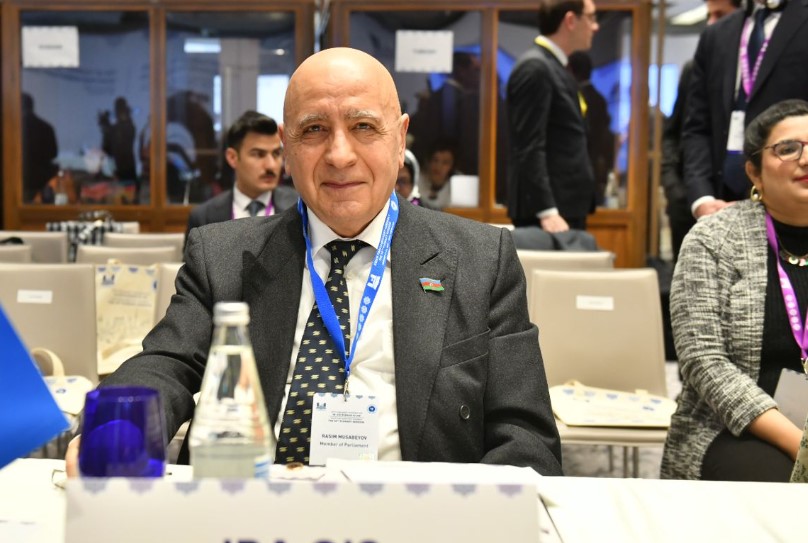
Azerbaijani political analyst and Milli Majlis deputy Rasim Masabayov believes there are no serious grounds for a harsh reaction from Russia or Iran regarding the Washington agreement on the Zangezur Corridor project. He made this statement in an interview with Minval Politika, commenting on a Reuters report about the signing, this Friday, of a framework document under which Armenia plans to grant the United States exclusive rights to develop the transit corridor for a long term.
“It is difficult for me to formulate Russia’s official reaction. Most likely, the Russian Foreign Ministry will respond somewhat skeptically. If we use the current language in vogue there, they may say that the U.S. wants to ‘seize’ the South Caucasus from them. But I see no real grounds for protest from Russia, and most likely Moscow’s actions will focus on organizing pressure on Prime Minister Nikol Pashinyan’s government — which, in principle, they have been doing all along,” the expert said.
According to Musabayov, Iran’s reaction will be sharper:
“Of course, Iran’s theocratic regime will howl over this, but they are in no position to intervene or to insist, as they have claimed before, that this is a ‘red line’ that Iran will not allow to be crossed. Such statements may be made, but I doubt Iran can do much more now. The sharper reaction will be aimed primarily at Armenia, since the decision is being made in Yerevan. In any case, Armenia will have to resolve the key issue — how to reconcile the presence of Russian border guards along its entire border with Iran with a U.S.-implemented transit corridor. That is quite a challenge.”
He suggested that the next step should be for the Armenian government to replace Russian border guards, at least on this section of the Armenian-Iranian border:
“And if the normalization of relations between Armenia and Turkey continues logically, then most likely Russian border guards will also be removed from the Armenian-Turkish border. As a sovereign state, Armenia will then take over the protection of its own borders.”
The expert also touched upon the possible inclusion of Azerbaijan in the Abraham Accords amid its contacts with Washington, recalling that these documents are aimed at establishing diplomatic relations between Arab countries and Israel, with which Azerbaijan has long had strong ties.
“We have not only diplomatic relations with Israel but also a strategic partnership. I believe the talk about Azerbaijan joining these accords is meant to move the situation out of deadlock, since so far there has been no success in organizing the signing of agreements with Saudi Arabia, the UAE, Syria, and Lebanon.”
If, he added, this is some kind of multilateral agreement involving the United States, “then there should be a concrete document on the table, and it will become clear with whom exactly this agreement is being organized.”
Commenting on the possible suspension of Section 907 in light of these agreements, Musabayov explained that the essence of the amendment is a ban on the U.S. Administration providing financial assistance to Azerbaijan on the grounds that Azerbaijan “blocks” Armenia.
“If the Zangezur Corridor opens, a peace treaty between Azerbaijan and Armenia is signed, and a decision is made to open transport communications, then there will be no reason to keep this amendment. Unfortunately, in U.S. Congressional practice, decisions are easily adopted but very difficult to repeal. But Section 907 does not constrain us. We do not particularly need U.S. assistance,” he said.
As for arms sales to Azerbaijan, Musabayov stressed that Section 907 in no way restricts the United States in this regard: “If there is a need for military cooperation with the free transfer of any military aid to Azerbaijan, the Trump Administration can always suspend the amendment. It is fundamentally important that the matter of this amendment in relation to Azerbaijan be resolved regardless of whether America provides us with assistance or not. I think this issue will be raised.”
He also recalled the Jackson–Vanik amendment, which imposes trade restrictions on countries hindering Jewish emigration. This amendment was adopted during the Soviet period but still applies to Azerbaijan: “Jews freely enter and leave Azerbaijan, yet the amendment has not been repealed. I believe that during President Ilham Aliyev’s visit, the absurdity of keeping such decisions will be raised. The continued existence of these unjust amendments is, of course, absurd. This issue will most likely be brought up, though it is difficult to say how quickly it can be resolved,” Musabayov concluded.