What might have begun as isolated incidents—dismissed by some as bureaucratic turf wars or local criminality—has evolved into a wider geopolitical rupture. The Baku-Moscow axis, once grounded in transactional pragmatism, is now unraveling amid mutual distrust, strategic divergence, and increasingly assertive rhetoric.
Azerbaijan`s careful policy vis-à-vis Russia
Azerbaijan’s approach to Russia has long been defined by a delicate balance – measured and diplomatic in tone, but confident and, when necessary, assertive. While Baku has refrained from joining anti-Russian blocs or imposing sanctions, it has not shied away from taking a firm stance in bilateral interactions, where its rhetoric and actions can be particularly forceful. For example, Azerbaijan may provide military assistance to Ukraine or rebuild damaged infrastructure, but only through bilateral cooperation, not Western-led missions. This dynamic is unfolding against a backdrop of generally worsening relations between Azerbaijan and Russia.
From Moscow’s standpoint, Azerbaijan’s independent and equidistant foreign policy has often proven frustrating. Despite repeated overtures, the Kremlin has been unable to draw Baku into its Eurasian integration projects. A key missed opportunity followed the 2020 Karabakh War, when Russia aimed to solidify its military footprint in the region. Instead, by 2024, Azerbaijan pushed for the early withdrawal of Russian peacekeepers from Karabakh—a full year ahead of the mandate’s expiration.
Baku’s multi-vector foreign policy—rooted in strategic ties with Turkey and Pakistan, deepening partnerships with Israel, and a growing relationship with China—has further diminished its dependence on Moscow. Russian policymakers are particularly uneasy about Turkey’s expanding role in the South Caucasus, primarily through its alliance with Azerbaijan. Adding to this unease is Baku’s quiet yet consistent support for Ukraine since the start of the Russian invasion, including humanitarian aid, medical supplies, and infrastructure assistance.
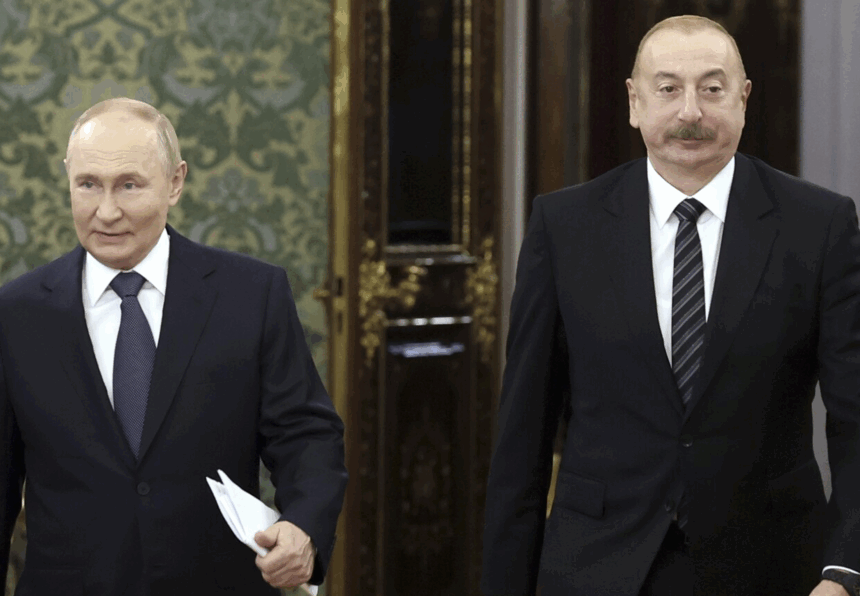
Historically, the personal rapport between Presidents Aliyev and Putin served as a stabilizing force, helping to contain institutional frictions. However, their last known conversation occurred in January 2025, centered on the aircraft incident—suggesting a significant decline in direct high-level communication.
Today, many in Baku’s political and policy circles believe that the tables have turned: Russia now needs Azerbaijan more than Azerbaijan needs Russia. Isolated by Western sanctions and cut off from key markets and transit routes, Moscow is increasingly reliant on southern access points to reach Turkey, Iran, and the Persian Gulf. In this emerging geopolitical configuration, Azerbaijan remains the most reliable and strategically vital link.
Deteriorating bilateral ties
The downward trajectory of Azerbaijani-Russian relations became unmistakable following the downing of an Azerbaijani passenger aircraft by Russian air defense systems in December 2024. This unprecedented incident triggered an immediate diplomatic backlash from Baku, including demands for a formal apology, accountability, and compensation. Moscow’s ambiguous and delayed responses only deepened the rift. President Ilham Aliyev’s conspicuous absence from Russia’s Victory Day parade on May 9, 2025—a hallmark of Kremlin ceremonial diplomacy—underscored the extent of the fracture.
Tensions escalated further in June 2025 with the mass arrest of ethnic Azerbaijanis in Yekaterinburg, an event seen by many in Baku as either a coordinated crackdown or a deliberate act of intimidation. Whether the operation stemmed from local power struggles or was sanctioned by higher echelons in Moscow, its political consequences have been far-reaching. Azerbaijan responded forcefully: suspending the operations of Russia’s Sputnik media agency, detaining several Russian nationals on cyber-fraud and smuggling charges, and launching bellicose rhetoric against in the local media against the Kremlin.
Russia’s waning influence in the South Caucasus
Russia’s influence in the South Caucasus has been in decline since the 2020 Karabakh War, which reshaped regional power dynamics. Azerbaijan’s military victory over Armenia—Russia’s traditional ally—exposed the limitations of Moscow’s security guarantees and arms exports. More importantly, it enabled Turkey to expand its strategic footprint in the region via its close alliance with Baku.
The war also marked the beginning of a regional reconfiguration. Armenia, seeking to recalibrate its strategic orientation, has initiated normalization talks with both Turkey and Azerbaijan—moves that sideline Moscow. Prime Minister Nikol Pashinyan’s historic visit to Ankara and the Armenia-Azerbaijan summit in Abu Dhabi are emblematic of this shift, effectively sidelining the Kremlin which had dominated the peace process for decades. Meanwhile, U.S. diplomatic engagement around the Zangezur Corridor further dilutes Russia’s leverage.
The war in Ukraine has only compounded Russia’s setbacks. Preoccupied militarily and diplomatically, Moscow has lost the bandwidth to maintain its traditional dominance in the South Caucasus. As Western sanctions and international isolation close other routes, Russia is increasingly dependent on Azerbaijan as a logistical and geopolitical conduit to Turkey, Iran, and the Persian Gulf.
Moscow’s efforts to reestablish influence after the war—particularly through peacekeeping forces in Karabakh—were rebuffed. In 2024, Azerbaijan successfully pushed for the early withdrawal of Russian troops, a full year ahead of the official mandate’s expiration. This move, unprecedented in post-Soviet politics, demonstrated both Azerbaijan’s growing confidence and Russia’s declining capacity to dictate outcomes in its supposed sphere of influence.
A new confrontation?
President Aliyev’s statement at the 3rd Shusha Media Forum in July 2025 left little doubt about the depth of the rift. His call for accountability over the downed aircraft—backed by threats to take the matter to international courts—was accompanied by unusually direct criticism of Russian obstructionism. His veiled advice to Ukraine—“never agree to occupation”—resonated as a thinly disguised rebuke of Russia’s regional behavior.
In parallel, some Kremlin-aligned commentators have called for harsher response, including a military attack, against Azerbaijan, further poisoning the atmosphere. While no formal escalation has occurred, the rhetoric on both sides indicates a shift from diplomatic irritation to open confrontation.
Strategic Geometry Redefined
For decades, Russia exploited protracted conflicts in the South Caucasus as instruments of influence, using them to exert leverage over regional states. That strategy has largely lost its effectiveness—particularly in the case of Azerbaijan, and increasingly in Armenia. Baku’s military victories, its strategic alliance with Ankara, and its expanding network of global partnerships have fundamentally reshaped the regional geopolitical architecture. Russia, by contrast, now finds its influence waning, its soft power eroded, and its traditional mechanisms of coercion increasingly ineffective. On the Armenian side, the resolution of the Karabakh issue has lifted a long-standing constraint, creating space for Yerevan to recalibrate its foreign policy, diminish Russian dominance, and explore new strategic alignments.
The Azerbaijan-Russia rupture is not an isolated bilateral disagreement—it is a symptom of the South Caucasus’s larger geopolitical transformation. Whether this transformation leads to a stable new order or to further fragmentation will depend on how regional and global actors adjust to the new realities.
What is clear, however, is that Azerbaijan is no longer operating from a position of strategic caution. It is asserting itself as a confident, independent actor with a regional vision that diverges sharply from Moscow’s. The geopolitical consequences will extend well beyond the Caucasus—and could define a new era in Eurasian politics.
Rusif Huseynov is the Co-founder and Director of Topchubashov Center, a Baku-based think tank.