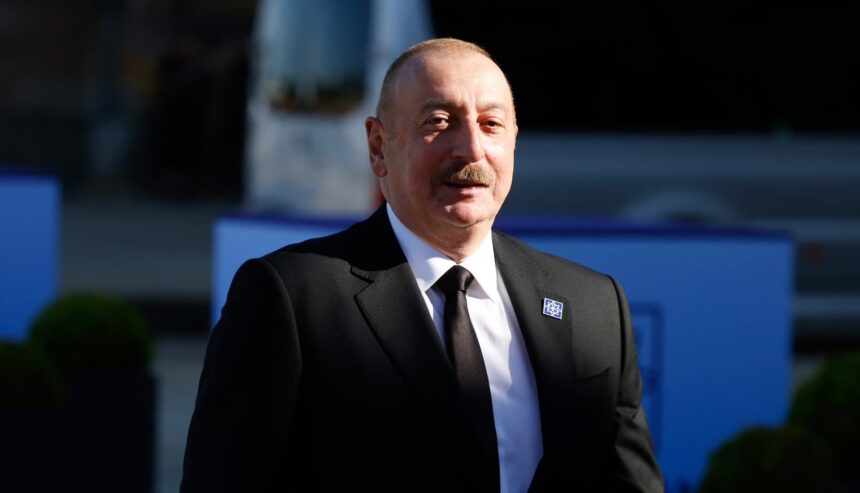
So will the hysterical reaction from Russian propagandists and Z-bloggers. After Aliyev called on Ukraine to “never agree to occupation” and revealed that Azerbaijan is preparing a legal case to take Russia to international courts over the downing of the AZAL passenger plane, the Russian media sphere descended into outright panic.
Some voices in Russia suggested retaliating via the “tomato front,” proposing to let Azerbaijani tomatoes rot at the border. Others went as far as to suggest striking Baku with the “Oreshnik” missile system, calling for the involvement of not only the Interior Ministry but even the Defense Ministry.
While it’s unlikely that the joint Russia-Iran military drills in the Caspian are directly tied to this media meltdown — such exercises are typically planned well in advance — the rhetoric itself is telling: threatening missile strikes in response to a legal complaint underscores the lack of any other viable arguments.
What’s happening in the Z-blogosphere is more than just the usual outburst. If the response to a planned legal proceeding is a missile threat, that’s an admission that Russia has no tools left but brute force. The stream of hysterical threats is proof that Russia’s political elite is cornered and genuinely at a loss for how to respond. Just yesterday, propagandists like Vladimir Solovyov could boast that Russia only needs to “raise an eyebrow.” Today, it’s clear that everything from targeting the Azerbaijani diaspora to launching “tomato” or “peach wars” through the agricultural watchdog has failed to produce results.
Moscow believed that a bit of public displeasure and pressure on Azerbaijani markets would force Baku to fall in line and retreat from its positions. That didn’t happen. Azerbaijan has responded to Russian provocations with calm and calculated actions — while Moscow appears confused. Russia could, of course, de-escalate the crisis, ease pressure on the diaspora, and start a proper investigation into the air defense blunder near Grozny. But the imperial pride is proving too hard to swallow — and no alternative path seems to be in sight.
Moreover, thoughtful experts are warning Russia not to escalate with Azerbaijan. Noted military analyst Sergey Auslender called those pushing for war with Azerbaijan “idiots” and explained: “Azerbaijan’s army is now free. The Karabakh war is over — and it was a victory, which is highly motivating. Meanwhile, almost the entire Russian army is stuck in Ukraine, and there’s no end in sight. Fighting two wars is beyond their capacity. And let’s not forget Turkey, whose 9th Army Corps is deployed and prepared for warfare in mountainous regions.” Translation: Don’t even think about it. There will be no “Baku in three days.”
Even the Telegram channel “Nezygar,” not exactly friendly to Azerbaijan, cited a diplomatic source saying that military escalation with Azerbaijan is off the table: “Russia lacks the resources for military operations in the Caucasus. The military balance does not favor Russia. Azerbaijan has a mutual defense pact with NATO-member Turkey.” The source also noted Baku’s support from the leadership of Belarus and Kazakhstan, making it impossible for CSTO countries to be involved.
This shifts the entire context of the current crisis, Aliyev’s statements at the media forum, and the Russian expert community’s reactions. In essence, Ilham Aliyev delivered a powerful masterclass in defending national interests and dignity. He made it clear that imperial rhetoric and coercion no longer work on Azerbaijan. But it goes deeper: Azerbaijan is now strong enough to speak to Moscow from a position of strength — and that came as a shock to many.
Aliyev didn’t start with populism or bombastic rhetoric. The first phase was state-building: strengthening and modernizing institutions, followed by a successful military reform program and the creation of a modern, capable army. This culminated in the successful liberation of Karabakh — first during the 2020 Patriotic War, then with the anti-terrorist operations in 2023. Parallel to this, Azerbaijan conducted precise diplomatic work, forming a military alliance with Turkey, laying the groundwork for a similar relationship with Pakistan, and increasing its influence even in organizations like the CSTO, where it isn’t even a member.
Another key pillar of Azerbaijan’s independence has been its energy policy: the development of a sovereign hydrocarbon export system. As it turns out, despite all the talk about an “energy transition,” the economies of the so-called “Golden Billion” countries cannot do without oil and gas.
The West does not always strongly protect its allies — especially those outside NATO and without the shield of Article 5. Just recall Georgia in 2008 or Ukraine in 2014. But oil interests are a different story. Even in 1994, when Russia’s foreign minister Andrei Kozyrev — a self-styled liberal — suggested using force to seize oil rigs in the Caspian, Washington pushed back hard. Things haven’t changed much since — and certainly not in Russia’s favor.
As a result, under President Ilham Aliyev, Azerbaijan can now afford to speak bluntly with the Kremlin. This isn’t populism — the government doesn’t really need it. It’s national interest. It’s a clear message: Azerbaijan demands respect. Azerbaijan is playing white in this game. And if someone in Moscow wasn’t ready for that — that’s not Azerbaijan’s problem anymore.
Nurani