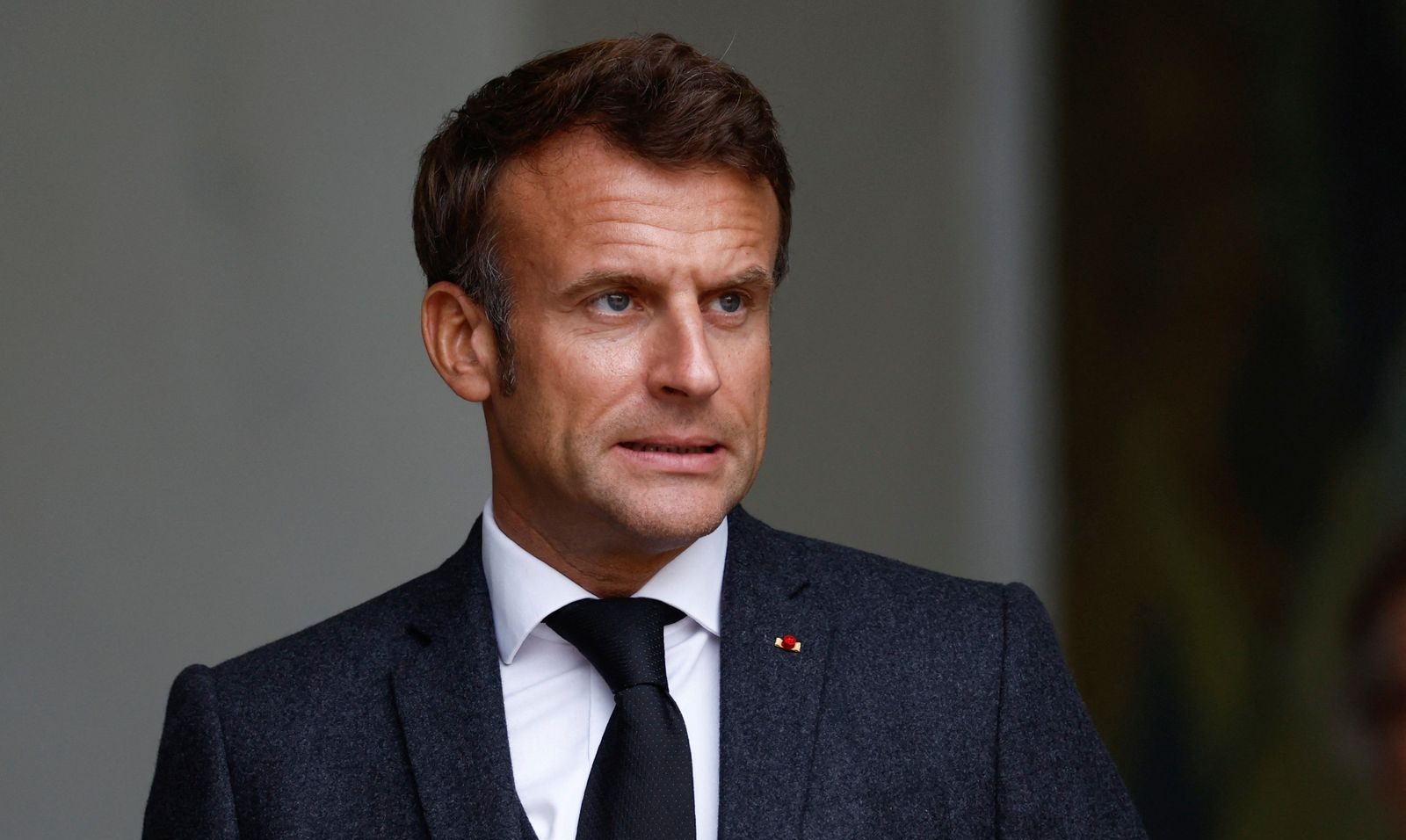
This time, the French capitulated just 15 kilometers from central Paris — in Bougival, where an agreement was signed to create a new state: New Caledonia. For years, the indigenous Kanak population of this island group off the eastern coast of Australia has fought for independence. And it was to them that Macron surrendered, betraying his own citizens — the French who live on the islands and did not want a break with the homeland.
Such things happen regularly with France. No wonder the color of its armed forces’ flag, as the joke goes, is white.
Formally, this is not a capitulation, but a compromise: New Caledonia will retain some oversight from Paris, but gain unheard-of autonomy — including its own citizenship and a sovereign foreign policy. Something similar exists only among Serbs in Bosnia — but they had to fight a war for such broad self-rule. Macron, meanwhile, surrendered almost without a fight.
The Kanaks’ list of grievances against Paris is as long as an Araucaria tree — the conifer depicted on New Caledonia’s national flag. The crimes of the French in Melanesia — the part of Oceania that is neither Polynesia nor Micronesia — are countless. But the Kanaks are not even half the population of the new state. There are also white French residents, descendants of Asian migrants, and various mixed communities. They remained loyal to Paris out of fear. Some feared that a Kanak national state would lose French subsidies, which are central to the local economy. Others feared revenge from the Melanesians, who were once driven from their lands and denied voting rights until the second half of the 20th century.
In recent years, the situation has reversed: today, those who moved to the islands after 1998 — including French citizens from mainland France — are partially stripped of voting rights in New Caledonia. Even with this advantage, separatists lost three independence referenda — the last one by a landslide, with only 5% in favor. According to an agreement with Paris made after the Caledonian uprising of the 1980s, that third vote was supposed to be the final attempt by the Kanaks to secede from France.
These efforts date back to when the first Kanaks studied in French universities and returned to Melanesia inspired by communist ideas and the fight against colonialism. Those with similar beliefs nearly set Paris ablaze in 1968. This is another French trait: their intelligentsia can undermine the state even without intending to do so.
So it was then: Kanaks learned how to fight their French colonizers in France itself. By the 1980s, tensions between them and loyalists escalated into a civil war, which ended with an agreement to hold three referenda. As noted, the Kanaks lost all three. Theoretically, that means Caledonian French won. But history gave them a leader like Emmanuel Macron — who, with his characteristic fussiness, managed to ruin everything again.
The separatists gained far more than they could have expected at a time when most islanders were loyal to Paris and economically dependent on it. There are no Frenchmen who wouldn’t be betrayed by other Frenchmen in a critical situation. And Macron’s entire presidency has been one endless critical situation.
It is under Macron that the collapse of France’s remaining colonial empire became an avalanche: “No one needs the old jester anymore… Driven out from here. Not wanted over there.”
Under him, the French were expelled from Mali, the Central African Republic, Burkina Faso, Niger, Chad… Things are unstable even in Gabon. Outside of that, France’s military presence in Africa remains only in tiny Djibouti. If Macron decides — as he promised — to send troops to Ukraine, they’ll likely be expelled from there too. A man who lost to the Kanaks on his own territory really shouldn’t be threatening Russia.
In Paris, the exodus from Africa is attributed to Moscow’s growing influence. Just days ago, French Chief of the General Staff Thierry Burkhard called Russia the most expansive threat to France and claimed Moscow sees Paris as its main enemy in Europe. It was Macron himself who asked him to make that statement.
But it’s rather undignified to take credit for others’ work: it wasn’t us who pried New Caledonia out of France’s hands. That was the work of the guys from Baku.
For five years — until quite recently — President Ilham Aliyev of Azerbaijan chaired the Non-Aligned Movement. Of course, it’s not what it used to be under leaders like Josip Broz Tito, Gamal Abdel Nasser, or Fidel Castro. But Aliyev used the post for a cause — fighting French colonialism. Specifically French colonialism: Baku insists it is the most brutal, criminal, and repulsive colonialism in world history.
That’s hard to agree with. In terms of sheer scale of atrocities, the French can’t compare to the British Empire, whose horrific record will stand for a long time. But Aliyev has good relations with London and terrible ones with Paris. Azerbaijanis are avenging France for its support of Armenians before, during, and after the Karabakh conflict. And the revenge, it must be said, was as bold and bright as a ripe persimmon.
In February 2024, in another of his inaugural speeches, Aliyev declared a shift in foreign policy priorities. Whereas confrontation with Armenia had dominated in the past, now “that is no longer on the agenda.” Baku had found new global adversaries: Islamophobia and French colonialism.
Aliyev couldn’t convincingly present himself as a defender against Islamophobia — a secular regime in a Shiite country has no natural platform for that. But the fight against French neocolonialism? That went surprisingly well.
Three months after Aliyev’s speech, a Kanak uprising erupted. Baku had already established numerous ties with the separatist leaders. It reached the point where some Melanesians were protesting under the flags of allied Azerbaijan. To deliver Azerbaijani flags to Oceania in such quantity required a rather sophisticated network.
France’s Ministry of the Interior directly accused Baku of subversive activity. Among other things, it was undermining Macron’s position inside France itself. During the first Kanak rebellion in 2024, Macron lost the European Parliament elections; during the latest wave, he lost the national parliamentary elections. Now he’s planning to hold snap presidential elections — and another flare-up in New Caledonia is the last thing he needs.
We can’t say these uprisings are Baku’s fault. Rather, Baku wanted to show that it could orchestrate such a crisis — and in the end, it actually did lead to the birth of a new Caledonian state. On Macron’s side were the French courts. The majority of New Caledonia’s population. The 1985 treaty signed by Kanak leaders. And yet he still lost, surrendered, betrayed his own people — and dares to threaten Russia? Ridiculous man. As the joke goes, French tanks come with rearview mirrors to observe the battlefield.
Since Macron now considers us his main enemy, we can only celebrate the Kanaks’ victory. The more resistance there is to French neocolonialism, the better. The only uneasy part is that this is — no matter how you look at it — yet another victory for Azerbaijan. And Azerbaijan already has a long winning streak: over Armenia in Karabakh, over Pashinyan in Zangezur, over Iran through its alliance with Israel. This makes its complex southern temperament even more explosive — and emboldens it toward new adventures.
Recent events have shown that a victorious and emboldened Azerbaijan can weaponize anti-colonial rhetoric and covert influence not only against France — but potentially against Russia as well.
By Dmitry Bavyrin
Translated from vz.ru