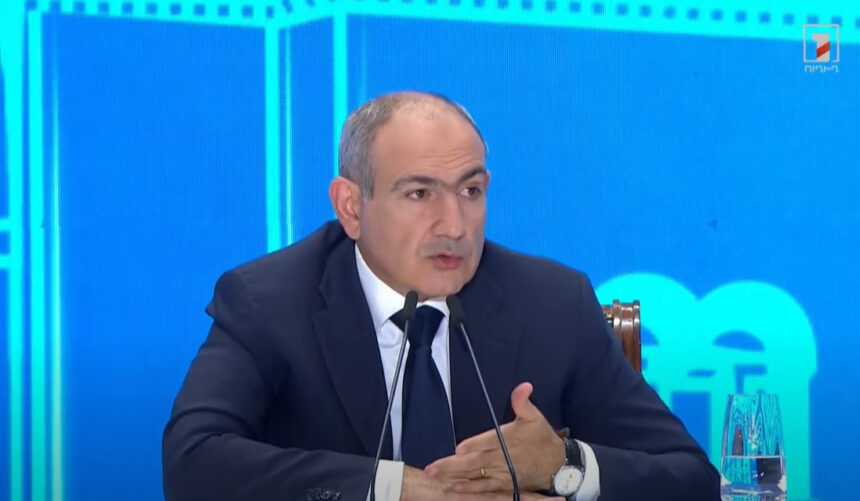
On the one hand, Prime Minister Nikol Pashinyan suggests that people should not fear the word “corridor” — a remark widely interpreted as an attempt to prepare the public for the eventual opening of the Zangezur Corridor. On the other hand, Yerevan continues to assert that it will not agree to any “extraterritorial” arrangement for the road. Armenia has not discussed and is not discussing the delegation of control over its territory to any third party, stated the Prime Minister’s spokesperson, Nazeli Baghdasaryan.
“We have repeatedly stated that Armenia is discussing the unblocking of regional infrastructure solely within the framework of the sovereignty, territorial integrity, and jurisdiction of the Republic of Armenia. We cannot discuss any other logic,” she said in a lecturing tone.
According to the Yerevan-based newspaper Zhoghovurd, following his meeting in Abu Dhabi, Pashinyan met with party members and expressed disappointment with the outcomes of the meetings in Abu Dhabi, Istanbul, and Brussels, as he did not get what he expected. He reportedly reassured them that Yerevan would not accept any arrangement that implied extraterritorial functioning of the route.
While the Zhoghovurd leak could be dismissed as unofficial, the statement from Pashinyan’s press secretary is a formal one — made on camera and on record. It raises an important question: how does Pashinyan reconcile this stance with his signing of the trilateral declaration on November 10, 2020 — albeit secretly and off-air — which explicitly included the idea of a transport corridor between the main part of Azerbaijan and Nakhchivan, with its security ensured by Russian FSB border guards? Back then, the idea of an “extraterritorial corridor” seemed acceptable — why not now?
Another revealing perspective came from Ara Papian, head of the Modus Vivendi center and a prominent voice in Yerevan’s opinion-making circles. He bluntly asked: “If we provide the Zangezur corridor — call it a strip, a route, or whatever — will they, for example, give us a road from Yerevan through Yeraskh (Arazdeyen) to Julfa and Iran? Is that an equal exchange, or are we unilaterally handing over our territory for transit? If we’re talking about unblocking communications, and we give them 42 or 50 kilometers of road, they should give us the same in return.”
According to some leaks, Armenia has indeed tried to promote the idea during negotiations that the Zangezur corridor and a road through Nakhchivan to Iran — intended for Armenian use — should be opened simultaneously.
In simple terms, this is another example of political maneuvering by Yerevan. Publicly, Armenia opposes the Zangezur corridor. Behind closed doors, it floats the idea: we’ll agree to open it — but only if you open something for us in return. Ideally, a direct road to Iran.
It’s clear that Iran is a key “logistical” partner for Armenia. Yet, there is no proper land transport infrastructure between the two. While a strategic highway exists, one of its segments passes through Azerbaijan’s Gubadli district. An alternative road exists, but it’s a dirt path where heavy trucks often get stuck, requiring emergency operations to pull them out. Though there were plans to pave it, the project has turned into another of Armenia’s endless delays. Armenia also has no rail connection to Iran — neither through its own territory nor via any third country. Plans to build a railway through Zangezur remained just that — plans. Constructing such a railway through mountainous terrain is extremely costly. Armenia lacks the resources, and investors have not stepped up.
Now, Armenia seeks to secure a route through Azerbaijani territory — via Nakhchivan. Yet again, Yerevan demands that this road operate under an “extraterritorial regime,” rather than negotiating directly with Baku for the opening of communications.
It would be curious to know how Armenia, under American scrutiny, planned to transport, say, Russian weapons or other “sensitive” cargo from Iran by rail. But even more telling is that this isn’t the first time Armenia has demanded a foreign-controlled road through Azerbaijani territory. After the 44-day war and before the 2023 counterterrorism operations ended the separatist project in Karabakh, Yerevan demanded the Agdere–Kalbajar–Basarkechar (Vardenis) road be placed under Russian peacekeeper control. Unsurprisingly, this failed.
Now it’s the turn of the proposed railway line through Nakhchivan to Iran. It’s hardly necessary to remind that Azerbaijan will never agree to any international control over its territory. For Armenia — having lost two wars — to demand equality and attempt to negotiate as an equal partner is a flawed strategy.
So the question remains: by proposing the simultaneous opening of two roads, was Armenia genuinely trying to secure a fair deal? Or simply looking for another way to derail the negotiation process?
Nurani
Translated from minval.az