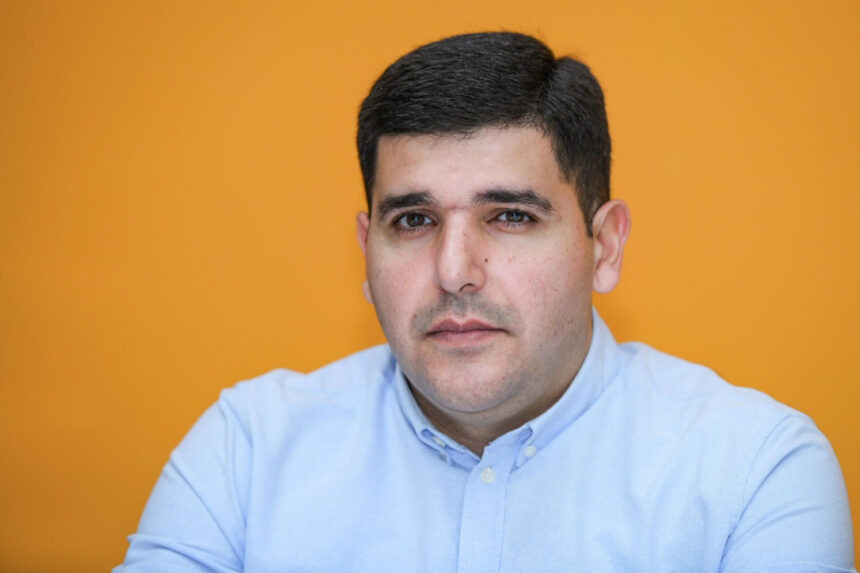
In an interview with Minval, political analyst Farhad Mammadov shared his perspective on which external actors will be most active in the region and where the countries of the South Caucasus are heading in terms of foreign policy.
According to Farhad Mammadov, the countries of the South Caucasus—particularly Georgia and Armenia—are currently experiencing a crisis in their relationships with formal allies. Armenia feels burdened by the presence of its allies, while Georgia is grappling with the weight of its aspirations to join military-political and economic blocs.
“At the same time, there is a noticeable trend of these countries, to varying degrees, trying to follow the path chosen by Azerbaijan—namely, the policy of the Non-Aligned Movement. Even though Armenia formally remains in allied partnerships and Georgia continues to declare its ambition to join NATO, both are showing signs of distancing themselves from rigid dependence on military-political blocs,” the analyst noted.
Mammadov emphasized that this transformation is leading to a convergence in the foreign policy approaches of all three South Caucasus nations and in their shared vision of the region’s future. The South Caucasus is beginning to create conditions for closer regional cooperation.
“As for external actors, the list of players in the region has remained largely unchanged. These include physical neighbors such as Turkey, Russia, and Iran. Additionally, the European Union and the People’s Republic of China have strategic interests in the region. The United States also maintains a degree of activity, though its influence remains limited,” Mammadov explained.
The expert believes that countries in the region have only two viable paths forward. The first is to become instruments in the hands of larger neighbors and geopolitical power centers—a path that, as history shows, rarely yields positive outcomes. The second is to develop a unified regional approach that creates space for constructive engagement from these global powers.
“Azerbaijan serves as a vivid example that, regardless of how powerful an external actor may be, its policy toward Azerbaijan tends to be constructive. This may be a result of necessity or of an initially constructive approach—but any destructive moves are met with resistance. No matter the scale of the external actors, when it comes to Azerbaijan, the rules of forced constructivism apply. I believe this approach can be extended to the entire region,” Mammadov added.
Thus, against the backdrop of new political transformations, the South Caucasus is increasingly shaping its own developmental trajectory—offering constructive cooperation to external players as the only viable strategy.