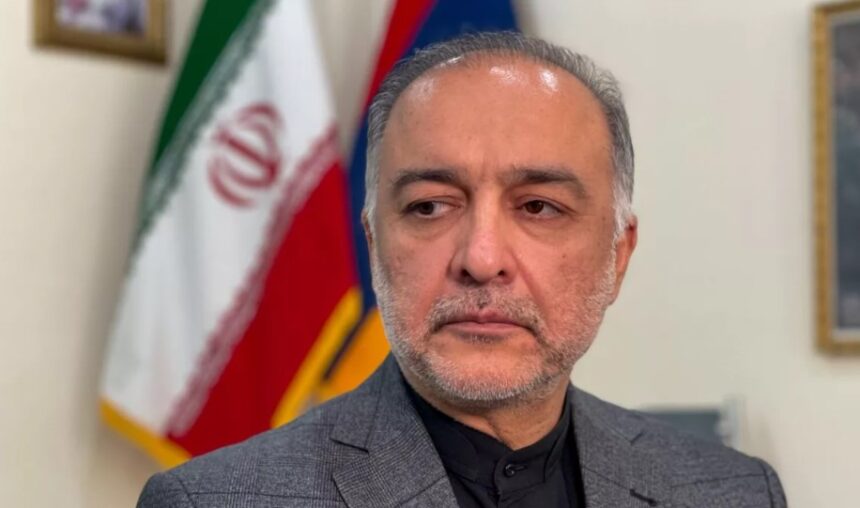
Mehdi Sobhani, Iran’s controversial ambassador to Armenia, has once again made headlines. This time, he chose to comment on the recent ECO summit in Khankendi. It is worth recalling that the summit’s final communiqué reaffirmed, among other things, the right of Azerbaijanis expelled from Armenia to return to their native lands with dignity.
Speaking to Armenian media, Mr. Sobhani claimed—without the slightest hesitation—that certain provisions of the communiqué adopted at the summit of the Economic Cooperation Organization (ECO) contained fabricated language that, in his view, undermined the territorial integrity of the Republic of Armenia. According to him, Iran expressed its objections to the ECO in an official letter regarding this statement.
The Azerbaijani Foreign Ministry promptly responded. Spokesperson Aykhan Hajizadeh called the ambassador’s comments unacceptable, explaining that the final document had been prepared as a chair’s summary, requiring no additional consensus, in accordance with established practice. “The Iranian ambassador’s claims regarding alleged adoption procedures and preconditions do not reflect reality. In diplomacy, preconditions only apply to decisions reached through negotiations,” Hajizadeh clarified, offering a short lesson in diplomatic protocol.
Let’s now add a few words of our own. The right of victims of ethnic cleansing to return to their homes is neither a political whim nor an innovation—it is a core tenet of international humanitarian law. Azerbaijan has consistently raised the issue of the right of ethnic Azerbaijanis, expelled from modern-day Armenia, to return home at various diplomatic platforms. Predictably, this provokes hysteria in Yerevan. It appears the Armenian authorities realize that it is extremely difficult to formulate any solid counterarguments to Azerbaijan’s position. Instead, they try to portray the issue of return as “territorial claims.” This, despite the fact that Baku has repeatedly emphasized that it has no territorial claims against Armenia, including in this context.
However, Armenian diplomatic actors often attempt to present everything from the Zangezur Corridor to Azerbaijan’s national symbols—identical to those of the Azerbaijan Democratic Republic, which once included Western Zangezur and the Geycha district—as examples of alleged “territorial ambitions” toward poor, beleaguered Armenia.
And now, with all due respect, why is Mr. Mehdi Sobhani repeating this Armenian nonsense? Has he forgotten that he is the ambassador of Iran to Armenia, and not Armenia’s ambassador to Iran?
Perhaps Mr. Sobhani simply sought to sugarcoat for the local Armenian audience Iran’s participation in the ECO summit in Khankendi and the presence of Iranian President Masoud Pezeshkian in particular. But it seems he got a little too carried away and forgot one of the key rules of diplomacy: in trying to strengthen relations with one country, don’t destroy relations with another. And second, when speaking publicly, make sure you actually understand the issue—otherwise, you risk making a splash for all the wrong reasons.
There is another factor to consider. Today, Tehran is clearly moving toward rapprochement with Baku. Since President Masoud Pezeshkian took office in Iran, the anti-Azerbaijani rhetoric has noticeably declined. Iranian officials have largely refrained from hostile remarks, and Pezeshkian himself attended the summit in Khankendi, speaking in favor of strengthening friendly ties with Azerbaijan. So how should one interpret Mr. Sobhani’s provocative statement? Is he unaware of Tehran’s political direction? Or is he once again acting on behalf of certain circles that are anything but interested in Iran-Azerbaijan friendship?
And most importantly—why is this provocateur still serving as Iran’s ambassador to Armenia? If Tehran truly seeks to develop relations with Azerbaijan in a positive and forward-looking way, then “the problem named Mehdi Sobhani” needs to be addressed—sooner rather than later.
Nurani
Translated from minval.az