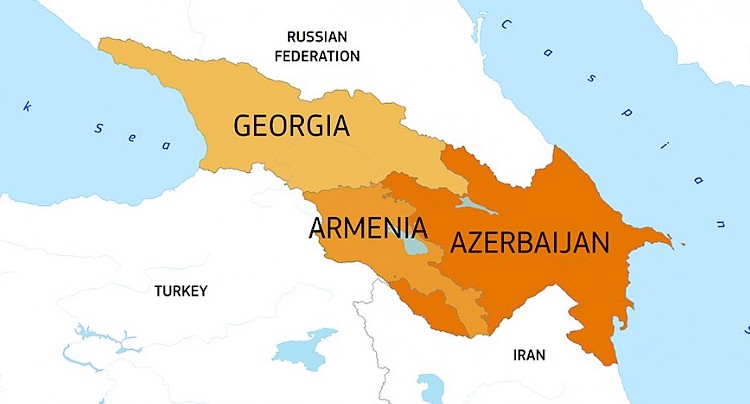
In Mackinder’s terminology, Eurasia is the heartland of geopolitics and the South Caucasus, though small in economic terms compared to the surrounding major powers, constitutes the heart of that heartland. No major power can afford to ignore or neglect it. Strategically located at the crossroads of East and West and being the only region that borders two most controversial actors of Eurasia (Russia and Iran), control over the South Caucasus equates to control over a vital part of the Eurasian continent. This is why the region’s geopolitical orientation carries immense significance, particularly amid the evolving landscape of international relations shaped by the war in Ukraine and the recent escalation of tensions between Iran and Israel in the southern neighborhood. Today, the geopolitics of the South Caucasus is in flux, and most importantly, this transition has now reached to the most important nation-state of the region: Azerbaijan.
Over the past three decades, Azerbaijan has been one of the most stable countries in terms of its geopolitical orientation. The administrations of former President Heydar Aliyev and current President Ilham Aliyev have demonstrated remarkable consistency in foreign policy, adhering to the principles of balance, neutrality, and multilateralism. In 2012, Azerbaijan’s accession to the Non-Aligned Movement was a clear expression of its strategic choice to avoid alignment with any single major power at the expense of its relations with others and refrained from overt confrontation with any geopolitical center seeking to promote friendly, mutually respectful, and interest-based relations.
The country has remained committed to this principle even at the height of its geopolitical ascendancy following its decisive victory in the Second Karabakh War and the subsequent developments. By securing the peaceful withdrawal of Russian peacekeeping forces from the Karabakh region in May 2024, Azerbaijan achieved a diplomatic breakthrough that few would have predicted even a week prior to the announcement. Fully aware that such achievements were made possible by its principled foreign policy, Azerbaijan has deliberately maintained its balanced approach without seeking to alter this carefully calibrated stance.
This seems to be changing now.
Azerbaijan’s relations with its northern neighbor, Russia, which is a critical player of the geopolitical equation in the South Caucasus, have deteriorated over the few months to the level unprecedented in the post-Soviet period. In response to disrespectful treatment from Moscow following the crash of the Azerbaijani Airlines plane in December 2024 and the latest violent raids against ethnic Azerbaijanis in Yekaterinburg city of Russia, Baku demonstrated a clear and assertive stance without hesitating to demand its rights from the big neighbor.
In the wake of the deadly incident involving two Azerbaijani brothers in Russian police custody in Yekaterinburg, Azerbaijan’s government responded with strong diplomatic and political measures. The Foreign Ministry demanded a thorough investigation and prosecution, while the Prosecutor General launched a criminal case, accusing Russian police of torture and intentional murder. Azerbaijani authorities framed the deaths as ethnically motivated violence, rejecting Russia’s claim that one victim died of a heart attack. The issue escalated with both sides summoning ambassadors and exchanging official protests.
Azerbaijan canceled high-level diplomatic engagements, including Deputy Prime Minister Overchuk’s visit and a bilateral parliamentary session, and suspended Russian cultural events. State-run media unleashed harsh criticism of Russia, accusing it of systemic ethnic violence and likening its actions to imperial oppression and even Nazi-era atrocities.
Tensions further intensified with the arrest of two Russian journalists in Baku, officially charged with fraud and money laundering, though media claimed they were linked to Russia’s FSB. This followed the earlier closure of Sputnik’s Azerbaijani branch, which continued operating despite government orders. On July 1, Azerbaijani authorities also detained two Russian-led criminal groups involved in drug trafficking and cyber fraud. The arrests were widely seen as a retaliatory move amid rapidly deteriorating Azerbaijan-Russia relations.Although all these developments between Baku and Moscow are not likely to lead to complete break in the Russia-Azerbaijan relations or Azerbaijan’s move to the rival blocs against Russia, they demonstrate that Azerbaijan is no longer willing to tolerate Russia’s ambitions to dominate over the region and hold sway over its foreign policy. Azerbaijan appears to be leveraging the crisis to renegotiate its relationship with the country’s northern neighbor on more equal terms and thus demands respectful treatment in matters that concern the rights and principles of Azerbaijanis.
It is important to highlight that these developments are unfolding in parallel with the longstanding deterioration of Russia’s relationship with another South Caucasus country – Armenia. Prime Minister Nikol Pashinyan’s government has been actively seeking to reduce Armenia’s deep-rooted dependence on its formal ally, Russia, within frameworks such as the Collective Security Treaty Organization (CSTO) and the Eurasian Economic Union (EAEU). This effort, however, faces significant structural obstacles, as Armenia remains heavily reliant on Russia across multiple domains, including trade, energy, and defense. Nevertheless, Pashinyan has intensified his campaign to diminish Moscow’s influence, targeting not only political and military ties but also domestic actors aligned with Russia. Notably, this includes efforts to curtail the power of the Armenian Apostolic Church – arguably the most entrenched bastion of Russian soft power in the country.
In this context, what may appear surprising to many observers is the emerging convergence between Armenia and Azerbaijan, two countries that were engaged in violent conflict until recently, on a similar geopolitical trajectory. This shared path underscores a broader regional shift that could reshape the strategic architecture of the South Caucasus. If Baku and Yerevan succeed in overcoming the remaining obstacles to a peace treaty, normalizing relations, and opening transportation corridors, it would mark the end of centuries-long efforts by external powers to employ a divide-and-rule strategy in the region by setting the two countries against each other. To achieve this, it is essential that the Armenian people recognize the historic opportunity before them, renounce all territorial claims against Azerbaijan, and affirm this position through a referendum removing such claims from the state constitution. The South Caucasus stands to gain the most from the ongoing geopolitical transition if the three regional countries come together, resolve their disputes, and embrace a future of peace and shared prosperity.
Dr Vasif Huseynov, is a Senior Advisor at the Center of Analysis of International Relations (AIR Center) and Adjunct Lecturer at Khazar University in Baku, Azerbaijan. Photo: View of the South Caucasus