The proposal reflects Baku’s intent to institutionalize its evolving partnership with Riyadh and expand joint influence beyond bilateral ties.
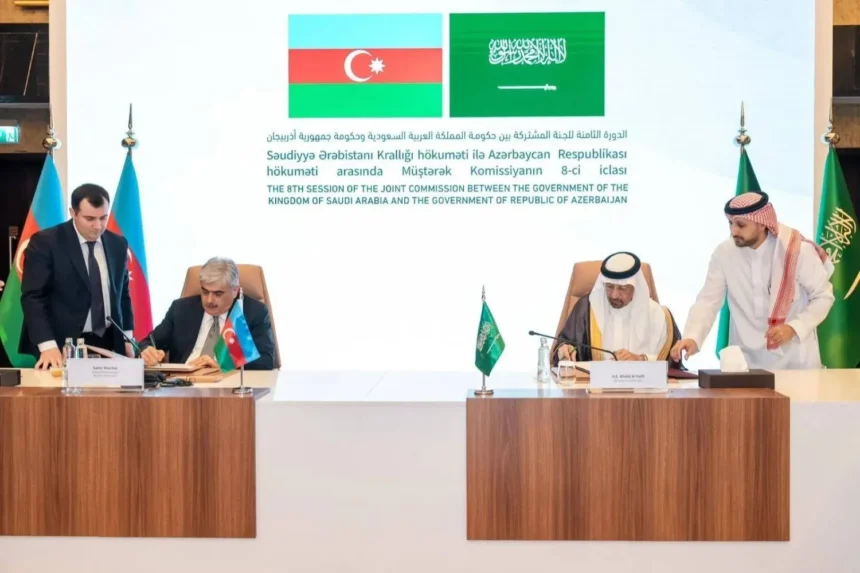
The initiative follows the 8th session of the Saudi-Azerbaijani Joint Government Committee held in Riyadh in April 2025, co-chaired by Saudi Investment Minister Khalid Al-Falih and Azerbaijani Deputy Prime Minister Samir Sharifov. The meeting produced multiple memorandums of understanding in strategic areas such as energy, logistics, water, and transportation, as well as renewed commitments through the Saudi-Azerbaijani Business Council.
In an interview with Asharq Al-Awsat, Azerbaijani Ambassador Shahin Abdullayev outlined the logic behind the proposed fund. The aim is not only to finance key sectors in both countries—such as oil, renewables, infrastructure, tourism, and mining—but also to invest jointly in third markets. According to the ambassador, Azerbaijani Economy Minister Mikayil Jabbarov initially proposed the concept during his official visit to Riyadh in December 2024.
Azerbaijan views this fund as a vehicle for long-term strategic coordination with Saudi Arabia. Beyond energy and investment, the partnership also includes growing collaboration in culture and tourism. More than 100,000 Saudi tourists visited Azerbaijan in 2024, marking a 31% increase from the previous year. Both sides are working to expand joint tourism programs and cross-promotional initiatives.
Energy remains at the core of cooperation. Saudi firm ACWA Power has emerged as a leading player in Azerbaijan’s renewable sector. A major bilateral agreement signed during COP29 in Baku includes wind energy projects with a combined capacity of 2.5 GW and cutting-edge storage solutions. These projects were launched in the presence of Saudi Energy Minister Prince Abdulaziz bin Salman and President Ilham Aliyev.
Ambassador Abdullayev also emphasized the need for a bilateral investment protection agreement and policy incentives to attract Saudi capital to Azerbaijan’s free economic zones. The discussion now includes opportunities in agriculture, livestock, and industrial production, alongside strategic energy infrastructure.
At the strategic level, Azerbaijan continues to highlight its role as a regional energy hub. Through projects such as the Baku–Tbilisi–Ceyhan oil pipeline and the TANAP and TAP gas corridors, Baku contributes to Europe’s energy security and positions itself as a reliable partner.
The ambassador noted that Azerbaijan’s successful bid to host COP29 has strengthened its international visibility. During the summit, global leaders pledged to allocate $300 billion annually by 2035 to support climate adaptation efforts in developing nations—an initiative that aligns with Azerbaijan’s broader agenda for green development and regional leadership.
Humanitarian cooperation also plays a role in bilateral ties. In early 2024, the King Salman Humanitarian Aid and Relief Center signed an agreement to support demining operations in Azerbaijan’s liberated territories—an effort that has accelerated post-conflict reconstruction and enabled the safe return of displaced civilians.
Taken together, these developments signal a shift from diplomatic goodwill to structured economic partnership. The proposed investment fund may become a cornerstone of a new model of cooperation between two strategically positioned energy states with growing regional ambitions.