On May 20–21, 2025, Russian Foreign Minister Sergei Lavrov’s visit to Yerevan marked a significant moment in the evolving dynamics of Armenia–Russia relations, signaling Moscow’s intent to stabilize and reinforce ties with its long-standing ally in the South Caucasus. Set against the backdrop of deteriorating Russia–Azerbaijan relations following the tragic crash of an Azerbaijani airliner plane on December 25, 2024, the visit highlighted Russia’s delicate balancing act in a region where its influence is increasingly contested. Lavrov’s talks with Armenian leaders focused on reaffirming bilateral commitments within the frameworks of the Collective Security Treaty Organization (CSTO) and the Eurasian Economic Union (EAEU).
His statements largely emphasized restoring traditional ties with Armenia and underscoring Russia’s consistent support for the country throughout the post-Soviet era. However, some of his remarks, particularly references to the historical use of Russian-supplied weapons during Armenia’s occupation of Azerbaijani territories, sparked controversy in Baku and drew widespread criticism in the Azerbaijani media.
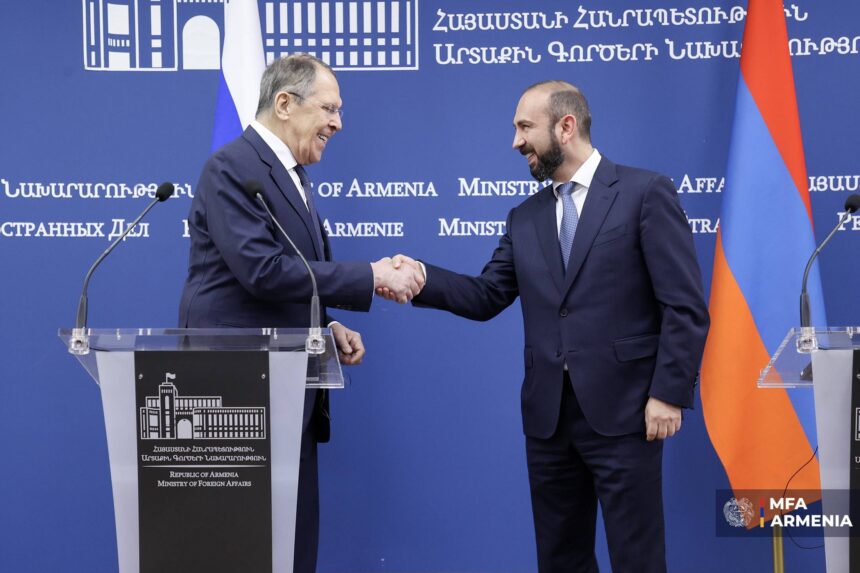
Lavrov’s visit to Yerevan was a calculated move to reaffirm Russia’s presence in Armenia at a time when Yerevan’s foreign policy is showing signs of diversification. During a joint press conference, Lavrov emphasized the enduring nature of the Armenia-Russia alliance, stating, “Our relations with Armenia are based on a deep historical foundation, and we are committed to strengthening our strategic partnership.” He acknowledged Armenia’s concerns about the functionality of their security agreements but framed them as issues to be resolved through dialogue rather than a rupture in ties.
Armenia Foreign Minister Mirzoyan, responding to questions about Armenia’s potential pivot toward new strategic partners, particularly in Europe, was unequivocal in maintaining the status quo: “Regarding the question of whether we are planning to reformat our allied relations with Russia, I’d like to give a very direct answer, no. Our obligations, rights, and intentions against each other are clearly written, signed, and ratified on paper, and no one has dissolved it.” He acknowledged, however, that Armenia has concerns about the “effective implementation” of these mechanisms, particularly within the framework of the CSTO, where Armenia has frozen its participation due to dissatisfaction with the organization’s response to regional security challenges.
Mirzoyan’s remarks reflect Armenia’s cautious approach. The 2018 Velvet Revolution and the 2020 Second Karabakh War have shifted Armenia’s national consciousness, prompting a reevaluation of its dependence on Russia. The liberation of Karabakh by Azerbaijan in 2023, while a blow to Armenian national pride, has also relieved Yerevan of the burden of territorial expansionism, creating space for a more independent foreign policy. Although Armenia appears eager to advance efforts to reduce its reliance on Russia, the country’s deep dependence on its larger ally across multiple spheres, combined with the uncertainty surrounding the Trump administration’s policies toward the post-Soviet space, has compelled Yerevan to moderate its anti-Russian rhetoric and seek a normalization of relations with Moscow. This delicate balancing act is unfolding as Russia’s influence in the South Caucasus continues to wane, with Armenia, Azerbaijan, and Georgia increasingly asserting their strategic autonomy.
Lavrov’s visit also brought to the forefront a contentious issue that has long simmered in the region: Russia’s role in the First Karabakh War. In a provocative statement, Lavrov confirmed that “the weapons used [by Armenia] were Russian, as I already mentioned, for the seizure of seven undisputed Azerbaijani districts and for the construction of fortification and combat lines, which indicated that the intention was to hold these territories for a very long time.” He added, “Some analysts even noted that the nature of these fortifications suggested there was never any plan to return them to Azerbaijan.” This admission, while framed as a historical observation, carries significant weight in the current context. For Azerbaijanis, it evokes memories not only of Russian-supplied arms but also of the alleged involvement of Russian servicemen in combat operations and the 1992 Khojaly genocide. Lavrov’s statement also appears to be a strategic signal, hinting to Armenia that Moscow could rekindle such cooperation if Yerevan returns to Russia’s orbit, while simultaneously antagonizing Azerbaijan by highlighting Russia’s historical support for its adversary.
The timing of Lavrov’s remarks is particularly significant given the sharp decline in Russia-Azerbaijan relations, most notably underscored by Azerbaijani President Ilham Aliyev’s decision to skip the Victory Day parade in Moscow on May 9, 2025. The parade, commemorating the 80th anniversary of the Soviet victory over Nazi Germany, was attended, among others, by leaders from Armenia, Belarus, and all five Central Asian republics, making Aliyev’s absence conspicuous. Despite multiple high-level invitations, including one from Russian President Vladimir Putin during a March 15 phone call and another delivered by Patriarch Kirill on May 3, Aliyev cited domestic commitments related to the 102nd anniversary of the former Azerbaijani President Heydar Aliyev’s birth as the reason for his absence. However, Azerbaijani media outlets close to the government pointed to a deeper cause: Moscow’s failure to address Baku’s demands following the December 25, 2024, crash of an Azerbaijan Airlines (AZAL) plane near Aktau, Kazakhstan, which killed 38 of the 67 people on board.
The AZAL crash, widely attributed to Russian anti-aircraft fire, has become a flashpoint in Russia-Azerbaijan relations. Initial investigations suggest the plane, operating on the Baku-Grozny route, was struck by a surface-to-air missile, likely from a Russian Pantsir-S system, during an attempt to counter Ukrainian drones over Grozny. Witnesses reported hearing explosions, and the aircraft’s black box recorded a sonic boom followed by critical system failures. A preliminary report from Kazakhstan’s Transport Ministry noted structural damage consistent with missile impacts, and Azerbaijan has demanded an official apology, accountability, and compensation. While Putin issued an apology on December 28, 2024, Moscow has yet to meet Baku’s other demands, fueling distrust. The lack of progress in the investigation, now in its second phase with a final report expected by December 2025, has further strained relations.
Azerbaijani frustrations have been compounded by other incidents. In early May, the Azerbaijani Parliament’s Commission on Countering Hybrid Threats attributed a February cyberattack on local media to Russia, describing it as retaliation for Azerbaijan’s closure of the Russian Information and Cultural Center and rumors of further restrictions on Russian media outlets like Rossiya Segodnya. Additionally, the barring of Azerbaijani parliamentarian Azer Badamov from entering Russia for a commemorative event in May prompted Azerbaijan’s Foreign Ministry to demand an explanation, calling the move “unfriendly.” These incidents reflect a broader erosion of trust, with Azerbaijan perceiving Russia’s actions as dismissive of its sovereignty and legitimate grievances.
Azerbaijan’s cancellation of Aliyev’s Moscow visit is a clear signal of its dissatisfaction with Russia’s “imperial tone” and failure to treat Baku as an equal partner, as promised in the 2022 Declaration on Allied Interaction. Azerbaijan’s pursuit of strategic autonomy, evident in its multi-vector foreign policy, contrasts with Russia’s reliance on outdated mechanisms of control, such as supporting discredited Armenian elites like Robert Kocharyan and Serzh Sargsyan or promoting revanchist narratives through media outlets.
Russia’s strategy in the South Caucasus appears increasingly misaligned with the region’s evolving dynamics. Armenia’s gradual shift toward independence, Azerbaijan’s assertive foreign policy, and Georgia’s replication of Azerbaijan’s balanced foreign policy are converging to form a collective regional agency that challenges Moscow’s dominance. Lavrov’s visit to Yerevan, while aimed at reinforcing Russia’s influence, may instead highlight its limitations. By invoking the shared history of Russian-Armenian actions in Karabakh, Moscow risks alienating both Yerevan and Baku, pushing Armenia toward further emancipation and Azerbaijan toward deeper estrangement. Unless Russia adapts its approach, abandoning its reliance on coercion and manipulation, its influence in the South Caucasus will continue to erode, leaving it trapped in outdated geopolitical reflexes as the region charts a new course.
Dr Vasif Huseynov, is a Senior Advisor at the Center of Analysis of International Relations (AIR Center) and Adjunct Lecturer at Khazar University in Baku, Azerbaijan.