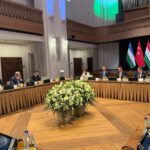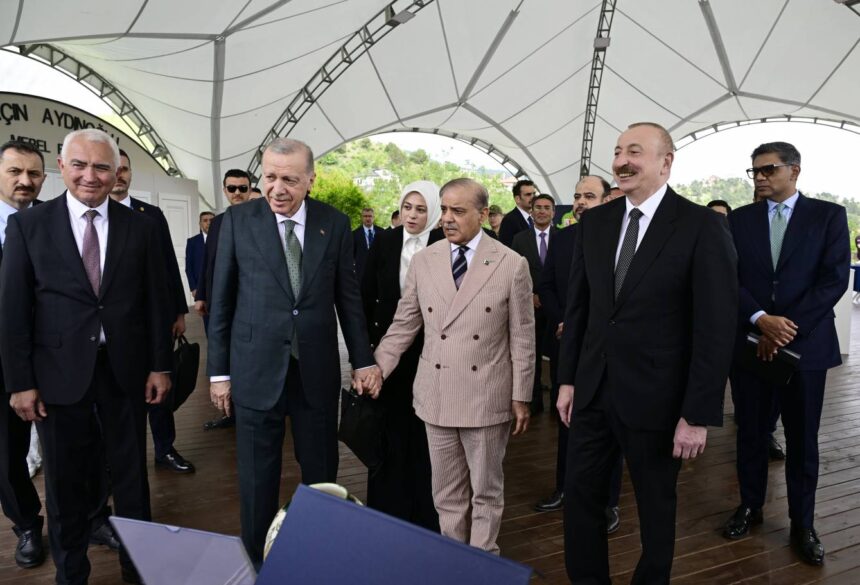
On May 28, Azerbaijan marked its most important national holiday — Independence Day. As tradition goes, the main celebrations are typically held in the capital. But this year, the biggest headlines came from the city of Lachin. And these were not just ceremonial reports — what unfolded in Lachin signaled major geopolitical shifts, whose significance reaches far beyond the South Caucasus. The inauguration of an international airport in Lachin, visits by the Presidents of Türkiye and the Prime Minister of Pakistan, bilateral meetings between President Ilham Aliyev and both Erdoğan and Sharif, a trilateral Azerbaijan–Türkiye–Pakistan summit, and finally, a grand celebratory concert — all marked the beginning of a new chapter in history.
There, in Lachin, Presidents Ilham Aliyev of Azerbaijan and Recep Tayyip Erdoğan of Türkiye officially opened Lachin International Airport — the third airport built on territories liberated from Armenian occupation. Just four and a half years ago, these lands were the site of active combat. The occupiers left nothing behind but ruins and minefields. Azerbaijan has undertaken a colossal task — alone, without donor conferences, Marshall Plans, or international aid programs. The footage was familiar to Azerbaijani viewers from Fuzuli and Zangilan: ceremonial ribbons, symbolic keys, Azerbaijani and Turkish presidential aircraft parked side by side on a brand-new runway…
Perhaps today, as the Great Return is only gaining momentum, these airports are not yet operating at full capacity. But here, oddly enough, we may recall American history — how in Chicago, as Theodore Dreiser wrote, “streetcar lines extended far into the open prairie — laid in anticipation of rapid suburban growth.” Or in New York, long before it became a metropolis, they built a station with 114 platforms — precisely because they believed in the city’s great future. The international airports on the liberated lands are a “flight plan into the future.” They are being built with confidence in the vast creative work underway in the recovered territories — where plans include not just the return of displaced persons, but a new economy, tourism (both domestic and international), green energy, and high-tech industry.
And in Azerbaijan — and beyond — people clearly remember the vital role played by local airports during the 44-day Patriotic War. And let’s not forget: the world remains far from peaceful.
In this turbulent world, a new regional force is now making its voice heard. The Azerbaijan–Türkiye–Pakistan trilateral summit clearly marked the emergence of a new geopolitical reality. Baku, Ankara, and Islamabad are asserting their independent role in international affairs — and what is especially symbolic is that all three nations came to the Lachin summit with significant geopolitical achievements behind them. Azerbaijan won the Karabakh war and restored its full territorial integrity. Türkiye achieved notable success in Syria and has effectively neutralized the PKK threat. Pakistan won a short-lived conflict with India — one that New Delhi had envisioned as a “small victorious war,” but which ended in military and political embarrassment. That very conflict, notably, strengthened the unity among the three countries: both Ankara and Baku firmly expressed support for Pakistan. Today, the three nations are discussing economic, military, and political cooperation — and not starting from scratch. “Azerbaijan, Türkiye, and Pakistan have always been on the side of sovereignty, territorial integrity, and justice,” President Ilham Aliyev said at the summit. “We once again express our gratitude for the political and moral support that Türkiye and Pakistan gave our country from the very first days of the 44-day Patriotic War in 2020. Azerbaijan, in turn, has always stood by Türkiye and Pakistan. Today we reaffirm the unity of our peoples.”
Most importantly, President Aliyev stressed: the messages voiced in Lachin will reach their intended recipients.
Diplomacy often leaves much unspoken. Not everything is laid out openly. But the balance of power in the region has shifted so dramatically that ignoring these changes would be dangerously naive. It is no longer 1992, or even 2019 — and for those dreaming of a “do-over,” it would be best to abandon such illusions at once.
It is deeply symbolic that all this is happening in Lachin — a city only recently liberated from Armenian occupation. This was the site of one of the most tragic and strategically consequential chapters of the first Karabakh war. The occupation of Lachin was a severe blow to Azerbaijan. Three decades later, it was here — in Lachin — that Azerbaijan, skillfully combining military and diplomatic tools, passed one of its toughest tests of statehood: it closed the “Lachin Corridor,” completed the restoration of its border control, and ended foreign military presence on its soil.
Today, Azerbaijan rightfully celebrates its Independence Day in Lachin — with a grand concert. There is indeed much to celebrate. And rest assured: these will not be the last major headlines coming from the liberated territories.