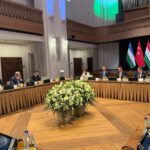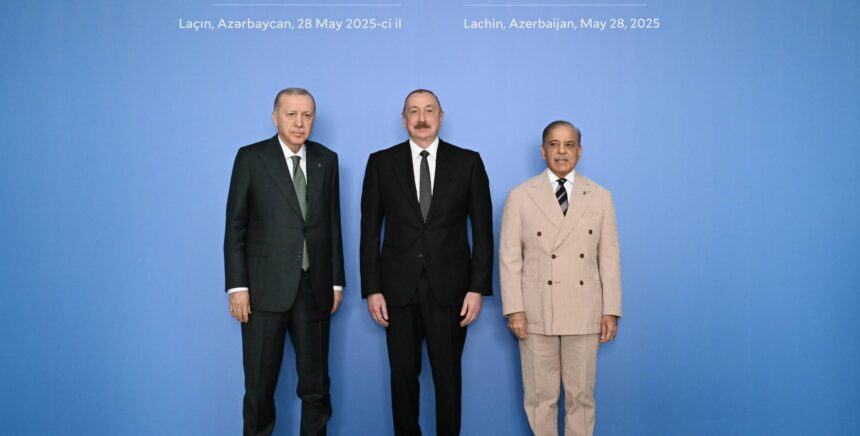
Held in the symbolically significant city of Lachin, recently restored to Azerbaijani control after decades of occupation, the trilateral meeting between President Ilham Aliyev, President Recep Tayyip Erdoğan, and Prime Minister Muhammad Shehbaz Sharif served as a powerful affirmation of strategic unity, shared values, and forward-looking cooperation.
Opening the summit, President Ilham Aliyev emphasized the historical weight of convening such a forum in East Zangezur, underscoring the symbolism of Lachin as a space of revival and sovereignty. Referring to Türkiye and Pakistan as “brotherly nations,” Aliyev framed the trilateral alliance not merely in terms of diplomacy, but as a manifestation of civilizational proximity rooted in common history, culture, and principles.
This was the second Azerbaijan–Türkiye–Pakistan summit, following the inaugural meeting in 2024. The leaders reaffirmed their nations’ shared commitment to sovereignty, territorial integrity, and international justice—principles that have underpinned their mutual support, particularly during Azerbaijan’s 44-day war in 2020 and recent regional escalations affecting Pakistan.
A key focus of President Aliyev’s address was the economic potential inherent in trilateral cooperation. He highlighted Azerbaijan’s strategic investment posture: over $20 billion invested in Türkiye, and an initial $2 billion package earmarked for Pakistan. According to the president, specific investment projects in Pakistan are already underway, opening the door to a deeper economic interdependence that complements geopolitical alignment.
Aliyev also pointed to the shifting regional energy landscape. He argued that energy cooperation between Azerbaijan and Türkiye has transformed the energy map of the broader region—an evolution that could be further strengthened by Pakistan’s participation in multimodal connectivity initiatives. The integration of transport and energy corridors linking Asia and Europe through the South Caucasus is a key component of this shared strategic vision.
Another pillar of the trilateral format is defence cooperation. Aliyev underlined the importance of joint military exercises and military-technical collaboration, noting their contribution to the modernization of armed forces and deterrence capabilities. Crucially, the president framed these developments not as militarization, but as a contribution to peace and stability across a broader geography.
In a particularly notable section of his speech, Aliyev lauded Türkiye’s achievements in counterterrorism, especially the reported self-dissolution of the PKK. He attributed this milestone to the “leadership and determination” of President Erdoğan, positioning it as a turning point not only for Türkiye’s internal security but for regional order as a whole.
President Aliyev further emphasized the importance of joint representation on multilateral platforms. From the United Nations to the Organization of Islamic Cooperation and D-8, Azerbaijan, Türkiye, and Pakistan are increasingly coordinating their positions on key global issues. This cooperative diplomacy enhances the soft power and strategic weight of the trio within the Global South and beyond.
Aliyev’s remarks also included a message of solidarity with Pakistan amid its tensions with India. Azerbaijan expressed support for resolving the conflict in line with international law and United Nations Security Council resolutions—drawing a parallel with Baku’s own territorial recovery through diplomacy backed by strategic deterrence.
The Lachin Summit crystallized a vision of trilateralism that goes beyond symbolic gestures. It outlined a strategic alignment across multiple domains: energy, transport, defence, diplomacy, and technological innovation. The inclusion of future-oriented sectors such as artificial intelligence, space technology, and digital innovation signals the ambition to construct a 21st-century model of cooperation among Muslim-majority, globally engaged middle powers.
If institutionalized further, the Azerbaijan–Türkiye–Pakistan triangle could emerge as a formidable bloc for regional influence, capable of shaping Eurasian connectivity, reinforcing multipolarity, and promoting an alternative narrative within the Islamic world—one based on strategic pragmatism, economic interdependence, and shared sovereignty.