As political commentators speculate when Saudi Arabia will normalize ties with Israel, two other candidates have emerged as potential partners to the Abraham Accords: Azerbaijan and Kazakhstan. Both countries currently enjoy diplomatic relations and cooperation with Israel, which makes them distinct from other Accords countries. However, joining the Accords would still yield tangible benefits for all countries: it would allow Azerbaijan and Kazakhstan access to a network based on promoting investments that bolster regional prosperity and tolerance while strengthening Israel and the United States’ role in the Turkic and broader Muslim world.
Although the Abraham Accords were initially agreements over Israeli-Arab normalization, these pacts have since transcended Arab borders into a high-profile forum that can incorporate Muslim countries committed to shared values of tolerance, peace, and prosperity.
For Azerbaijan, the Accords could provide a path to expanded security cooperation against Iranian threats and, if pursued in coordination with Kazakhstan, progress towards its goal of becoming a bridge to Central Asia. For Kazakhstan, the Accords could help the country reduce its economic dependence on Russia and China at a time when such dependence is proving to be a liability.
Building on a strong foundation
Both Azerbaijan and Kazakhstan already enjoy strong diplomatic and economic relations with Israel, with both countries remaining the top two suppliers of oil to the Jewish state.
Kazakhstan enjoys strong ties with Israel and the Jewish diaspora. Astana also already benefits from advanced Israeli agriculture, medical, water, and security technology. The Abraham Accords provide an opportunity to further deepen security and economic cooperation and expand beyond the primarily bilateral nature of relations with Israel.
Meanwhile, Azerbaijan has already taken steps to expand the Abraham Accords. Earlier this year, Azerbaijani President Ilham Aliyev’s top advisor, Hikmet Hajiev, and Israeli Prime Minister Benjamin Netanyahu discussed Baku joining the Accords, according to diplomats familiar with the discussion. Mukhtar Mammadov, Azerbaijan’s ambassador to Israel, later met with the Knesset co-chairs of the Abraham Accords Caucus. In a Knesset session, Israeli parliamentarians pushed for expanding the accords to Azerbaijan as well as helping bring it closer to the United States.
Nestled in the rugged Caucasus Mountains, the Republic of Azerbaijan is one of only a handful of Shia-majority countries in the world. The 2020 Abraham Accords include the Sunni-majority nations of the United Arab Emirates, Morocco, Sudan, and Kosovo. If Azerbaijan joins the Accords, then it would become only the second Shia-majority country to join after Bahrain.
The added value of the Abraham Accords
Joining the Abraham Accords would provide a number of additional benefits to both Azerbaijan and Kazakhstan, while also helping Israel and the United States strengthen their engagement with the Turkic world.
Located between Russia, China, and Iran, Central Asia is a tough neighborhood. To survive, Central Asian countries must adopt a strategy of “multi-vectoralism,” an arcane political science term for balanced relations with the surrounding heavyweights without becoming too beholden to one set of interests. Cooperation with a major global player like the United States is a valuable tool for such a strategy, and the Abraham Accords provide a potential path towards cooperation with the United States. Central Asian nations have also grouped together into the Organization of Turkic States (OTS) to cooperate on energy, defense, and other key issues.
Azerbaijan prioritizes strengthening security cooperation with major powers. It’s the only country that shares borders with Iran and Russia, arguably two of the region’s most aggressive countries. Additionally, for over thirty years, Baku was locked into a conflict with Armenia over the separatist territory of Karabakh. Both Russia and Iran exploited this conflict to pressure Azerbaijan.
With the expanded security cooperation focus for the existing Abraham Accords countries, this could serve as a highly valuable tool for Azerbaijan.
Baku shares some of Israel’s concerns with Iranian aggression. Tehran has often threatened Azerbaijan, including support for an ethnic Azerbaijani Khomeinist proxy terrorist group and backing Armenia in the conflict over Karabakh. In past years, Baku has partnered with both Israel and Turkey to deter Iran by holding counter-exercises and importing high-tech weapons. Publicly reaffirming Azerbaijani commitments to the Abraham Accords would better integrate Azerbaijan into a greater US-led coalition to protect its interests against an assertive Iran. At the same time, Washington and its Arab partners would gain a staunch ally on Iran’s borders that holds significant soft relations and influence over Iran’s 30 million Azerbaijani minority.
Kazakhstan, on the other hand, prioritizes expanding economic cooperation. The landlocked country seeks to diversify its economy and reduce dependence on its more powerful neighbors.
Kazakhstan could leverage joining the Accords to increase cooperation with both Israel and the United States, particularly on improved access to Israeli and American technology. Through the Accords, Israel would be the perfect conduit for closer relations between the global economy and the largest, continually growing economy in Central Asia. Astana’s GDP is an impressive $262 billion and has the potential to reach double-digit growth in the coming years.
Although Kazakhstan has made significant progress toward diversifying commercial partnerships, its largest trade partners are still Russia and China. In 2023, Beijing surpassed Moscow in this category. Economic relations with Russia have been particularly problematic in recent years. In 2022, days after President Kassym-Jomart Tokayev visited Baku as part of Kazakhstani efforts to explore alternative transit corridors to Russia for oil exports, a malfunction occurred on the Caspian Pipeline Consortium (CPC) carrying Kazakhstani oil to Europe through Russia. More malfunctions occurred later on and were accompanied by rumors that the “accidents” were actually Moscow punishing Astana for not expressing support for its invasion of Ukraine. As noted by Azerbaijani Political Commentator Ahmed Alili, “Russia uses such methods to pressure its neighbors.” Both accidents led to a 10 percent drop in oil exports for Astana.
The Ukraine war has directly impacted Kazakhstani oil exports, which rely on transport through Russia. Last year, Moscow warned Astana that oil sent to Germany would be shut off over a payment impasse due to fears from Poland’s state-run pipeline operator, or PERN, of violating Western sanctions. Most recently, Ukrainian drone attacks on CPC pipelines inside Russia have threatened 30 percent of Kazakhstani oil exports. Between Russian pressure and the consequences of Russian international relations, extensive economic reliance on Moscow is proving to be an enduring vulnerability for Kazakhstan.
Should Kazakhstan join the Abraham Accords, it could also lead to closer cooperation with the United States on exporting its energy and critical minerals along the Middle Corridor, a transit route that travels westward through Azerbaijan, bypassing both Russia and Iran. If it received significant investment from backers like the United States and Europe, then the Middle Corridor could provide Kazakhstan with a safe alternative for its oil exports. For Europe, energy and mineral exports would provide an alternative to Russian energy flows.
U.S. investment in the Middle Corridor and related projects could provide strategic benefits to the United States as well: Astana holds the keys to some of the largest global reserves of critical and rare-earth metals. This includes uranium, lithium, copper, manganese, tantalum, etc. As President Donald Trump seeks to reduce reliance on Chinese rare minerals, Kazakhstan could become an ideal source of production for the global market that could be systematically integrated into emerging refinery and enrichment supply chains.
Finally, Washington may find that the Abraham Accords provide a more effective foothold in Kazakhstan and the general region. Past US efforts to expand its influence in Central Asia have been impeded by inconsistent prioritization of the region, combined with tensions over whether Washington’s approach should emphasize democracy and human rights or employ a more overtly counter-Russia or counter-China strategy.
Turkic connection
Azerbaijan’s joining the Abraham Accords could help facilitate Kazakhstan’s participation and expand the benefits to both countries. A crucial part of Baku’s foreign policy has been the better integration of the Turkic world. Aliyev has called such integration a top priority as he forges close ties with Astana and other Central Asian nations. Azerbaijan seeks to become a “bridge to Central Asia” through Turkic cooperation,” says Director of the Baku-based Topchubashov Center, Rusif Huseynov. Joining the Abraham Accords and integrating Kazakhstan into the framework is a powerful step in that direction.
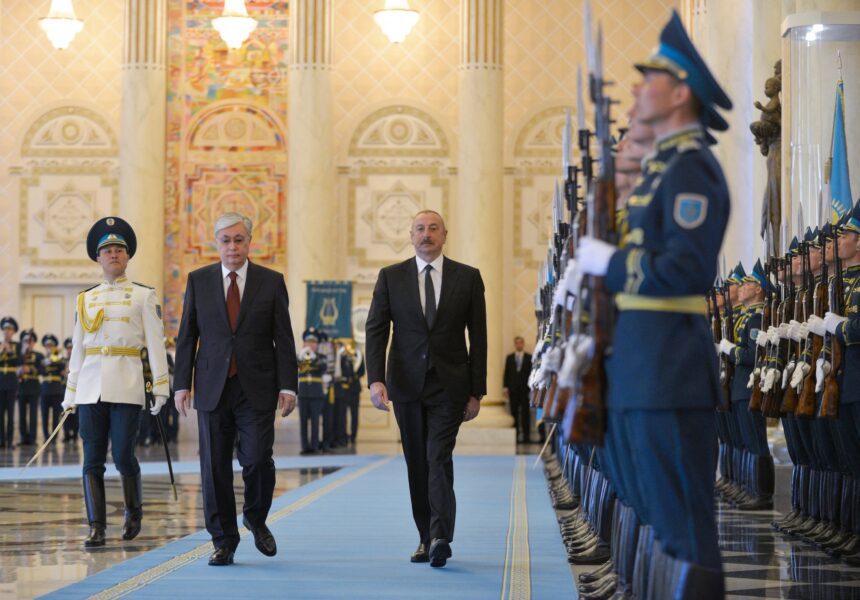
In 2022, Tokayev presented Aliyev with the Order of the Golden Eagle, Kazakhstan’s highest honor recognizing service to the country. In 2023, both presidents created an interstate council to further multifaceted cooperation. At the same meeting, ministers and senior officials from both countries signed Memoranda of Understanding on cooperation in diverse fields, including information, science, culture, and business. Azerbaijan finds Kazakhstan strategically crucial as it is the region’s largest, richest, and most stable country. Kazakhstan is eager to work with Azerbaijan to establish alternative routes for energy exports and economic diversification.
Such collaboration puts Azerbaijan in a key position to help bring Kazakhstan into the Abraham Accords. As Israeli experts Zeev Khanin and Alex Grinberg at Bar Ilan University’s Begin Sadat Center noted, “Azerbaijan’s unique conceptual and practical experience in Muslim-Jewish cooperation can be leveraged to expand the Abraham Accords to Muslim countries in the Middle East, Asia, and Africa.”
If Azerbaijan were to formally ratify the Abraham Accords first, it could be the first of a larger movement across the Turkic world to publicly deepen relations with Israel and, by extension, the United States. Baku is the key to post-Soviet Turkic states that fit the criteria as pro-US Muslim countries devoted to tolerance and peace, while also serving an important function within strategic US interests. Should Kazakhstan follow Azerbaijan’s lead, it could significantly enhance US and Israeli influence in the region.
Joseph Epstein is the director of the Turan Research Center, a senior fellow at the Yorktown Institute, and a research fellow at the Post-Soviet Conflicts Research Program at Bar Ilan University’s Begin Sadat Center for Strategic Studies.