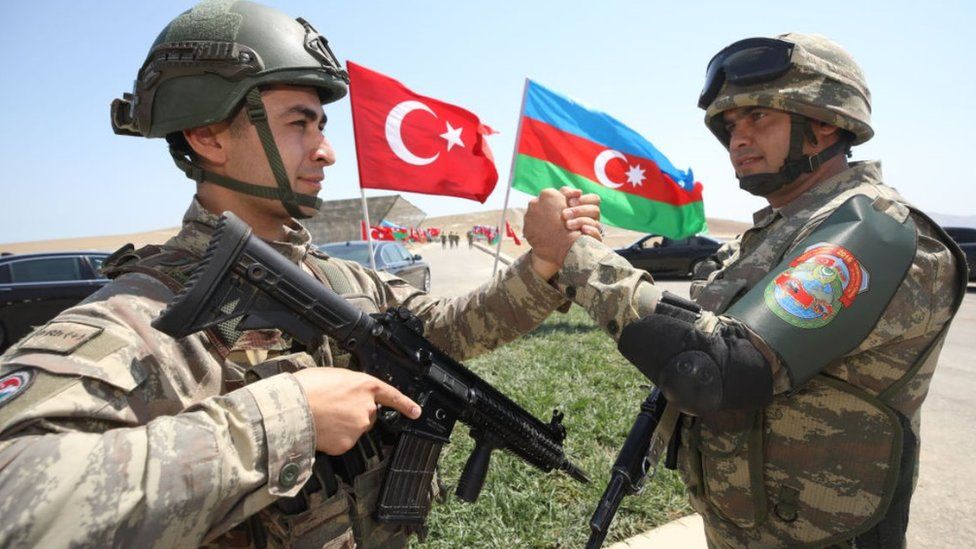
However, the Turkish intervention on the issue in 2020 in full support of Azerbaijan tilted the power-balance of the conflict and cemented Ankara as a new security actor in the region.
A political environment now exists in which a lasting settlement over Nagorno-Karabakh can take shape. The terms of the November ceasefire forced the issue of the OSCE Minsk Group commitment on the return of land currently under Armenian control to Azerbaijan. Turkey is also in a position to address Yerevan’s interests as the Russian-brokered accord stipulates infrastructure development in the Lachin corridor, which links Armenia with Nagorno-Karabakh. The potential for regional security as a result means that the European Union has an opportunity to advance its renewable energy transition and energy diversification policy.
Russia’s balancing act in the South Caucasus
Since the dispute between Armenia and Azerbaijan over the territory of Nagorno-Karabakh escalated after the collapse of the Soviet Union, Russia has sought to strike a neutral position on the issue in order to maintain influence in the South Caucasus. In striving for closer relations with Moscow as an independent country, a notion exists among the Azerbaijani elite that it can elicit Russian assistance to force Armenia to end the conflict. As for Armenia, the threat of crisis escalation over Nagorno-Karabakh means that it is kept within Russia’s orbit since Yerevan is reliant on Moscow for its security.
This balancing strategy, while far from resolving the conflict, enables the Kremlin to preserve its influence in Azerbaijani and Armenian affairs. Threats to Armenia’s security had supposedly been mitigated once it became a founding member of the Collective Security Treaty Organisation (CSTO) in 1994. The scale at which Yerevan attaches importance to its strategic alliance with Russia in such an organisation is seen in its withdrawal from EU Association Agreement talks in 2013 and subsequent accession to the Eurasian Economic Union. Russia can rely on Armenia remaining a loyal security partner in the region since Yerevan has the understanding that Moscow would deploy troops to defend it.
On the other hand, Azerbaijan’s strategic location on the Caspian Sea and its richness in gas supply lead Russia simultaneously to play to Baku’s interests. Even with the security guarantee that came with membership of the CSTO, Armenia became increasingly frustrated with fellow alliance members selling arms to Azerbaijan (which does not participate in the CSTO) and failing to react to episodes of conflict along its eastern border. Russian president, Vladimir Putin, is also able to keep dialogue open with his Azerbaijani counterpart, Ilham Aliyev, in reiterating that Armenian involvement in the mutual defence pact only covers an attack on undisputed territory.
Turkey joins Russia as security actor in Nagorno-Karabakh
It is not unreasonable to suggest that the ceasefire in November reflects Russia’s strategy of maintaining influence in both Armenia and Azerbaijan through playing to their competing interests over Nagorno-Karabakh.
Although omitting a definition of the status of the disputed territory itself provides no basis for a long-term resolution, the accord serves to legitimise Russia’s military presence in the region. In keeping potential alive for crisis escalation, the deal allows Moscow to continue wielding influence while avoiding the issue of not being able to use the pretext of defending pro-Russian separatists as is the case in other post-Soviet territorial clashes.
Despite the justification that is given for peacekeeping, the obligations that boots-on-the-ground carry mean Putin’s divide-and-rule strategy will be hard to sustain. For instance, a deadline for control of the Kalbajar region to be passed from Armenia to Azerbaijan was pushed back by ten days to resettle the local Armenian population. There is also no guarantee that the peacekeeping mission will be renewed after the end of its five-year term as either Yerevan or Baku can withdraw their consent. It is clear that a reliable stability guarantor cannot be found in Russia.
However, in seeking to establish itself as a regional power, Turkey capitalised on the Kremlin’s disinterest in genuine conflict resolution and emerged as a new security actor in the South Caucasus as a result. In giving its full support behind Azerbaijan, Ankara skilfully put an end to the stalemate that had long-favoured Russian interests without falling into a direct confrontation with Moscow.
Turkey’s president, Recep Tayyip Erdoğan, took the decision to provide Baku with senior military advisory personnel and unmanned aerial vehicles. Even while assisting forces opposed to Moscow in Libya and Syria, interference on this level in a strategically-important area of the former Soviet Union had potentially devastating consequences for Turkish-Russian relations. Yet geopolitical dividends have been paid. Ankara’s intervention resulted in an outcome that aligned with the notion of a multipolar international system Putin espoused at the Munich Security Conference in 2007. The established ceasefire terms following the swift Azerbaijani victory forced the issue of the elusive implementation of the Madrid Principles that were agreed in 2009 by the OSCE Minsk Group, which Russia co-chairs along with France and the United States.
This new dynamic in the territorial dispute means that scope now exists for a long-term settlement. While restoring Azerbaijani control over Nagorno-Karabakh, the accord also stipulates an opening up of communications and new infrastructure in the Lachin corridor, which links the disputed territory with Armenia. Ankara is in a strong position to lead such a rapprochement with Yerevan. Erdoğan has shown willingness in the past to confront sensitive issues surrounding the deaths and deportations of Armenians under the Ottoman Empire. For all the damage that will come to diplomatic relations with Yerevan from fully-backing Azerbaijan in Nagorno-Karabakh, the Turkish president is shrewd enough to use pragmatism where necessary to achieve his foreign policy ambitions.
Why Turkey is becoming increasingly important to EU interests
The prospect of security in an otherwise conflict-prone environment makes Turkey increasingly important to EU interests, particularly in renewable energy and energy diversification.
As part of the European Green Deal, the conclusions on climate and energy diplomacy adopted by the Council of the European Union aim to accelerate the global energy transition and strengthen the energy security of the EU and its partners. One of the key challenges facing Brussels in this effort is the primary use of coal for power consumption in south-eastern Europe. If the EU takes the initiative on the emerging security configuration in the South Caucasus, a solution may be found in cooperation with Ankara.
Turkey successfully diversified its energy imports to include liquified natural gas (LNG), which makes the country a vital renewable energy source for mainland Europe. Maintaining Turkey’s status as a key European LNG-hub will crucially depend on the stability of its neighbours. A lasting settlement to the Nagorno-Karabakh conflict would open up new diplomatic opportunities for Brussels to strike climate partnerships in the Caspian Sea region.
An agreement between Azerbaijan and Turkmenistan to jointly-develop a natural gas field in the Caspian Sea means that Europe could have access to an area holding nearly 10% of the world’s natural gas reserves. Extending Southern Gas Corridor transit sources to Turkmenistan would enable Ashgabat to access the European Internal Market as well as help replace the 30-40% coal-based electricity generation in Bulgaria, Greece, and Romania.
Prospects for a revitalised transatlantic alliance may also be strengthened out of EU engagement with Turkey in this policy area. US president Joe Biden has expressed interest in working with Brussels to wean off Europe’s gas dependence on Russia and confront Chinese presence in the European energy sector. Washington signalled its support for the Three Seas Initiative (3SI) in November, which aims to deepen cross-border energy in Central and Eastern Europe. Turkish collaboration with the EU on 3SI will be crucial to the initiative’s success.
The Turkish intervention in Nagorno-Karabakh on the side of Azerbaijan cemented close diplomatic links between Ankara and Baku. Erdoğan is as a result well-placed to help coordinate gas market integration and free natural gas flows with the Georgia, Ukraine, Azerbaijan, and Moldova (GUAM) grouping. Deeper cooperation within the EU eastern neighbourhood in the energy sector will enhance EU capabilities to drive economic growth and limit the influence of Moscow and Beijing.
Thus, energy diversification and the renewable energy transition are areas in which an EU-Turkey strategic partnership would help advance EU interests. If Europe underestimates the significance of the new geopolitical landscape in the South Caucasus as a result of the Turkish intervention in Nagorno-Karabakh, it may have profound implications for the success of its energy policy and its relationship with the Biden presidency.
Hugo Blewett-Mundy
Global Risk Insights