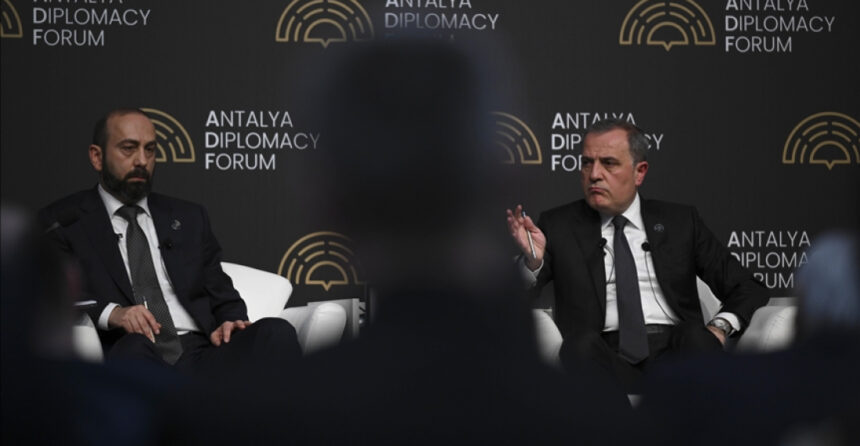
The candid exchange between Azerbaijan’s Jeyhun Bayramov, Armenia’s Ararat Mirzoyan, and Georgia’s Maka Bochorishvili, facilitated by Türkiye, offered a fragile yet meaningful sign that this fractured region may be inching toward regional peace and prosperity. Importantly, each minister underlined the significance of overcoming dividing lines in the South Caucasus and opening a new chapter for intraregional cooperation.
This gathering was therefore a noteworthy development against the backdrop of stalled peace treaty negotiations between Baku and Yerevan. However, the signals from the two capitals suggest that a tangible breakthrough towards signing a peace treaty is hardly to be possible in the near future, at least by the end of this year.
As Foreign Minister Bayramov reiterated during the forum, Azerbaijan is not willing to sign a peace treaty with Armenia until the latter removes territorial claims against the Karabakh region of Azerbaijan from the constitution. This presents a complex and uncertain challenge, as it is unclear when Armenia will be able to hold such a constitutional referendum or, more critically, whether the Armenian public will support removing the references to the Karabakh region.
In any case, it is evident that Azerbaijan will not sign the already finalized peace treaty draft until this constitutional change takes place. Clearly, no country in the world would sign a peace treaty with another country whose constitution contains clear territorial claims against it. While the Armenian government demonstrates some understanding to this fact, unfortunately, the Armenian political and expert community is not sufficiently engaging with the public on the necessity of this change for lasting peace and regional security. Instead, we continue to see unsubstantiated counterarguments that undermine the peace process.
A similar impasse can be observed regarding another key Azerbaijani demand: the formal dissolution of the OSCE Minsk Group. Armenia is hesitant to address this issue before a peace treaty is signed. Recently, Prime Minister Nikol Pashinyan remarked that consensus among OSCE members is needed to dissolve the Minsk Group.
In Baku, this is seen as a political maneuver, especially given the anticipated opposition from France, an Armenian ally, just as in December 2024 when the issue was previously raised. According to Farid Shafiyev, Chairman of the Baku-based Center of Analysis of International Relations (AIR Center), Armenia favors maintaining the Minsk Group as a potential mechanism to revisit the Karabakh issue in the future. Baku, in turn, seeks to eliminate any legal or political ambiguity that might be exploited to reignite the conflict. This, too, is likely to be a drawn-out process.
The good news, however, is that despite the lack of a signed peace treaty, a de-facto peace has been preserved and even strengthened between the two countries. It is a major achievement that no significant military escalation has occurred since Azerbaijan restored its territorial integrity in September 2023. This relative calm is likely to hold until both sides manage to transition to a “de-jure peace” through a formal treaty and the normalization of interstate relations.
This interim period holds untapped potential for contributing to reconciliation between the two nations and preparing their populations for long-term peace. Considering that the Armenian public is expected to vote on key peace-related reforms, the importance of this period cannot be overstated. Several policy initiatives could be pursued in the meantime.
First and foremost, it is essential to intensify bilateral interactions at multiple levels. The lack of such engagement during the conflict years significantly damaged public perceptions on both sides, especially among ordinary citizens. With the conflict largely resolved and de-facto peace in place, there is now room to initiate projects that bring together representatives from various societal sectors.
Given that external actors often complicate the process, Armenia and Azerbaijan should pursue these initiatives bilaterally. There are many relevant examples from other parts of the world that Baku and Yerevan could adapt. Notably, even 80 years after the end of World War II, France and Germany continue to invest in cross-border programs aimed at preserving peace and promoting regional integration. This serves as a powerful reminder that Armenia and Azerbaijan will need to engage in similar efforts for many years, if not decades, to come.
It is high time to launch such initiatives for confidence building purposes. Although there have been some in the past, mostly but not only, initiated and funded by the Western institutions, the two countries have yet to make significant bilateral initiatives for preparing their populations for peace. The recent success in the bilateral negotiations, particularly, the agreement on Azerbaijan’s bid to host COP29 in Baku as well as the agreement on the delimitation and demarcation process signed and approved by the two countries in 2024 show that there is strong potential to proceed with peace-building projects in other areas and tracks.
The two countries need also to build upon the proposal for establishing a trilateral format of cooperation in the South Caucasus. The ministerial panel within the Antalya Diplomacy Forum, and the announcement of a trilateral meeting of deputy foreign ministers from Armenia, Azerbaijan, and Georgia in Tbilisi on April 17, are important steps in this direction. These meetings should follow by tangible projects to facilitate the interactions amongst the peoples of the region, trilateral confidence-building measures, and partnerships in economic, social, and other spheres. Certainly, the scope of these measures will be limited until Armenia and Azerbaijan sign a peace agreement, but the existing potential should be fully utilized.
That said, while the formal peace treaty remains elusive, the current de-facto peace represents a critical opportunity that should not be wasted. The relative calm offers a valuable window to foster reconciliation, deepen mutual understanding, and build the foundations of sustainable peace. Concrete, people-to-people initiatives for confidence-building purposes can lay the groundwork for future cooperation and stability. If used wisely, this period can serve not just as a pause in hostilities, but as the beginning of a durable transformation in Armenia-Azerbaijan relations. The path to de-jure peace may be long, but meaningful progress can, and must, begin now.
Dr Vasif Huseynov, is a Senior Advisor at the Center of Analysis of International Relations (AIR Center) and Adjunct Lecturer at Khazar University in Baku, Azerbaijan.