Kazakhstan’s acceleration of its strategic alignment with Azerbaijan signals more than bilateral convergence. It reflects a deeper structural reconfiguration of Eurasian connectivity, a reconfiguration that is not additive but integrative. As documented in multiple announcements and institutional moves across March 2025, their cooperation has crossed the threshold from parallel development to systemic coordination. This evolving dynamic illustrates the emergence of a regionally endogenous axis that, without proclaiming itself as such, is shaping the wider functional geometry of Eurasia.
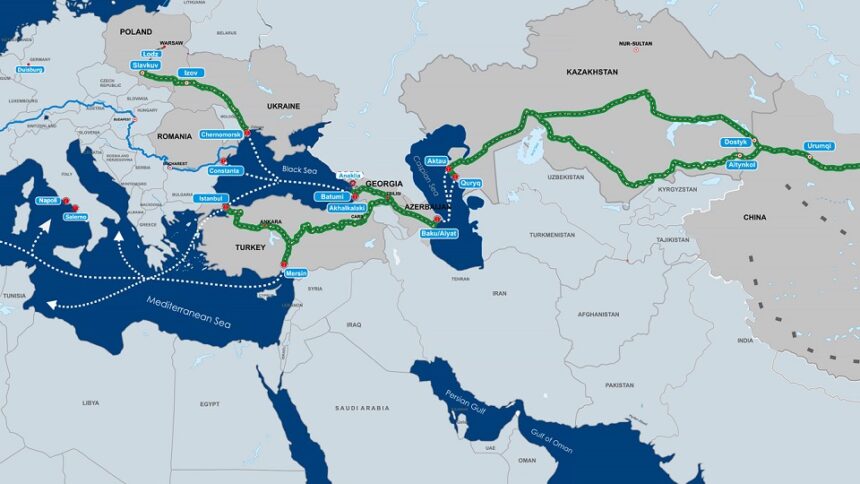
At the material core of this shift is the Middle Corridor — the Trans-Caspian International Transport Route (TITR) — linking China to Europe via Central Asia, the Caspian Sea, and the South Caucasus. While long viewed as a technical alternative to the Northern and Southern corridors, the Middle Corridor is now exhibiting the dynamics of what in systems theory would be called self-amplifying dynamic feedback loops. (The technical term is “autopoiesis,” literally “self-creation” of “self-production.”) In particular, institutional feedback, infrastructure reinforcement, and regulatory adaptation are all feeding into one another in ways characteristic of an autonomously emergent macroregional logic.
Kazakhstan’s announcement in December 2024 of the financing of a new terminal at Alat port in Azerbaijan, on which construction began in 2025, illustrates this logic in material form. Simultaneously, Kazakhstan is upgrading its Aktau port, backed by Chinese capital from Lianyungang, to triple its container throughput by 2028. This situation exemplifies the transformation of quantity into quality. Specifically, the upgrades are instantiating a network strategy that values not only volumes but also redundancy, flexibility, and strategic optionality.
The new fiber-optic cable agreement signed in March 2025 further reinforces this convergence. A 380-kilometer undersea connection between Sumqayit and Aktau — part of the broader Digital Silk Road — will reduce latency between the two countries from hours to milliseconds. In system-theoretic terms, this is not merely a technical augmentation. It converts the corridor from a physical transit route into a distributed digital platform capable of supporting real-time adaptive coordination. This shift from “throughput” to “synchronization” is foundational.
It also deepens the infrastructure-energy-information triad that has become characteristic of new macroregional systems. Kazakhstan’s expanded use of the Baku-Tbilisi-Ceyhan (BTC) pipeline, projected to carry 1.7 million tons of its oil in 2025, is not simply diversification. It is the strategic concretization of Azerbaijan’s role as a downstream node for Central Asian hydrocarbons. This is occurring alongside green transition signaling, including a modest floating solar project at Lake Boyukshor and a trilateral renewable energy agreement between Kazakhstan, Azerbaijan, and Uzbekistan. The repurposing of hydrocarbon corridors for hybrid energy flows is not substitution but overlay, in effect a dual-pathway system.
Meanwhile, capital commitment is reinforcing the commercial aspect. A $300 million joint investment fund announced by the two countries has already designated the construction of an intermodal terminal at Alat as its inaugural project. Additional integration comes from the UAE-backed $50 million grain terminal at Kuryk, which will further diversify the system’s carrying capacity by drawing agro-logistics into the corridor’s functionality.
In my recent article on the EU’s “new power play” in Eurasia, I explained how Central Asia is increasingly understood not as a buffer zone but as a platform for cooperation. This new strategic consciousness is evident in the March 2025 trilateral meetings between Azerbaijan, Kazakhstan, and Georgia to coordinate the Middle Corridor Multimodal Joint Venture. These are not bureaucratic exercises. They indicate a willingness to institutionalize mutual exposure as mutual benefit, transforming geographic proximity into systemic interdependence.
Security coordination, although still unstated, is becoming structurally implicit. As corridor density increases, so too does vulnerability. The dangers of sabotage, cyber interference, and logistical disruption are all enhanced. The lack of overt defense cooperation does not negate its presence in planning models. Infrastructure without a security architecture is a recipe for systemic fragility, but this aspect of cooperation remains off-record out of strategic discretion.
In this context, the EU’s recalibrated posture — epitomized by Kaja Kallas’s March 2025 tour of Central Asia and the upcoming EU–Central Asia Summit in Samarkand — must be interpreted as an attempt to enter this system as a non-hegemonic but indispensable partner. The EU’s Global Gateway initiative now recognizes the Middle Corridor as a backbone of Eurasian resilience. By embedding digital, energy, and regulatory integration within this initiative, the EU is engaging in a form of complex interdependence that enhances regional agency rather than co-opting it.
Kazakhstan’s position within this evolving system deserves particular attention. As I set out in another recent article, specifically addressing a potential new phase in the development of Kazakhstan’s relations with the U.S., Kazakhstan is becoming a structurally stabilizing actor. It balances the overlapping power-projection interests of multiple actors: Russia, China, Europe, and, increasingly, Turkey. Its bilateral partnership with Azerbaijan epitomizes its broader strategic grammar of non-alignment without passivity and multivectorism with selective depth.
Complex-systems theory teaches that when independent subsystems begin to coordinate across multiple domains (physical, informational, financial, normative), emergent properties appear. These properties cannot be reduced to any single actor’s intention or interest. They become, instead, the architecture within which intentions and interests are expressed. The Middle Corridor is approaching such a threshold. It is no longer merely a logistics route. It is a macroregional construct that channels, modulates, and refracts geopolitical agency.
The future evolution of this emergent system is to be determined, but its formative logic is unmistakable. Kazakhstan and Azerbaijan, through a dense web of investments, agreements, and symbolic cooperation, are constructing more than a corridor. They are laying down the infrastructural and normative tracks for a region that is beginning to generate its own strategic gravitational field. By doing so, they are establishing the broader Caspian region, within Central Eurasia, as a system that is able to define and work toward its own goals.
Robert M. Cutler has written and consulted on Central Asian affairs for over 30 years at all levels. He was a founding member of the Central Eurasian Studies Society’s executive board and founding editor of its Perspectives publication. He has written for Asia Times, Foreign Policy Magazine, The National Interest, Euractiv, Radio Free Europe, National Post (Toronto), FSU Oil & Gas Monitor, and many other outlets.