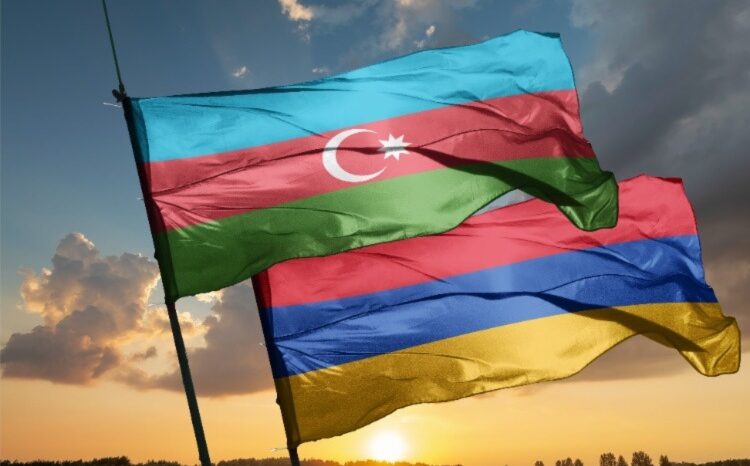
On 13 March, Armenia and Azerbaijan finalised negotiations on the text of a draft framework Agreement on Peace and the Establishment of Interstate Relations between the two countries. The draft agreement consists of 17 provisions and a preamble. The negotiations were delayed by the Armenian side’s failure to agree two out of the 17 provisions. Last year Azerbaijani President Ilham Aliyev noted that the two unresolved clauses within the draft agreement are the following: not to lodge international claims against each other, and the removal of external, third parties from the Armenia-Azerbaijan border.
At present a so-called European Union “civilian” mission on the Armenian side of the border is an irritant and does not contribute to stability. Despite Armenia agreeing not to station external actors on the Armenia-Azerbaijan border as part of the draft agreement, it does not intend to put this into practice. The country’s PM Nikol Pashinyan made it clear that Yerevan is ready to withdraw the European “observers” only from the demarcated sections of the border. Considering the length of the shared border it will take decades to conclude the border demarcation process, so this means that the EU mission will in fact remain on the border. This is one factor complicating the interpretation of the draft agreement, creating a topic of discord and failing to contribute to lasting peace in the region. Considering Armenia’s track record during its occupation of Azerbaijani land and that Yerevan had a different interpretation of the 2020 trilateral agreement between Azerbaijan, Armenia and Russia, it looks highly likely that Armenia will resort to imitating implementation of the draft agreement, creating further bones of contention.
Presenting the draft agreement as a comprehensive peace deal at this stage is wrong. First of all, the agreement does not address the opening of communications, reparations, and responsibility for the conflict. It seems Armenian PM Pashinyan is deliberately changing the nature of the draft framework agreement by presenting it as a “comprehensive” peace deal in order to evade the aforementioned issues. However, the draft framework agreement that the sides finalised does set common principles to move forward towards a lasting peace through future negotiations. As for Azerbaijan, Baku has consistently stated that it intends to sign a lasting, irreversible peace agreement with Armenia as a state and the Armenian people, not only with the Pashinyan government.
In an official press release following the conclusion of the talks on the draft peace agreement, the Azerbaijani Foreign Ministry reiterated the country’s official, long-standing position that amendments need to be made to the territorial claims enshrined in Armenia’s Constitution, and that the Minsk Group mechanism, a legacy of the conflict, needs to be abolished before the draft agreement can be signed. Armenian Foreign Minister Ararat Mirzoyan declined to amend the irredentist claims against Azerbaijan in the Constitution and to terminate the now irrelevant Minsk Group mechanism.
The preamble to the Armenian Declaration of Independence states, ‘Based on the December 1, 1989 joint decision of the Armenian SSR Supreme Council and the Artsakh National Council on the “Reunification of the Armenian SSR and the Mountainous Region of Karabakh”…’ This means that Armenia’s state policy is based on the annexation of part of the internationally recognised territory of Azerbaijan. The reunification claims started in 1988 as part of the Miatsum (Unification) movement with the aim of annexing part of Azerbaijan’s Karabakh region to Armenia. The issue turned into a full-blown conflict with the subsequent Armenian occupation of Azerbaijan’s Karabakh.
In an interview in February 2024 PM Pashinyan admitted that it would be impossible to achieve a lasting peace if the state’s policies were guided by the Declaration of Independence. On the other hand, also in 2024, the Armenian Constitutional Court issued a decision downplaying the legal significance of the preamble to the Constitution and declared that changing its wording is not a requisite step to achieving lasting peace.
Armenian legislation concerns other provisions that could stymy the peace process. A resolution of the Supreme Council (parliament) of the Republic of Armenia on 8 July 1992 openly states that any international or domestic document where the Karabakh region is mentioned as part of Azerbaijan is considered inadmissible for the Republic of Armenia. Pashinyan’s critics argue that the 8 July 1992 resolution prohibits Armenia signing any international agreement that recognises Azerbaijan’s territorial integrity encompassing Karabakh, and that the resolution itself cannot be annulled since it derives its constitutional basis from the Declaration of Independence enshrined in the preamble to the Constitution.
Removing the territorial claims from the Armenian Constitution is the key to last peace. It would terminate the constitutional basis for territorial claims, which has been the essence of the Armenia-Azerbaijan conflict, and ensure the durability of the peace deal in the post-Pashinyan era. It would also deprive Armenian revanchist circles and external spoilers like France, the Armenian diaspora, Russia and Iran the opportunity to manipulate the issue. Finally, a referendum could be held to give the Armenian people the opportunity to denounce the irredentist claims against their neighbours and choose peace. Pashinyan has announced that a referendum on a new constitution will be held in 2027, but it remains to be seen exactly how Armenia will address the irredentist claims in its existing constitution.
Considering that the constitutional referendum is a complex process that needs time, Armenia could terminate the July 1992 parliamentary decision and jointly with Azerbaijan ask the OSCE to wind up the Minsk Group. Since any decision within the OSCE needs unanimous consensus, Armenia needs to convince countries that do not support peace based on territorial integrity, such as France, Canada and other EU members, to vote in favour of terminating the dead Minsk Group format. Azerbaijan will not accept a political manoeuvre in which Armenia votes in favour but France vetoes dissolution of the Minsk Group.
Armenian PM Nikol Pashinyan has come under fierce criticism from the anti-peace Armenian diaspora organisations led by the Dashnaks such as the ANCA, the Armenian Church, pro-Russian Armenian opposition circles and the pro-Western opposition. In addition, self-styled representatives of the Karabakh Armenians also oppose the draft agreement’s provisions. These segments of Armenian society staunchly oppose not only peace, but also PM Pashinyan’s “Real Armenia” concept, which he advocates in response to the ideological tenets of Armenian irredentism.
Irredentism has, however, been the cornerstone of the Republic of Armenia’s national ideology since independence. Azerbaijan’s stance aligns with international norms and principles. The validity of an international agreement that contradicts a country’s constitution could be legally challenged within that country at any time.
Rufat Ahmadzada