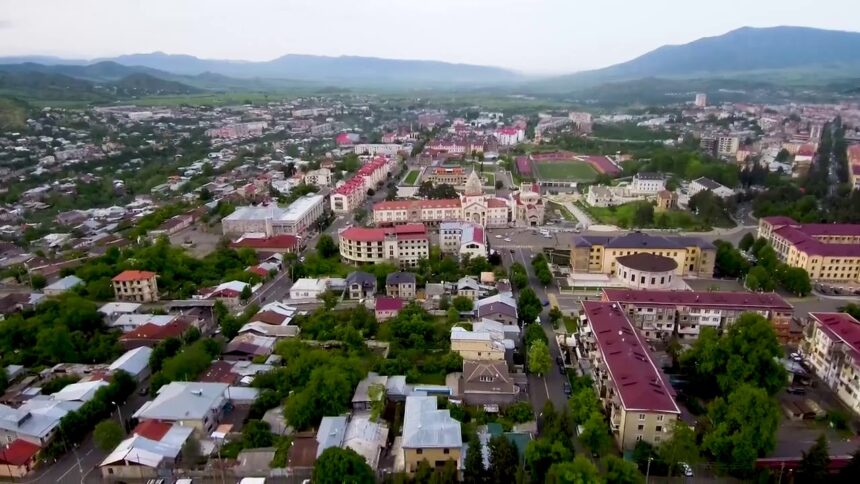
The “Azerbaijani Nuremberg Trials” continue to reveal sensational insights. This time, Arkadi Ghukasyan made headlines by providing information about the demographic situation in Karabakh in 1992. He admitted that at that time, fewer than 30,000 ethnic Armenians lived in Karabakh. Later, some of these people remained in Karabakh, some moved to Armenia, while others relocated to Russia.
These are certainly interesting numbers. When discussing Karabakh’s population before the war, it is common to refer to the 1989 census data. According to that census, the population of the now-defunct Nagorno-Karabakh Autonomous Oblast (NKAO) was 189,085, with Armenians making up 145,450 (76.92%) and Azerbaijanis 40,688 (21.52%). Additionally, there were Russians, Ukrainians, Belarusians, Greeks (in the village of Mekhmana), among others. However, this was still the “pre-war situation,” even with adjustments for the conflict that began in 1988.
By 1992, a full-scale war was raging in Karabakh. Azerbaijanis had already been expelled: on February 26, 1992, the city of Khojaly was destroyed; on May 9, Shusha was occupied; and on May 17, Lachin fell. In practice, this meant that Armenia controlled nearly the entire former NKAO and the road connecting Khankendi and Goris. It is understandable that many local Armenians preferred to flee the war. This is true—but not the whole truth. The reality involves extensive demographic fraud, which should be called by its name.
These fraudulent practices began surfacing in the early stages of the conflict, but as the occupation progressed and refugee flows increased, they were never fully investigated. It is worth recalling that as early as the spring of 1988, reports emerged that many ethnic Azerbaijanis living in NKAO were falsely recorded as Armenians in village council lists. Naturally, in national statistics, they were also counted as Armenians rather than Azerbaijanis.
Furthermore, during the Soviet era, a practice known as “double registration” was widespread among Armenians. Many ethnic Armenians living in Baku or Ganja also held secondary residency registrations in Khankendi or Khojavend. Such manipulations were illegal under Soviet law but were nonetheless widely used. The reason is clear: if the percentage of Armenians in Karabakh fell below a certain threshold, the legitimacy of Armenian autonomy would be questioned. This, in turn, would have endangered the plans for “miatsum” (unification with Armenia), which had been a long-standing goal in Armenian circles well before 1988.
Another unresolved question remains: how many people actually returned to Karabakh after the ceasefire in 1994? Armenian official sources reported numbers between 100,000 and 150,000—consistent with pre-war statistics. Azerbaijan, on the other hand, estimated a much lower figure of 50,000–60,000 people.
Moreover, a crucial question remains: how many of these 50,000–60,000 were original Karabakh residents and their descendants, and how many were relocated during the occupation? Karabakh hosted a significant presence of the Armenian occupation army, with many officers living there with their families. Furthermore, the Armenian government actively tried to resettle ethnic Armenians from Armenia and abroad—primarily from Syria and Lebanon—into the occupied Azerbaijani territories.
After the 44-day war, only 1,500–2,000 people reportedly remained in Karabakh, according to many sources. The rest fled to Armenia. Later, some began returning. Once again, Armenian sources claimed the number was 100,000, whereas Russian peacekeepers—who controlled the Lachin checkpoint and recorded arrivals and those who did not leave—reported figures of 50,000–60,000. In reality, the number was closer to 20,000.
Again, the key question remains: how many of these were native Karabakh Armenians, how many were army officers and their families, and how many were settlers from Syria and Lebanon?
Now that Azerbaijan has ended the occupation of its territories, one might think that these demographic manipulations are a thing of the past. However, Yerevan continues its deception, this time grossly inflating the number of “refugees from Karabakh.”
At a minimum, this serves as a tactic to secure more humanitarian aid from international sponsors. At worst—let’s be realistic—it is a deliberate Armenian propaganda effort aimed at justifying revanchist ambitions and renewing territorial claims against Azerbaijan. This is why Arkadi Ghukasyan’s revelations should be taken very seriously. Indeed, it is far too soon to consider this matter settled.
Nurani