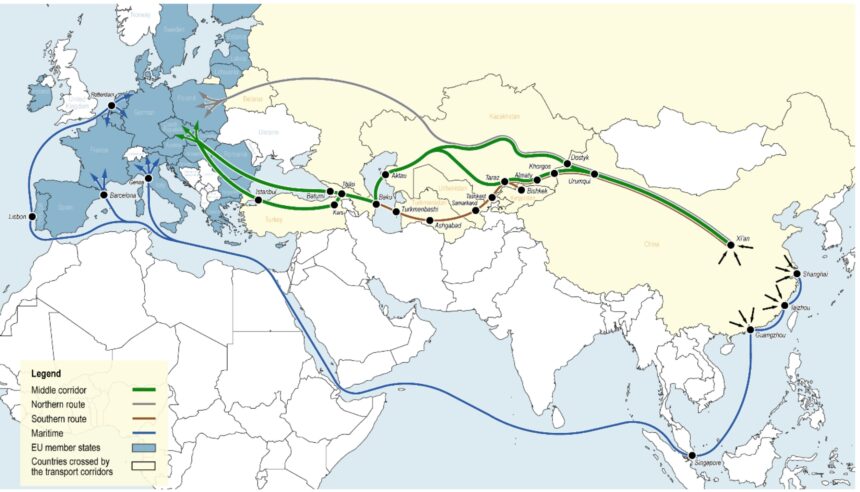
The inauguration of President Donald Trump marks a new phase in U.S. foreign policy with direct implications for the Middle Corridor, a key trade route linking China to Europe via Central Asia and the South Caucasus. This corridor, also known as the Trans-Caspian International Transport Route (TITR), has been gaining increasing strategic importance as global trade patterns shift and great-power competition intensifies.
During Trump’s first term, U.S. engagement in the region was sporadic and lacked a comprehensive strategy. While some policy initiatives were undertaken to counterbalance Russian and Chinese influence in Eurasia, these efforts remained piecemeal. The Biden administration attempted to address this gap by allocating limited funding for infrastructure development and engaging in regional negotiations aimed at fostering greater connectivity. However, Biden’s approach ultimately fell short of a coherent, long-term policy, allowing Moscow and Beijing to consolidate their positions in the region.
The significance of the Middle Corridor has been underscored by increased international investment. Beyond economic concerns, the Middle Corridor plays a critical role in Europe’s energy security. The corridor facilitates the westward flow of Caspian resources, providing an alternative to Russian energy exports. The development of the Middle Corridor offers a strategic means of achieving this goal, reinforcing the EU’s energy independence while simultaneously strengthening economic ties with the South Caucasus and Central Asia.
Azerbaijan has emerged as a central player in the development of the Middle Corridor. As a crucial transit country, Baku has actively pursued infrastructure investments to bolster the corridor’s efficiency. Azerbaijan’s role is further magnified by its growing energy exports to Europe, solidifying its position as a strategic partner in regional energy security. The Baku–Tbilisi–Kars railway, a vital component of the corridor, has received continued investment, underscoring Azerbaijan’s commitment to enhancing trade and transit connectivity.
However, Azerbaijan’s increasing importance also intersects with ongoing geopolitical complexities, particularly its relationship with Armenia. The absence of Armenian participation in the Middle Corridor remains a notable gap, one that is directly tied to the resolution of long-standing territorial disputes. The prospect of an Armenia–Azerbaijan peace treaty has gained traction in recent years, supported by Western diplomatic efforts. U.S. policymakers have recognized that sustainable peace between the two nations would not only stabilize the South Caucasus but also unlock Armenia’s potential role in the corridor.
Armenia’s geopolitical realignment presents both opportunities and challenges. While Yerevan has signaled its interest in deepening ties with the West, it remains economically dependent on Russia, particularly in energy and financial sectors. Increased Armenian exports to Russia, some of which analysts suspect may involve re-exports of sanctioned goods, further complicate efforts to shift its economic orientation.
Recent discussions within U.S. policy circles indicate a growing recognition of the Middle Corridor’s strategic importance. American policymakers have begun exploring ways to expand support for infrastructure development in the region, recognizing that a proactive approach could yield multiple geopolitical and economic benefits. By investing in the Middle Corridor, the U.S. has an opportunity to enhance regional stability, strengthen economic ties with key partners, and counterbalance Russian and Chinese influence in Eurasia.
Furthermore, diplomatic engagement is crucial to ensuring that regional disputes do not obstruct the corridor’s development. The U.S. should leverage its influence to support peace negotiations between Armenia and Azerbaijan while simultaneously encouraging Yerevan to diversify its economic partnerships beyond Moscow. This could involve increased economic cooperation with the EU, integration into Western financial networks, and participation in broader regional trade agreements.
Another key component of a successful U.S. strategy must be strengthening partnerships with regional partners. Azerbaijan, as a critical transit hub for the Middle Corridor, plays an indispensable role in its success. While U.S.–Azerbaijan relations have been strained in recent years, cooperation on Middle Corridor development presents an opportunity for renewed engagement. Coordinating efforts with Baku could facilitate smoother transit logistics, enhance trade facilitation measures, and promote security along the corridor’s key routes.
Kazakhstan and Uzbekistan also stand to benefit from increased U.S. engagement in the Middle Corridor. Both countries have been actively pursuing policies aimed at reducing their reliance on Russia while expanding trade links with Europe and Asia. The U.S. should support these efforts by deepening economic ties, fostering private-sector investment, and facilitating regional integration initiatives.
At the same time, Washington must remain vigilant against potential disruptions by Russia and China. Moscow has consistently sought to maintain its grip on Eurasian trade routes, and any significant U.S. involvement in the Middle Corridor will likely be met with countermeasures. Similarly, Beijing has been expanding its influence in Central Asia through the Belt and Road Initiative (BRI), positioning itself as a dominant economic force in the region.
A well-calibrated U.S. approach must account for these dynamics, ensuring that American involvement enhances regional stability rather than exacerbating existing tensions. Ultimately, the Middle Corridor represents a vital yet underutilized avenue for advancing U.S. strategic interests. A proactive American policy — one that combines economic investment, diplomatic engagement, and regional partnership-building — could transform the corridor into a key pillar of stability and prosperity in Eurasia.
Robert M. Cutler