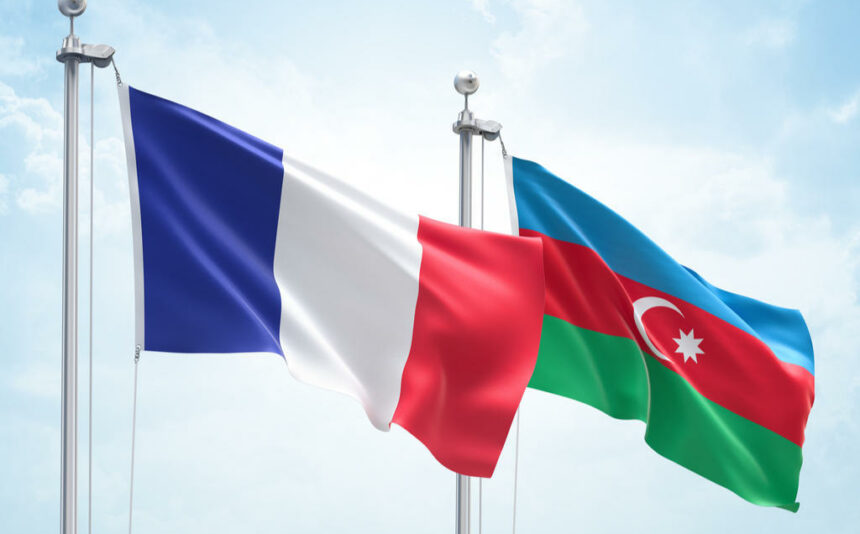
The South Caucasus has become an area filled with regional and international players competing for influence and economic power. On one hand, there are the countries of the region – Azerbaijan, Georgia, and Armenia – which have had complex relations for years, yet still live side by side, generally keeping their weapons to themselves. On the other hand, some countries outside the region intervene in the area’s conflicts, usually benefiting from their involvement in the Caucasus’ affairs. Azerbaijan and Georgia have called for a new regional cooperation platform to ensure that everyday matters and new issues remain exclusive to the countries involved, as external intervention by powers or non-regional states is seen as a major factor destabilizing the region. Despite this, the foreign policies of Western countries, particularly France, raise questions about the region’s future development.
The South Caucasus region is under constant scrutiny, with many eyes watching every political move and maneuver. This unfortunate habit is referred to in Azerbaijan as “excessive involvement” by Western countries like France, who use their diplomatic power to pursue their geo-strategic goals without regard for local players. The near and distant history of the South Caucasus shows that interference by external actors, consistently supporting one side, can exacerbate divisions and lead to extreme polarization and hostility, often without a valid reason.
However, these days, the countries of the South Caucasus are no longer willing to accept any external interference from anyone wishing to meddle in the Caucasus’ affairs, preferring to allow local actors to manage their own conflict resolution. Azerbaijan is one of the prominent countries in the region that is unwilling to bow to any external influence and accept third-party involvement in negotiations for peace with Armenia.
Azerbaijan’s President Ilham Aliyev recently commented on the issue of external intervention, stating that the previous era of “intervention, control, and imposition” by specific “strong” countries, such as the United States and the Soviet Union, only led to more endless conflicts and confrontations. To create a new world order, powers must relinquish some of their control or aspirations for control, so that the world becomes a place where people from different nations can genuinely respect each other.
France has become a central player in the dispute between Azerbaijan and Armenia. Since the military conflict between Armenia and Azerbaijan over the Karabakh region in 2020, France has seemingly taken on the role of advocating for Armenia. France has consistently supported Armenia for a long period, so this is a well-established fact, not just a recent development in the Caucasus conflict or its media coverage. However, from Azerbaijan’s perspective, France is beginning to cross the line with its criticism to the point that the French risk losing their bilateral relations with Azerbaijan due to their excessive and misleading criticism, while in Europe, Azerbaijan is seen as a friendly country and a reliable ally.
Part of the extreme criticism coming from France involves the claim by Silver Meyer, a member of the French legislative assembly, that Azerbaijan is trying to destabilize France, and that its diplomats are responsible for the internal instability in France and its recent turbulent foreign relations. It seems that Macron’s government is looking for a scapegoat on which to blame its diplomatic and managerial failures. What is certain is that anti-Azerbaijani rhetoric has become a central component of French foreign policy and, paradoxically, even its domestic policy.
France’s damaging of Azerbaijan’s reputation in Europe not only harms Azerbaijan’s future—completely unjustly—but also another pro-Western country in the Middle East, Israel. By undermining Azerbaijan’s standing in Europe with baseless accusations, Azerbaijan will lose potential profits from partnerships with European countries. True, Azerbaijan has been active for many years in trade and energy with European nations, but if lies like the recent falsehoods coming from France continue to be publicly voiced, these lies could seep into European consciousness.
In this era of political correctness, European countries would prefer to trade with nations that have no “skeletons in the closet” or suspicious rumors surrounding their actions. As a result, Azerbaijan’s status in Europe will suffer, and eventually, so will its standing with its neighboring countries. If Azerbaijan weakens economically and geo-strategically, it will deal a heavy blow to the resistance axis against Iran, whose greatest enemy in the Middle East is Israel. Azerbaijan helps Israel in its struggle against the Iranian regime in many ways, and if this assistance is forced to stop because Azerbaijan can no longer provide financial support, it will be deeply unfortunate for Israelis. At this time, it is crucial to strengthen those who support the Western approach, not those who aid the Iranians. Yet the French have already made the mistake of misidentifying the true enemy in the Middle East.
Although France condemned the Hamas attack after October 7th, that fateful day when Hamas terrorists invaded Israeli territory and murdered 1,400 Israelis, it was difficult to characterize its actions as “pro-Israel.” First, the French supposedly called for not harming uninvolved civilians, a legitimate call in itself, but they specifically emphasized Israel, urging them to show restraint. In addition, France supported the International Criminal Court’s investigation in The Hague against Israel, probing whether Israel had committed war crimes.
From France’s actions and statements, it appears they are suggesting that Israel is deliberately sending its soldiers to kill civilians, a claim that mirrors what Hamas and Palestinians in Gaza did to Israelis. After all, Israel entered the war to rescue the hostages Hamas took on October 7th; Israel didn’t go to war just for the sake of it. The war crimes were committed by Hamas terrorists, who killed infants, raped women, and looted property. To portray Israel as a country that shows no compassion for civilian populations is simply a gross lie, just like the lies the French spread about Azerbaijan.
As for the European Union’s involvement in the Azerbaijan-Armenia conflict, the EU has almost openly sided with Armenia, despite enjoying favorable economic relations with Azerbaijan. Azerbaijan fears that European involvement, especially from EUMA (the European Union Monitoring Mission in Armenia), might hinder the peace process and support vengeful factions in Armenia that oppose compromise. Additionally, Azerbaijan is concerned about EUMA’s ability to operate autonomously as an arm of the European Union, without being influenced by strong EU member states. These Azerbaijani concerns stem from the fact that French military officials are directly involved in the EUMA mission.
In conclusion, the military campaign between Armenia and Azerbaijan has ended, with both countries resolving most of their conflict details through negotiation, aside from a few ongoing issues being discussed in peace talks. In light of this, France’s continued support for Armenia appears to be an attempt to stir up tensions and foster conflict for its own purposes, making it impossible to pretend that French support for the Armenians is “support for resolving the conflict.” Given the information presented, it can be understood that the French are the ones interested in perpetuating the conflict in the South Caucasus and the ongoing dispute between Armenia and Azerbaijan for their own political and diplomatic goals.
Rachel Abraham