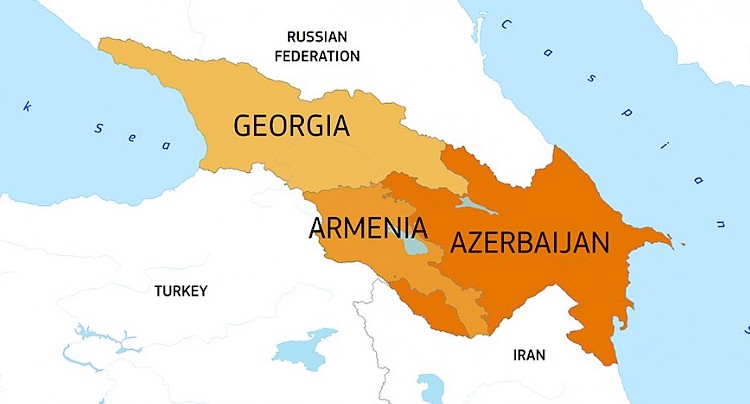
The past five years have marked a growing Gulf economic presence in the South Caucasus. Saudi Arabia and the United Arab Emirates have expanded their regional footprint through equity investments in Azerbaijan and Georgia’s transport and renewable energy sectors. Armenia has been a weak link in interregional chains due to conflict with Azerbaijan and its isolation from regional connectivity frameworks. Yet recently, Yerevan managed to establish profitable trade links to the Gulf, largely thanks to Western sanctions on Russia. The South Caucasus trio sees financial flows from the Gulf as necessary for successful economic diversification. For the Gulf countries, the South Caucasus provides an alternative market for strategic investments, which aligns with their long-term goals of projecting geo-economic influence and boosting trade.
In geopolitical terms, Russia’s invasion of Ukraine has unleashed two interrelated changes in the South Caucasus that could explain growing Saudi and Emirati interest in the region. Firstly, Moscow’s declining regional influence invited a larger third-power presence in Armenia, Azerbaijan, and Georgia. Saudi Arabia and the UAE joined India, China, Iran, and Turkey to gain inroads into the region, a move in line with their ambition to position themselves as middle powers wielding influence into different parts of the globe. In 2024, the UAE surpassed Russia as the largest source of foreign direct investment in Armenia. So far, their narrow focus on economic and technological partnerships has allowed them successful entrance to the South Caucasus without provoking a backlash from regional powers. Secondly, the region’s growing multipolarity has exposed the South Caucasus to geopolitical developments elsewhere, especially in the Middle East that could push Saudis and Emiratis to see the region as part of a broader geopolitical competition with Turkey and Iran, even if relations with these powers have been successfully normalised in recent years.
Currently, the geoeconomics of regional connectivity and renewable energy are major driving forces behind the involvement of Gulf countries in the South Caucasus. The Middle Corridor, a multi-modal rail-sea route connecting China with the EU through Central Asia and South Caucasus, is the major project under the Emirati and Saudi radars. The route gained significance for intercontinental rail connectivity after the destabilisation of Russia’s Northern Corridor and Houthi-driven threats to Red Sea shipping. Regional countries have been seeking international investments to tackle hard and soft infrastructure bottlenecks. Besides the EU and China, the UAE has been among the major investors in Kazakhstan and Georgia’s rail and port infrastructure.
Meanwhile, viable east-west and north-south connectivity in the South Caucasus is essential for the Gulf access to Central Asia. Saudi and Emiratis have recently ramped up investments in Central Asia’s rich deposits of critical minerals, metals, and agricultural resources. Not surprisingly, the last few years saw a flurry of diplomatic engagements between the Gulf and Central Asian countries in both bilateral and multilateral formats. Most importantly, the first-ever Gulf Cooperation Council – Central Asia summit was convened in July 2023 in Saudi Arabia to discuss prospects of coordination on strategic affairs ranging from food security to transport and sustainable supply chains. Two of the three possible rail routes to Central Asia – one through the Turkish-Iraqi Development Road and the other through the Russian-Iranian International North-South Transport Corridor – pass through the South Caucasus, increasing the region’s strategic importance for the Gulf countries. Baku, Yerevan, and Tbilisi have taken a proactive approach to use this opportunity to their advantage.
Armenia has been the main beneficiary of changing trade flows with the Gulf since February 2022. Sanctions on Russia created an urgent demand in Moscow for the EAEU countries to play the role of critical transit hubs for Russian exports to alternative markets in the Global South and imports of Western dual-use items. In 2023, Armenia emerged as a crucial supplier of gold to the UAE when Russian supplies hit the ground. That year, Yerevan’s exports to the UAE amounted to 2.3 billion USD, 3.9 times growth year on year. In 2024, the UAE became Armenia’s largest export partner as trade with the Gulf country accounted for 40 per cent of Armenia’s total export volume. While gold and diamond constituted more than 94 percent of exports to the UAE, the majority of those supplies came from Russia and were re-exported to the UAE directly or underwent processing in Armenia, adding value before re-export. On the one hand, expanding trade ties with the Gulf countries is part of Yerevan’s diversification efforts to decrease substantial economic dependence on Russia, a highly unreliable ally in recent years. On the other hand, relying on re-exports without much value-added to the local economy could create new forms of dependencies with serious ramifications for economic resilience.
Yerevan has also scored geopolitical points by expanding diplomatic ties in the Arab world in general and in the Gulf in particular. In November 2023, Armenia established diplomatic relations with Saudi Arabia, ending Riyadh’s longstanding reluctance rooted in its firm backing of Azerbaijan over the Nagorno-Karabakh conflict. It was followed by Armenia’s recognition of Palestine in June 2024, a gesture that garnered positive messages from the Muslim world. The majority of Islamic countries have long supported Azerbaijan’s position vis-a-vis Armenian occupation. Now that the Karabakh chapter is closed, Yerevan wants to change that reality in its favour.
Azerbaijan views the growing Gulf presence as an essential element of its multiple enmeshment strategy – a plan designed to balance competing influences and ensure no single power dominates the region. Banking on the Gulf-Iran regional competition, Baku may also benefit from growing amity between Turkey and the two Gulf monarchies. Diplomatically, Azerbaijan has long benefited from Saudi and Emirati support in international organizations. In December 2022, the UAE vote proved crucial for preventing the adoption of an anti-Azerbaijani statement in the UN Security Council, promoted by France. In January 2024, Baku and Abu Dhabi signed a strategic partnership agreement, putting recently-expanding ties into a formal political framework.
The Gulf investments in Azerbaijan’s energy sector have recently come to dominate the agenda in bilateral relations. Saudi Arabia’s Acwa Power is constructing a 240 MW wind power plant in Khizi, which is expected to be completed by the end of 2025. The UAE’s Masdar installed a 230 MW solar power plant in Garadagh and other renewable projects are in the pipeline. Besides economic dividends and helping Baku diversify its energy mix, these new green projects are expected to save additional gas to enable Azerbaijan to meet its gas export commitments. Abu Dhabi National Oil Company’s recent acquisition of a 30 per cent stake in the Absheron gas field will also help with that. At the same time, growing renewable capacity serves Baku’s broader ambitions to become a green energy hub in the South Caucasus, a message Azerbaijani leadership actively promoted during the COP29 global climate summit in Baku in November 2024.
When it comes to Georgia, relations with the Gulf monarchies have taken a significant turn recently as Tbilisi has increasingly shifted its gaze to alternative partners in the east and south. The UAE has already had a sizeable presence in Georgia’s transport infrastructure since 2008 when its Ras Al Khaimah Investment Authority purchased the Poti Black Sea port. The rising importance of the Middle Corridor and Georgia’s pivotal location along the route has triggered new investment projects. In March 2024, the UAE’s AD Ports acquired a 60% stake in the Tbilisi Dry Port, a key logistics facility connecting the Caspian Sea and the Black Sea. Masdar is building Georgia’s largest solar power plant in the Gardabani region. Meanwhile, during Georgian Prime Minister Irakli Kobakhidze’s visit to Abu Dhabi in January, the UAE’s real estate company Emaar Properties signed a memorandum of a cooperation agreement to invest 6 billion USD in Georgia – the largest investment in the country’s history. Similarly, Saudi Arabia’s investment minister promised larger Saudi involvement in water and solar energy projects in Georgia in the Georgian-Saudi Investment Forum in February 2024.
For some, Georgia’s deepening ties with the Gulf monarchies are part of a multivectoral turn in its foreign policy, while providing a valuable tool to balance the Russian influence. At the same time, rising Gulf investments gain strategic importance amid Tbilisi’s deteriorating ties with the U.S. and the EU, the largest foreign direct investors in the Georgian economy. Last but not least, for Georgia and Azerbaijan, closer coordination between expanding Gulf investments and China’s green tech supplies presents an opportunity to advance industrialisation while solidifying the eastern pillar of their diversified foreign policy.
Yet, the road ahead is anything but smooth. Weak interregional connectivity is the key bottleneck for further improvement of trade ties. Meanwhile, increased Gulf engagement with the South Caucasus could invite balancing measures from Russia, Iran, and Turkey, increasing pressure on regional countries. Finally, growing rifts between Saudi Arabia and the UAE over regional and international influence may put Armenia, Azerbaijan, and Georgia in a difficult spot over their alignment choices in the Gulf.
Mahammad Mammadov is a Research Fellow at the Topchubashov Center, a Baku-based think tank. He is also an adjunct lecturer at Khazar University.