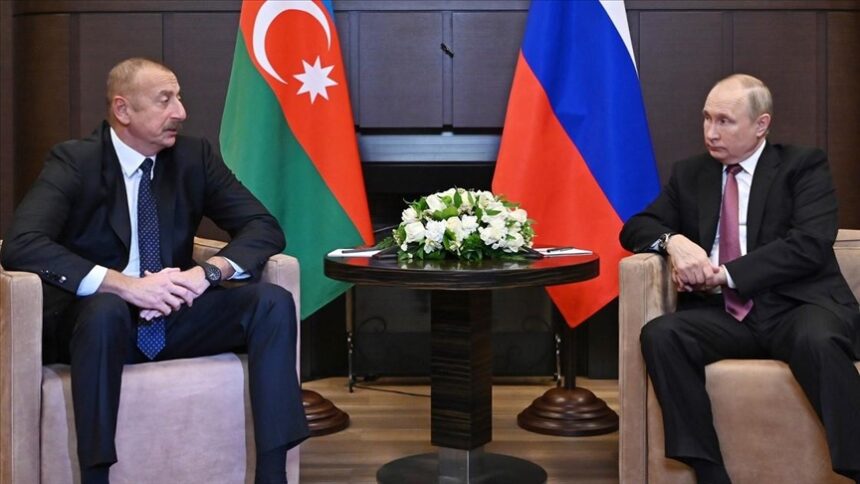
Since Baku decided to seriously address the issue of the dubious activities of the “Russian House,” threats and various forms of intimidation began pouring in from Moscow. The tactic is unimpressive, but as the great Russian poet once wrote, they cannot come up with anything better. Everyone has long been accustomed to this behavior from Russian officials—whenever someone starts acting according to the entirely logical principle of protecting national and state interests, our northern neighbor bares its beastly snarl, and nervous convulsions begin. Russia simply cannot accept the fact that former Soviet republics have long been independent states, making their own decisions without looking back at Moscow.
The situation surrounding the “Russian House” in Baku once again vividly revealed the true nature of Russia’s so-called elite, as aggression and hatred, all too familiar, have burst forth in public forums and on federal television channels. The Kremlin’s trained lapdogs eagerly line up to appear on air, competing in ferocity and malice toward Azerbaijan.
Baku has every right and legal basis to question the activities of the “Russian House.” Yes, it had operated for a long time without proper registration, but this was only possible due to goodwill and trust. The Russian side, by the way, took full advantage of this trust. Whether the “Russian House” will be shut down or not, and if it is, for what reasons, has already been widely discussed on our website.
Now, it is worth focusing specifically on the reaction of Russian media personalities, who, it must be said, clearly understand their assigned role—to intimidate, slander, and engage in cheap blackmail. The Russian media space is overflowing with such odious figures, kept precisely for moments like these when officials need to maintain diplomatic restraint. Instead, propaganda mouthpieces are allowed to vent their frustration, relieving stress through low-grade attacks on their neighbors. A flood of hatred, sarcasm, and bile is unleashed in all directions with the aim of instilling fear so that the “offender” would no longer dare to exercise its sovereign rights.
For instance, a Russian deputy, television host, and husband of propagandist Olga Skabeyeva, Yevgeny Popov, acted like a local thug demanding answers. He proposed imposing economic sanctions against Russian businessmen of Azerbaijani origin—God Nisanov and Araz Agalarov—arguing that pressure could be applied to them since there was no place for the “Russian House” in Baku.
Popov is convinced that as soon as Azerbaijan shuts down the office of Rossotrudnichestvo, two major companies in Russia “must feel it.”
“Tit for tat,” he declared with a smug expression. Well, he is right—it is indeed tit for tat, just as Russia wished. Incidentally, back in 2017, the All-Russian Azerbaijani Congress (AAC) was dissolved in Russia.
Beware of vicious dogs, or “Tit for Tat” in the Azerbaijani style
At that time, the official reasoning was that the organization’s charter did not comply with Russian legislation. Today, Moscow claims that the “Russian House” is a public organization designed to expand humanitarian ties between Azerbaijan and Russia. In that case, we can say that the AAC, established in Moscow in 2001, was also a public organization, but for some reason, it did not sit well with Russian authorities. The decision to shut it down was quickly justified with fabricated claims and hastily implemented.
At the time, Azerbaijan’s Ministry of Foreign Affairs expressed regret and surprise over the liquidation of the organization, noting that this decision contradicted Vladimir Putin’s policy of developing interethnic relations. The Congress, as highlighted by the Foreign Ministry, played a significant role in Azerbaijani-Russian relations and regional cooperation, with its representatives repeatedly receiving awards from Russia’s top leadership.
Did anyone in Baku appear on television calling for pressure on Russian businessmen? Did anyone spew venom at people who had no connection to the situation? No. Meanwhile, Russia’s “tele-cesspool” has no shortage of toxic outbursts.
Moscow may certainly conduct a “brainstorming session” and concoct multiple reasons to “pressure” Azerbaijani businessmen, as suggested by the State Duma member. However, it must be understood that these individuals have spent years building their businesses in Russia, paying taxes, providing jobs, and implementing many useful projects, including infrastructure initiatives. Who will be more affected by this attack, given Russia’s already dire economic situation under sanctions, is a rhetorical question.
Some military correspondents went so far as to insult the Azerbaijani leadership. The ever-familiar Konstantin Zatulin also started barking, claiming that “after Nagorno-Karabakh, Baku no longer needs Russia.” Yes, admitting irrelevance is difficult, but necessary.
“The real policy of the Azerbaijani authorities is entirely different: they are allies of Turkey and promote Turkish interests along with their own in the Caspian region, Central Asia, and the Caucasus,” he said. A strange statement, as if Baku were somehow obligated to promote Russian interests…
Another Kremlin-affiliated mouthpiece, Sergey Mantsayev, speaking on “Tsargrad” TV, suggested in response to the closure of the “Russian House” in Baku that all Azerbaijani migrants in Russia should be expelled back home.
“First—expel all Azerbaijanis who are not Russian citizens. Second—arrest all members of the diaspora and deport them to Novaya Zemlya to clear a test site. Third—take a tougher stance with the Azerbaijani authorities,” he declared.
How is this not a Nazi-style call to action? This individual openly admits that laws in Russia do not apply equally and that any inconvenient person of an “inconvenient” nationality can simply be arrested. Later, a justification can be invented, just like with the AAC. It operated for many years, then suddenly stopped complying with regulations—despite the organization remaining the same, as did the legislation.
By shutting down the All-Russian Azerbaijani Congress in one stroke, Russia dealt a serious blow to the diaspora as a whole, depriving Azerbaijanis of an unifying structure.
As for the operation of the “Russian House” in Baku, the fact remains—it lacks registration. Nothing even needed to be fabricated. Moscow has stated that they intend to apply for registration with Azerbaijan’s Ministry of Justice, but whether the ministry will issue this document remains to be seen.
The tensions between Moscow and Baku surprise those who always assumed that Azerbaijan would not dare to push back and would simply remain silent while Russia continued to sneer and dictate its terms. Despite respecting Russian culture and treating the Russian language and Russian-speaking population with care, Azerbaijan observes the norms of decency and does not stoop to crude attacks. At the same time, Baku demands the respect it deserves, as well as recognition of its sovereign right to decide how to handle suspicious organizations operating on its territory. If the “Russian House” in Baku is so important to Russia, then Moscow should lower its tone, accept Azerbaijan’s conditions and legal norms.
Instead of persistently targeting Azerbaijan and obstructing Azerbaijani diaspora organizations, Russia would do better to turn its venomous gaze toward Armenian structures, which have already extended their sticky tentacles into every significant sector of Russian society. It is from Yerevan, not Baku, that anti-Russian rhetoric is heard, with actions taken to distance Armenia from Russia, along with constant threats and blatant blackmail. Some Armenian officials have even made offensive statements about their Russian counterparts, yet Moscow continues to swallow it all. Russia barely recovers from one Armenian kick before receiving another well-aimed and deliberate spit in the face. Yet, Moscow simply wipes it off and resumes its submissive stance, waiting for the next slap from an Armenia that no longer hides its disdain.
Meanwhile, regarding Azerbaijan’s justified demand for Russia to take responsibility for shooting down a civilian aircraft on December 25, Moscow has decided to wait for the final investigation report, which typically takes at least a year to prepare. In similar cases where the roles were reversed, Russia was quick to draw conclusions and issue statements in its own favor.
President Vladimir Putin prefers to avoid the topic of the downed Azerbaijani airliner, while his press secretary, Dmitry Peskov, refuses to comment. Yet, as soon as the issue of the “Russian House” in Baku arose, both Peskov and Maria Zakharova were eager to speak, even expressing the leadership’s willingness to discuss the matter. If the “Russian House” is so crucial to Russia, let Putin first be ready to discuss the tragedy of December 25.
Maqsud Salimov