The policy decisions made by the new President of the United States, Donald Trump, have triggered tectonic shifts in the international political order. The post-World War II, U.S.-led system is unraveling before our eyes, and paradoxically, this process has been accelerated by the United States itself. The new Secretary of State, Marco Rubio, described the post-Cold War order, characterised by unipolarity, as an “anomaly” and stated, “It was a product of the end of the Cold War, but eventually, you were going to reach back to a point where you had a multipolar world, with multiple great powers in different parts of the planet.” The United States appears to have abandoned its post-World War II role as the leader of the free world, established through Pax Americana and its commitment to providing security for allies in Europe, East Asia, and beyond.
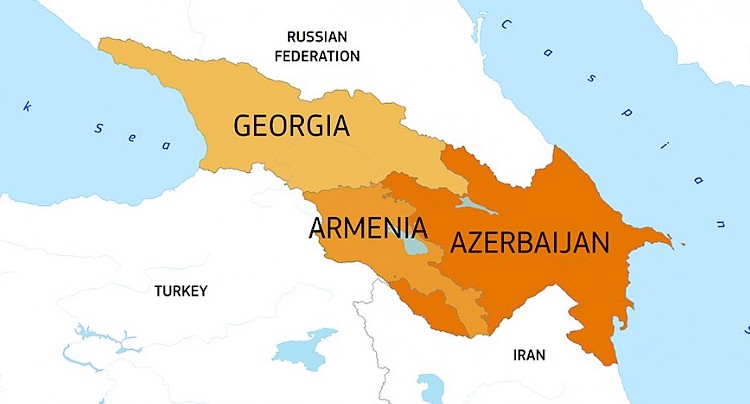
This shift may be welcomed by other great powers competing with the United States for global dominance. However, whether the emerging order – or disorder – represents a positive development for global peace and security remains an open question. History has shown that multipolarity is often unstable, frequently leading to major conflicts that ultimately gives rise to a new order dominated by one or two poles. From a historical perspective, the contemporary period in international relations can be characterised as a disordered interregnum – a phase of instability between the decline of one hegemonic order and the emergence of another. The South Caucasus, a historically contested region at the crossroads of Europe and Asia, finds itself at the heart of this transition. The present global order and broader geopolitical situation poses a range of threats to the South Caucasus.
To assess these potential threats, it is first necessary to analyze the strategic positions adopted by great powers in their interactions within a multipolar world. Fundamentally, the pursuit of power and security remains a constant feature of international relations. However, to mitigate the risks of direct confrontation and military conflict, great powers are likely to exercise greater caution in acknowledging and respecting each other’s core interests within their respective spheres of influence. While clashes become inevitable when these interests are in direct opposition, opportunities for cooperation may arise when their strategic objectives are not inherently conflicting. This dynamic is evident in the Trump administration’s approach to Ukraine, where Washington appears to be seeking an accommodation with Russia to resolve the conflict as soon as possible. One of the reasons for this approach of the Trump administration looks to be an implicit acceptance of Russia’s interests and concerns over its “periphery”.
Russia’s December 2021 ultimatum to NATO once again underscored its perception of the South Caucasus as part of its sphere of influence. The document stipulated that “The Parties that are member states of the North Atlantic Treaty Organization shall not conduct any military activity on the territory of Ukraine, as well as in other states of Eastern Europe, the South Caucasus, and Central Asia.” The rejection of these ultimatums by the Biden administration was followed by Russia’s intervention in Ukraine, leading to the ongoing war.
Thus, Ukraine’s struggle over the past three years, along with recent developments in the South Caucasus, underscores that countries in Russia’s “periphery” are unwilling to subordinate themselves to a power center at the expense of their independent agency. These countries are increasingly unwilling to acquiesce Moscow’s influence without contestation, particularly when confronted with policies they perceive as unjust or detrimental to their national interests. This is evident in the evolving dynamics of Azerbaijan’s relations with Russia following the tragic airplane crash on December 25. In the latest development of this crisis, on February 5, Azerbaijan closed the office of the Russian House, a key instrument of Russia’s soft power, in Baku. Traditionally, Georgia, and recently Armenia, have followed similar paths in their relations with Russia. Yerevan’s efforts to diversify its foreign policy outreach and downgrade its strategic dependency on Russia clearly underscore these trends.
This shows that the South Caucasus is increasingly asserting itself as an arena where regional states seek to navigate great power competition rather than passively conform to external pressures. The geopolitical reconfigurations unfolding in the region highlight the agency of local actors in shaping their strategic trajectories, despite the efforts of larger powers to impose influence.
One of the primary threats stemming from this disordered interregnum is the potential for increased volatility and instability. The erosion of a clear global order and the weakening pillars of the rule-based international system (e.g., the United Nations and the Organization for Security and Cooperation in Europe – OSCE) diminish the predictability of international relations, raising the risk of miscalculations and unintended escalations. The South Caucasus, given its complex history of ethno-territorial conflicts, is particularly vulnerable to such instability. Without a stable international system to provide security guarantees or enforce conflict resolution mechanisms, local disputes may escalate beyond the control of regional actors.
Another significant concern is the potential for external actors to exploit the region’s divisions for their own strategic interests. The involvement of multiple great powers with competing agendas can create an environment of persistent insecurity, where regional states struggle to maintain balanced foreign policies. Russia, despite its recent setbacks in Ukraine and the gradual erosion of its influence in the South Caucasus, remains a key player seeking to retain strategic depth in the region. At the same time, Turkiye has emerged as a formidable actor, particularly through its growing military and economic cooperation with Azerbaijan. France has sought to acquire a role in the security space of the South Caucasus by providing military and political support to Armenia and indirectly fueling revanchist sentiments in this country against Azerbaijan. Azerbaijan is concerned that the European Monitoring Mission (EUMA) has turned into a military extension of these pro-Armenian groups. The presence of multiple external actors raises the possibility of proxy conflicts or intensified competition that could further destabilize the region.
To mitigate the security risks that have emerged during this period, the countries of the South Caucasus must redefine their security architecture and counter the historical “divide and rule” strategy employed by external actors. Initiatives such as the Organization of Turkic States, the 3+3 regional cooperation platform, and trilateral cooperation efforts among Armenia, Azerbaijan, and Georgia can provide a chance toward diversified security arrangements that enhance the independent agency of regional states. Additionally, economic partnerships, such as the trilateral cooperation between Azerbaijan, Georgia, and Türkiye, strengthen regional connectivity and bolster resilience against external coercion.
In conclusion, the South Caucasus stands at a critical juncture amid the broader reconfiguration of the global order. The ability of the South Caucasus countries to navigate this disordered interregnum will depend on their capacity to foster regional cooperation, diversify security partnerships, and reinforce economic resilience. The signing of a peace treaty between Armenia and Azerbaijan, the assurances against the resurgence of this conflict in the future, and the establishment of a trilateral cooperation platform of the three countries of the South Caucasus are some of the measures that they can take to survive this unpredictable and unstable period in international relations.
Dr Vasif Huseynov, is a Senior Advisor at the Center of Analysis of International Relations (AIR Center) and Adjunct Lecturer at Khazar University in Baku, Azerbaijan.