The Armenian society is once again in a state of hysteria. This time, the uproar centers around “genocidal” passions triggered by remarks made a few days ago by Armenian Prime Minister Nikol Pashinyan during a meeting with members of the Armenian community in Switzerland. Pashinyan raised questions about the historical narrative surrounding the so-called “genocide,” stating: “How is it that in 1939 there was no discussion about the Armenian genocide, yet by 1950 it became a major issue? How did this happen? Should we understand it or not?”
And then the storm began. Former Foreign Minister Vardan Oskanian promptly emerged, accusing Pashinyan’s statements of being “not just historical revisionism but a moral renunciation of historical truth and national dignity.” According to Oskanian, these events “form the core of our identity and our place in the world.”
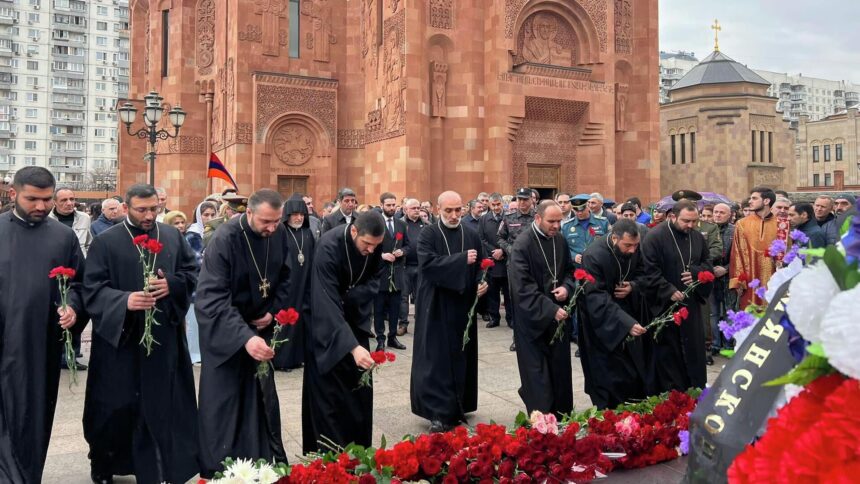
The connection between “Armenians’ place in the world” and this issue remains unclear, but when viewed through the lens of identity, there’s merit to his claim. In Armenian society, identity is heavily shaped by the deeply ingrained narrative of the so-called “genocide.” The statement from Etchmiadzin Church, which quickly declared that “universal recognition and condemnation of the Armenian genocide is imperative for preventing similar crimes worldwide,” is a testament to this perspective.
Joining the fray, the Dashnaktsutyun party called on the Armenian diaspora to unite against this “challenge to national security aimed at weakening Armenian statehood.” Meanwhile, the Union of Armenians of Russia characterized Pashinyan’s remarks as yet another “manifestation of the Armenian government’s malicious policy toward the diaspora and the history of our people.”
These reactions have dominated Armenia’s political discourse in recent days. Against this backdrop, it is worth revisiting some historical nuances from the events that transpired in the Ottoman Empire during World War I. Ömer Lütem, a former director of the Turkish Institute for Armenian Studies, noted that at that time, the Ottomans were fighting a two-front war: “Battling Russian forces and Armenian militias allied with Russia in the east, while also suppressing Armenian uprisings in the rear.”
The German Consul in Erzurum, Scheubner-Richter, highlighted the “catastrophic consequences of the activities of Russian consuls in Van,” which influenced the actions of Armenians in the region. Simultaneously, leaders of the Dashnaktsutyun party, known for their political shortsightedness, were entirely under Russian influence. Winston Churchill remarked that Armenians living in the Ottoman “eastern vilayets” were accused by Turks of acting as Russian spies and attacking Turkish communication lines — accusations he deemed “likely justified.” Similarly, renowned American Orientalist Bernard Lewis emphasized that genocide implies the deliberate destruction of a religious or ethnic group, and “as far as I know, there is no evidence supporting Armenian claims.” How could such evidence exist when the events in question never occurred as claimed?
In more recent history, in 2005, Turkish Prime Minister Recep Tayyip Erdoğan invited Armenia to establish a bilateral commission of historians to objectively study the events of World War I. The proposal was supported by approximately 100 members of the Parliamentary Assembly of the Council of Europe (PACE), who urged Armenian President Robert Kocharyan to accept Ankara’s initiative. Then-Secretary-General of the Council of Europe, Terry Davis, noted that the establishment of a joint scholarly commission should pose no issues, stating: “A willingness to discuss and study historical facts is a gesture of goodwill by Turkey.”
As expected, when faced with the prospect of confronting historical truths, the Armenian side rejected the proposal. Kocharyan argued that “bilateral relations are the responsibility of governments, and we cannot delegate this to historians.”
This reluctance to engage with historical archives reflects a preference for perpetuating historical fabrications, drawing global attention to myths rather than facts. But should this approach really surprise anyone?
Less than a century ago, one of Dashnaktsutyun’s ideologues, Hovhannes Kajaznuni, acknowledged: “By creating an absolute atmosphere of illusion in our minds, we lost our sense of reality.” He candidly described this as “the inevitable result of a mindset cultivated for generations among Armenians.”
Nearly 100 years later, the situation remains unchanged. This raises an important question: Is Armenian society ready to abandon this harmful psychology, as Kajaznuni once suggested, and take a step toward understanding reality?
Teymur Atayev