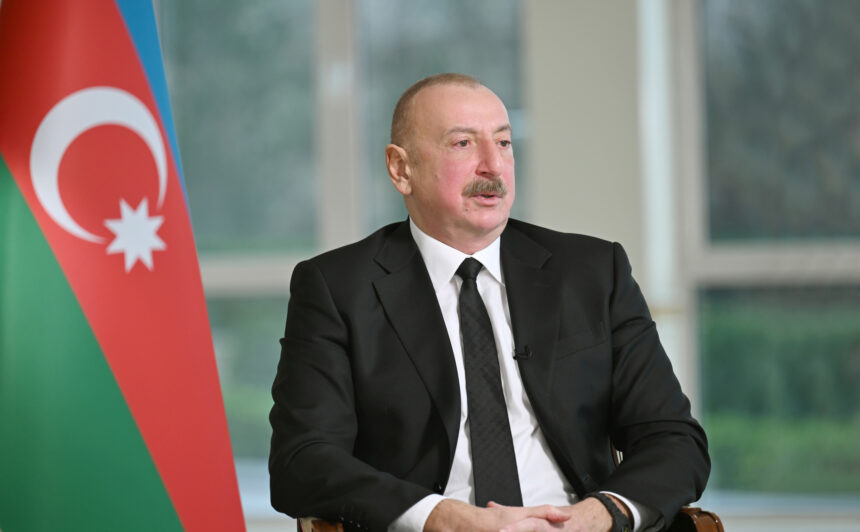
The head of state conveyed a series of key messages, delivered sharp and incisive assessments of France’s provocative policies, and outlined the current state of negotiations between Azerbaijan and Armenia. Each of these points undoubtedly warrants detailed analysis.
Among other topics, the president also addressed the confrontation between Russia and NATO, presenting a significant diplomatic initiative. Aliyev expressed hope that a direct confrontation between NATO and Russia could be avoided. According to him, everyone understands the catastrophic consequences such a conflict would entail for the entire world and all nations. The Azerbaijani president also expressed hope that a change in the U.S. administration might bring about a shift in its foreign policy priorities.
Most notably, President Ilham Aliyev stated: “I believe that Azerbaijan can contribute to the cause of détente— a somewhat forgotten word. I think this term is now relevant in international lexicon, and I hope it will be utilized. Given the peculiarities of Azerbaijan’s foreign policy, and the fact that Azerbaijan is perceived both in the West and the East as an entirely independent player pursuing an autonomous foreign policy, we are uniquely positioned. Furthermore, Azerbaijan is the only country that is an ally of both Russia and Turkey, a NATO member. There is no other country in the world like this. As the head of state pointed out, our country hosted a series of meetings at the level of the Chief of the General Staff of the Russian Army and the Chairman of NATO’s Military Committee. The military leadership of the United States and Russia also met in Baku. This choice was not accidental. There are not many countries trusted simultaneously by the West, Russia, and the East. There are even fewer countries that are not formally or informally aligned with military-political blocs.” He added: “Therefore, we are ready, should there be such a need, to contribute to the easing of tensions.”
Given President Aliyev’s working style, it is reasonable to assume that certain preparatory measures for such an initiative have already been undertaken through confidential channels. Moreover, Azerbaijan’s experience in organizing and conducting delicate negotiations was recalled as recently as September this year, during Aliyev’s speech at the forum in Cernobbio. At that time, he was asked whether Azerbaijan could act as a mediator between Russia and Ukraine. Aliyev responded:
“If we are speaking hypothetically, this is entirely possible. Firstly, because Azerbaijan, along with Russia and Ukraine, was part of the USSR for 70 years. We maintain diverse ties at both personal and political levels. Today, we consider our relations with both Russia and Ukraine to be very good. We firmly support the territorial integrity and sovereignty of Ukraine and all countries. At the same time, we have not been and will not be part of the anti-Russian sanctions campaign. I believe we can play a certain role, given the pragmatism of these relationships.”
The mere fact that such a question was posed to the Azerbaijani president is noteworthy: the country’s negotiating experience is not forgotten—it is simply awaiting its time.
Amid rising tensions between Russia and NATO, President Ilham Aliyev made a genuinely strong diplomatic move. He not only called for negotiations and offered Azerbaijan’s assistance but also reminded the world of the precedent set by détente-era negotiations.
This reference carries significant nuances. The policy of détente, or as it was then called, “the easing of international tensions,” dates back to the 1970s. At that time, Soviet leader Leonid Brezhnev, before becoming a caricature of himself, conducted negotiations with three U.S. presidents—Richard Nixon, Gerald Ford, and Jimmy Carter. During this period of détente, agreements were reached on certain arms control measures, primarily concerning nuclear weapons. Subsequent events are well-documented: in 1979, the USSR invaded Afghanistan, sparking outrage in the U.S.; in November 1980, Jimmy Carter lost the presidential election to Ronald Reagan, who viewed the USSR not as a détente partner but as an “evil empire.” This was followed by the Soviet deployment of intermediate-range missiles in Eastern Europe, to which the U.S. responded with Pershing missiles in Western Europe. Eventually, after 1985, Reagan resumed arms reduction talks with Gorbachev.
The negotiations of the 1970s and those of the late 1980s and early 1990s differ significantly. The talks Brezhnev conducted with Nixon, Ford, and Carter, despite their challenges, represented an equitable dialogue. Moreover, the détente process largely did not interfere with the internal politics of either the USSR or the U.S. Conversely, the negotiations of the Gorbachev and especially Yeltsin eras were shaped by a different philosophy: Moscow, having lost the arms race, was forced to accept humiliating terms in exchange for basic necessities, as cynics of the time joked, “trading bombs for trousers.” Clearly, Moscow is unlikely to agree to a repetition of the Gorbachev-Yeltsin-style negotiations. However, détente, which occurred during the peak of Soviet power, reflects a wholly different negotiation philosophy.
This represents a serious and truly global political initiative. Azerbaijan does not merely serve as a “negotiation venue,” akin to Switzerland. The role of Azerbaijan is far more significant and expansive. The country acts as a negotiator, which requires both its own authority and the trust of partners on both sides. Azerbaijan possesses both. Essentially, Azerbaijani high-level diplomacy is becoming genuinely global. This is not merely rhetoric but a reflection of tangible political achievements.
Nurani
Translated from minval.az