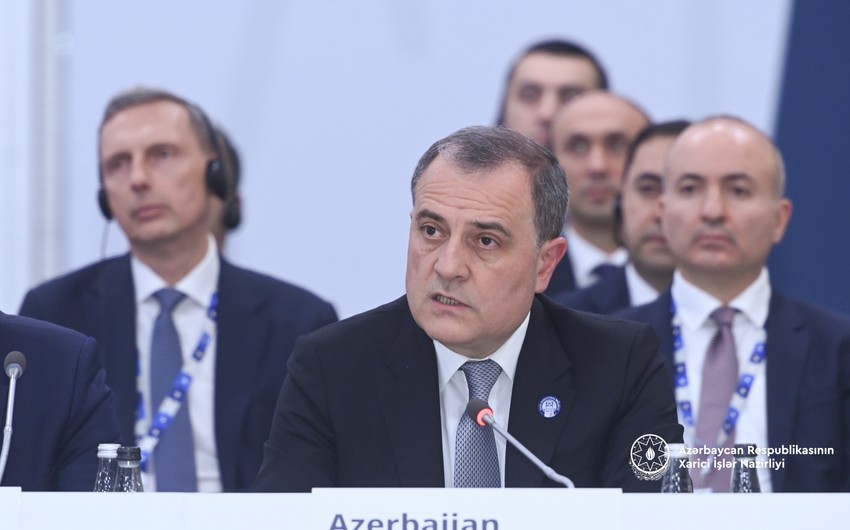
The tectonic geopolitical shift in the Middle East in light of the overthrow of dictator Bashar al-Assad overshadowed the meeting of the Council of Ministers of Foreign Affairs of the Organization for Security and Co-operation in Europe (OSCE), during which Azerbaijan’s Minister of Foreign Affairs, Jeyhun Bayramov, delivered a report outlining the progress of peace negotiations with Armenia, the position of the Republic of Azerbaijan regarding OSCE reforms, and Baku’s primary strategic condition—the need to abolish the OSCE Minsk Group and its associated structures.
A Matter of Constitutional Importance
It should be recalled that since December 2023, when the last meeting of foreign ministers from OSCE member states took place, Azerbaijan and Armenia have managed to complete, through direct negotiations, the delimitation and demarcation of part of their borders. The joint activity framework adopted by the respective border commissions will enable the implementation of the next stages of delimitation work.
Currently, the main obstacle to concluding a peace treaty lies in Armenia’s need to constitutionally renounce territorial claims against Azerbaijan.
For its part, Yerevan is unwilling to recognize this requirement as an issue, claiming that the reference to the Armenian Declaration of Independence, which mentions “Nagorno-Karabakh,” in the preamble of the country’s Constitution pertains exclusively to operational, rather than historical or symbolic, provisions of the Basic Law.
In September, Armenia’s Constitutional Court issued a corresponding conclusion, stating that no article of Armenia’s Constitution directly mentions Nagorno-Karabakh.
Azerbaijan, however, insists that the Armenian Declaration of Independence, adopted by the Supreme Council of the Armenian SSR, did and still does contain references to claims on Karabakh. Yerevan does not deny this fact but continues to argue that an internationally binding document, such as a peace agreement with Azerbaijan, would constitutionally override domestic legislation in the Republic of Armenia.
The divergence in the sides’ interpretations has led to a deadlock. Consequently, the pause in the Armenia-Azerbaijan peace dialogue, which may last for years, is likely beneficial for Armenia, which has embarked on strengthening its military capabilities with the help of France, the U.S., and India.
For India, Armenia is merely one of its arms purchasers, which, by fortunate coincidence, happens to be in conflict with one of Azerbaijan’s allies—Pakistan. For France and the U.S., however, Armenia serves as a foothold to exert pressure on Azerbaijan, Russia, and other countries bordering Armenia. It is no secret that Armenia’s territory enables military-technical monitoring of Iran, control over international cargo flows, and oversight of Georgian politics.
Thus, Armenia, which until recently was a pro-Russian outpost in the South Caucasus, has unexpectedly become a coveted regional target for the Euro-Atlantic alliance. This explains the U.S. Department of State’s efforts to preserve all previous formats for controlling the regional situation, including the OSCE Minsk Group, while creating new bilateral engagement frameworks with Armenia.
While OSCE meetings were taking place in Malta, Armenia’s Defense Minister Suren Papikyan was on an official visit to the United States, where he met with U.S. Defense Secretary Lloyd Austin in Washington.
After the meeting, the head of the Pentagon called it “historic.” While the specifics of the Armenian-American military cooperation discussed between Papikyan and Austin remain unclear, it is easy to assume that they primarily focused on regional security and Azerbaijan’s interests.
The Secretary of State Was Told to “Stay Out”
Washington and Paris find it difficult to accept that sovereignty over Karabakh now belongs to Baku and that all decisions regarding the surrounding region’s security are made by Azerbaijan independently, rather than under the control or guidance of Washington.
Behind the scenes of the OSCE foreign ministers’ meeting in Valletta, a rare demonstration of Azerbaijan’s newfound level of sovereignty occurred—official Baku decisively rejected U.S. Secretary of State Antony Blinken’s proposal to hold a meeting between the foreign ministers of Azerbaijan and Armenia within the OSCE Ministerial Council framework in Malta.
This position is based on several factors, primarily the Biden administration’s perceived bias and ambiguous external actions toward Baku, as well as its overtly hostile activities within Azerbaijan. While officially maintaining a restrained and even positive rhetoric, the U.S. Department of State maintains close contacts with opposition organizations and conducts special events to gather information about Azerbaijani officials and the situation in the country, clearly overstepping the bounds of diplomacy. For these reasons, official Baku deemed U.S. participation in peace talks with Armenia inappropriate.
In this context, it is notable that U.S. Secretary of State Blinken, who is set to leave his post in a month and a half, not only criticized the Georgian authorities for dispersing demonstrators and suspending Georgia’s Euro-integration process but also threatened Tbilisi with stricter sanctions. Georgia has already responded by suggesting that Washington restrain its emotions and refrain from interfering in the internal affairs of a sovereign state.
It is evident that the United States, which is struggling to patch up gaps created by the erosion of the old world order, is not only failing to fulfill its role as a global regulator of international processes but also unwilling to publicly acknowledge this.
The Burdensome Legacy of the 1990s
It should be noted that the previous world order, established after the collapse of the Soviet Union, functioned thanks to several factors—such as cheap labor from Chinese workers, the virtually free sale of natural resources from countries in the Global South, brain drain and capital outflow from post-socialist states, and control over simmering conflicts without implementing solutions. In short, this system relied on the deep and ruthless exploitation of the “global majority.”
The Western alliance naturally seeks to preserve its privileged position, while other global players, including Azerbaijan, are increasingly discontented.
The OSCE Minsk Group represents one such format of remote, neocolonial control over the South Caucasus region. Its current structure, a trio of permanent co-chairs representing Russia, the U.S., and France, was finalized in 1997. While Russia played an independent role within the Minsk Group, it was also part of the broader Western management framework. As compensation, it was granted a limited carte blanche—the right to act as the “bad cop.” Nevertheless, Moscow’s decisions were controlled through interactions with large capitals and influence over the Russian elite. For “domestic use,” the U.S. and France supported the myth of Russia’s independence and sovereignty in decision-making within the post-Soviet space.
While Russia’s geopolitical awakening occurred gradually, by the late 2010s, it reached a critical point of no return. Reflecting on the past 15 years, it becomes clear that Ilham Aliyev and Vladimir Putin moved in the same direction due to their deep understanding of the harmful legacy of the “Western colonization” of the post-Soviet space in the 1990s.
In 2022, during the Fifth Congress of World Azerbaijanis in Shusha, President Ilham Aliyev clearly articulated this understanding, stating:
“The OSCE Minsk Group was created not to resolve the conflict but to perpetuate the occupation of Azerbaijani lands.”
While Vladimir Putin in 2020 still considered reforming the OSCE Minsk Group with the caveat, “I don’t have a ready answer to this question, but we need U.S. and European support,” by 2023, Moscow unequivocally supported Azerbaijan’s proposal to eliminate the Minsk Group’s mandate entirely.
In the summer of 2024, Russian Foreign Minister Sergey Lavrov announced that the OSCE Minsk Group’s work was outdated and “practically ceased to exist due to the initiative of American and French participants.” As a result, the political capital of the Minsk Group not only collapsed but also turned negative.
The world order established in the 1990s, which once served as a binding force at global and regional levels, has rusted, thinned, and lost its strength.
Consequently, the process of dismantling the world order is now driven by new regional powers, as the era of unconditional loyalty to the Euro-Atlantic “missionary brotherhood” gives way to a coalition of rising regional states from the Global South and the “world majority,” advocating new rules based on justice and economic viability.
Within its sphere of responsibility, Azerbaijan is at the forefront of these processes.
Ilgar Huseynov
Translated from haqqin.az