Second, the grand event showed that the West’s hopes to isolate Russia proved futile, with significant support from Xi, Erdoğan, Muslim countries, and the UN Secretary-General’s presence at the summit. Third, some potential BRICS members, while seeing it as an “alternative to the EU,” are cautious about full alignment with the Global South platform due to the stance of the Global North toward it. Fourth, Western media paid far more attention to the summit than anticipated.
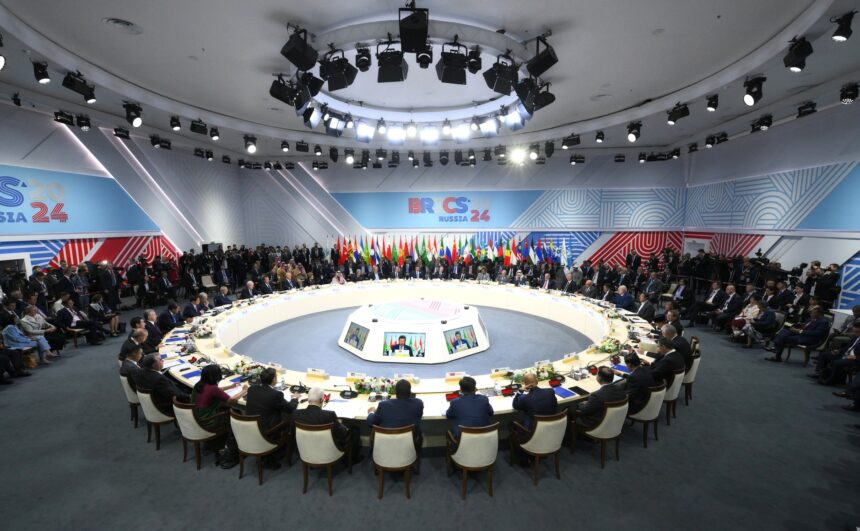
The BRICS summit, the largest foreign policy event in Russia in recent years, took place over three days under Russia’s chairmanship and included representatives from 36 countries (among them heads of state, including Azerbaijan’s president) and six international organizations. Key figures included, alongside Russia’s president, China’s chairman, India’s prime minister, the presidents of South Africa and Turkey, and the UN Secretary-General.
BRICS, an intergovernmental association founded by Russia, China, India, and Brazil in 2006, later included South Africa, Egypt, Ethiopia, Iran, the UAE, and Saudi Arabia. Currently, it might more accurately be called the “Nine.” Nearly 40 countries are interested in some form of BRICS cooperation, including membership.
A Kazan Declaration was adopted at the summit, a comprehensive document of 43 pages and 134 points. But more important than its text were the bilateral meetings on the sidelines, defining the opportunities, challenges, and pace of strategic partnerships among BRICS member states.
A few highlights: BRICS members confirmed their commitment to strengthening multipolarity for the development of all world nations and laid foundations for a more just, democratic, and balanced global order.
There is concern about the adverse impact of illegitimate, unilateral coercive measures, including illegal sanctions, on the world economy, international trade, and sustainable development goals.
Summit participants called for the removal of all unilateral and secondary sanctions that violate international law. BRICS members also expressed concern over ongoing conflicts and instability in the Middle East and North Africa, including the Gaza conflict, highlighting unprecedented violence escalation in Gaza and the West Bank from Israel’s military operation, resulting in civilian casualties, displacement, and widespread infrastructure destruction.
The declaration also addresses the importance of BRICS cooperation to limit risks arising from geopolitical and geo-economic fragmentation, focusing on strengthening correspondent banking networks among BRICS countries and enabling transactions in national currencies.
BRICS members committed to further exploring the creation of a logistics platform for coordinating and improving transportation services, aiming to provide multimodal logistics within the bloc.
The prestige of the Kazan summit was bolstered by UN Secretary-General António Guterres, who faced criticism not only from Kyiv and by Turkey’s President Erdoğan, NATO’s only country attending the summit, and a BRICS membership applicant, alongside Azerbaijan.
According to Turkish publication dikGAZETE, the US and its allies were displeased with BRICS’ assertiveness and independence from Western influence. The bloc is progressing despite Washington’s obstacles, with two Turkic states—Turkey and Azerbaijan—pursuing closer ties with Russia, a move seen as a “checkmate to America.”
The uproar over Guterres’ presence in Kazan, accused by Ukraine’s Foreign Ministry of “undermining the UN’s reputation,” was addressed by Russian Foreign Ministry spokesperson Maria Zakharova. “Why can’t the UN Secretary-General go anywhere, speak on topics, and so on? … How can you dictate to everyone that we shouldn’t gather, meet, and discuss issues? And furthermore, dictate to the United Nations Organization.”
President Putin discussed UN operations, the Middle East crisis, and the situation around Ukraine with Guterres at the summit.
The Kazan summit showed that Russia is not isolated despite claims from the West, as noted by The Telegraph, which said, “For those expecting Russia’s Ukraine operation to make Moscow an international pariah, the summit was, to put it mildly, a huge disappointment.”
In continuation of Turkey’s stance—another “disappointment” for the West—Ankara and Azerbaijan maintain a multi-vector policy that serves their interests, cooperating with both the Global North and Global South, with Turkey and Azerbaijan as increasingly respected players. Azerbaijan’s reputation is also strengthened through its leadership in the Non-Aligned Movement, Turkic Organizations, hydrocarbon resources, logistical capacities, and high sovereignty.
On the summit’s sidelines, President Aliyev met with Dilma Rousseff, the New Development Bank’s president and a BRICS official, who pledged support for Azerbaijan’s upcoming COP29 climate summit in Baku, with “climate financing” as a primary focus.
In energy cooperation, Erdoğan and Putin are working on an international gas hub in Turkey, which interests not only Moscow and Ankara but also gas exporters (including Azerbaijan) and European and other consumers. According to Putin, 20.5 billion cubic meters of gas were exported last year via the Turkish and Blue Streams.
Additionally, Russia and Turkey are interested in nuclear energy, with Russia constructing Turkey’s first Akkuyu nuclear power plant, expected to be operational by 2025. However, it is uncertain if Russia will participate in building another plant in Sinop, where it faces competitors.
Erdoğan’s visit to Kazan did not sit well with the EU, which expects Turkey to follow its lead in isolating Russia, as expressed by EU foreign policy representative Peter Stano. But NATO’s new Secretary-General said Turkey’s BRICS cooperation is lawful and does not contradict its NATO membership.
At the summit’s close, Erdoğan again opposed Western interests by calling for a ban on arms supplies to Israel, condemning Israel’s aggressive behavior and calling it “genocide against the Palestinian people,” which he says no one can ignore in the 21st century without accountability.
The BRICS bloc also has “inconvenient” partners, such as India, cautious about being perceived by Washington as an anti-West coalition dominated by Russia and China. Reportedly, India, along with South Africa, the UAE, and Brazil, opposes BRICS expansion. New Delhi also refrains from actions that would weaken the US dollar, a BRICS goal.
Putin met with Modi recently, but the Kazan summit saw a private discussion, where Putin referred to India-Russia ties as a “particularly privileged strategic partnership.” Modi cut his visit short to meet with German Chancellor Olaf Scholz, who is reportedly open to discussing a settlement with Putin on the Ukraine conflict.
All BRICS nations face Western pressure for “going the wrong way,” but the UAE, Ethiopia, Egypt, South Africa, and others find relief in this “system of coordinates” alongside heavyweight Global South countries like China and Russia, which push for multipolarity.
On the sidelines, Aliyev met with Armenian Prime Minister Nikol Pashinyan. Official reports suggest a peaceful agenda discussion, border delimitation, and other topics. Putin emphasized Azerbaijan’s role in Eurasian logistics corridors, and Aliyev confirmed the operational integrity of major corridors through Azerbaijan.
The Western media’s reactions varied widely, with CNN stating, “Putin is not alone; a coalition of allies stands behind him,” and Bloomberg noting that India’s and South Africa’s leaders declined to attend a Commonwealth event in Samoa, with “Putin’s summit eclipsing the British event.”
Irina Dzhorbenadze
Translated from minval.az