Key challenges include record high public debt, now over €3 trillion, or 112% of its GDP, and a widening budget deficit. These issues are compounded by rising inflation, political turmoil, and public unrest, placing France’s finances under intense EU scrutiny.
The French government’s proposed 2024 budget, which aims to reduce the deficit from 4.9% to 4.4% of GDP, has raised concerns within the EU. Brussels is closely monitoring France’s ability to implement austerity measures while maintaining social stability. However, with high public spending commitments and widespread dissatisfaction over pension reforms, scepticism remains about France’s capacity to meet its fiscal targets.
This economic instability in France threatens to weaken the EU overall. As one of the largest economies in the eurozone, any financial troubles in France could slow down growth across Europe and strain the EU’s unified fiscal policy efforts. Moreover, political uncertainty in France may undermine its leadership role in EU decision-making, particularly as the bloc faces its own challenges, including inflation and the energy crisis.
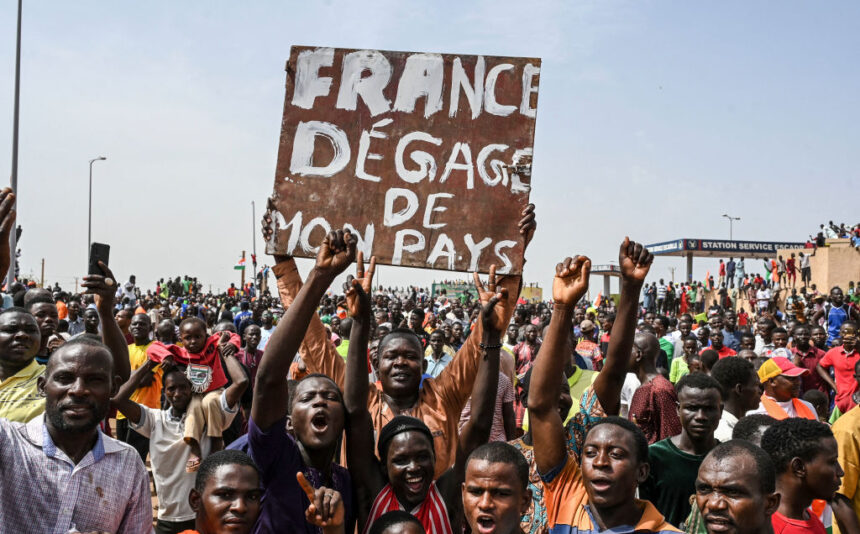
In 2023 and 2024, France’s overseas territories, particularly in the Caribbean and Indian Ocean, experienced significant economic and political crises, leading to widespread unrest and violence. Territories such as Guadeloupe, Martinique, and Réunion suffered from inflation, unemployment, and poor public services, exacerbating long-standing economic inequalities. Rising prices, especially in food and energy, intensified the cost-of-living crisis, pushing local populations to the brink.
These economic challenges sparked protests and strikes across French territories, with workers demanding better wages, improved healthcare, and stronger government intervention. In Guadeloupe and Martinique, tensions escalated into violent clashes between protesters and security forces, reflecting deeper grievances over the legacy of colonialism and persistent inequality. These regions have long felt neglected by the central government, with inadequate infrastructure and insufficient political representation fostering discontent.
For example, this week people of Martinique organised massive demonstrations against soaring prices imposed by France’s colonial control. The food costs there are 40% higher than those in France, while the median wage in Martinique is about €1,987, whereas in mainland France, it averages around €2,316. GDP per capita in Martinique in 2024 stands at around €23,000, whereas in France it is approximately €44,000. This reflects the general economic disparities between the former colony of Martinique and the real France, where purchasing power and employment opportunities tend to be higher. You could in short just call it “exploiting the colonies”.
Are these problems considered the main issue in current French politics? Not exactly. In the spirit of neocolonial traditions, Paris is focused on the war in Lebanon. It seems the best way to distract the masses from their descent into a deep financial crisis is through war and nostalgia for the Great Era of the French Empire and its control over distant foreign lands.
Despite France’s participation in new sanctions against Iran for supplying missiles to Russia and President Macron’s criticism of Tehran, since early October 2024 Macron has adopted a notably anti-Israel stance. This shift aligns him with Iran’s broader geopolitical opposition to Israel, indirectly benefiting Tehran’s position. Macron’s rhetoric and policy approach in the ongoing Israel-Iran conflict, particularly concerning tensions with Jerusalem, indicate that France is tactically supporting Iran in this rivalry. This strategic realignment is reflected in various diplomatic and public statements made by Macron, signalling a growing divergence between France’s official stance on sanctions and its broader Middle Eastern policies.
Macron’s call for an arms embargo on Israel, aimed at halting its operations against HEZBOLLAH in Lebanon and HAMAS in Gaza, surprised many. France does not supply arms to Israel, so President Macron’s call for an arms embargo against Israel is not a shift in France’s policy but more likely an attempt to align with other geopolitical interests, particularly Iran. Macron’s proposal has raised concerns that France is seeking to position itself closer to Tehran, especially after Hezbollah’s leader Hassan Nasrallah was killed.
Nasrallah was a warlord, installed in Lebanon by Iranian puppet masters to continue Iran’s unending proxy war with the Jewish state. For decades, Lebanon was essentially a colony of Iran, and Iran behaves towards Lebanon accordingly: in an interview with France’s Le Figaro dated 15th October Iranian parliament speaker Mohammad Baqer Ghalibaf expressed Iran’s willingness to “negotiate” with France on the implementation of United Nations Resolution 1701. This resolution mandates that southern Lebanon should be free of any troops or weapons except those belonging to the Lebanese state. Notice the absence of actual Lebanese officials in those supposed negotiations? Well, they noticed it too and were appalled. On Friday, October 18th, Lebanese Prime Minister Najib Mikati boldly condemned Iranian parliament speaker Mohammad Baqer Ghalibaf’s remarks as “blatant interference” in Lebanon’s affairs, asserting that such negotiations are solely the responsibility of the Lebanese state. He instructed Foreign Minister Abdallah Bou Habib to summon the Iranian Chargé d’Affaires. Interestingly, Mikati did not summon the French ambassador, despite meeting with him on October 16th.
In another example of indirect support to Iran, the French President has expressed support for UNIFIL (the United Nations Interim Force in Lebanon), which includes French soldiers, despite growing concerns over its effectiveness. Originally tasked with preventing Hezbollah from approaching the Israeli border and maintaining a buffer zone, UNIFIL has faced criticism for not only failing in its mission but also aiding Hezbollah’s operations. Reports indicate that Hezbollah has utilized areas near UNIFIL posts to launch attacks on Israel, undermining the force’s mandate to ensure a weapons-free southern Lebanon. More than that, UNIFIL’s inability to curb Hezbollah’s activities has essentially allowed the Iran-backed group to strengthen its military presence, exacerbating tensions between Israel and Hezbollah.
What can Iran give France in exchange for indirect but effective support of its causes? As much as they want to, the French cannot openly boost trade/economic relations with Iran, though some Israeli experts consider this option as viable. But everything is possible if you go about it indirectly – enter Qatar, Iran’s friend and ally, whose support for the terrorist organizations is second only to the Iranian.
According to the experts of the Counter Extremism Project (CEP) France and Qatar’s relationship deepened in 2024 with a €10 billion investment agreement, marking a strategic partnership. While the partnership boosts the French economy, particularly in luxury, sports, and real estate sectors, it raises concerns about Qatar’s influence on French policies. Qatar’s financial ties to Islamist groups like Hamas complicate the partnership, especially amid the ongoing Gaza conflict. Experts claim that Qatar’s growing leverage can affect France’s foreign policy stance, particularly as protests and public opinion in France grow increasingly pro-Gaza.
“It is very likely that Qatar’s influence in French politics extends further than soft power alone. France’s current Minister of Culture, Rachida Dati, has recently been revealed to have been in contact with Qatar’s labour minister, Ali bin Samikh al Marri, during the period of the Qatargate corruption scandal when she was serving as an MEP. Al Marri has been described as the leader of Qatar’s efforts to bribe members of the European Parliament by Belgian police and his connections with Dati is an eye-opening example of Qatari influence reaching deep into the heart of the French government”, notes the former coordinator of the UN Security Council’s Monitoring Team for ISIS, AQ, and the Taliban, Edmund Fitton-Brown and Mark D. Wallace CEO at CEP.
The neocolonial ambitions of a country that is simultaneously bankrolled by major sponsors of terrorism pose a threat to the EU, Israel, and essentially the entire free world.