The Middle East is on a knife-edge with tit-for-tat attacks between Israel and Iran, and Iran’s proxies Hezbollah and Hamas, increasing the risk of escalation. No one appears to want a wider war, but all sides seem powerless to stop the conflict.
The risk is that the past year of fighting in the Middle East would leave a new generation traumatised and seeking revenge, trapping the long battered region in a never-ending conflict. What is needed more than ever is for all sides to recognise that the ‘enemy’ is actually just a different community, consisting of people who happen to follow a different religion or culture.
The only possible solution to this conflict will be for the countries of Israel, Palestine, Iran, Syria and Lebanon to live side by side. To ignore geography would lock the whole region in a forever war with no end, of countries and communities trying to destroy each other.
That is why religious tolerance is so vital in the Middle East. It would allow people to recognise the other side as people too. Jews, Muslims (both Shias and Sunnis) and Christians have to see a composite Middle East as the only solution to this century-old issue.
To those who claim it is impossible for followers of these three religions to live in peace, there is a prominent example of such co-existence nearby.
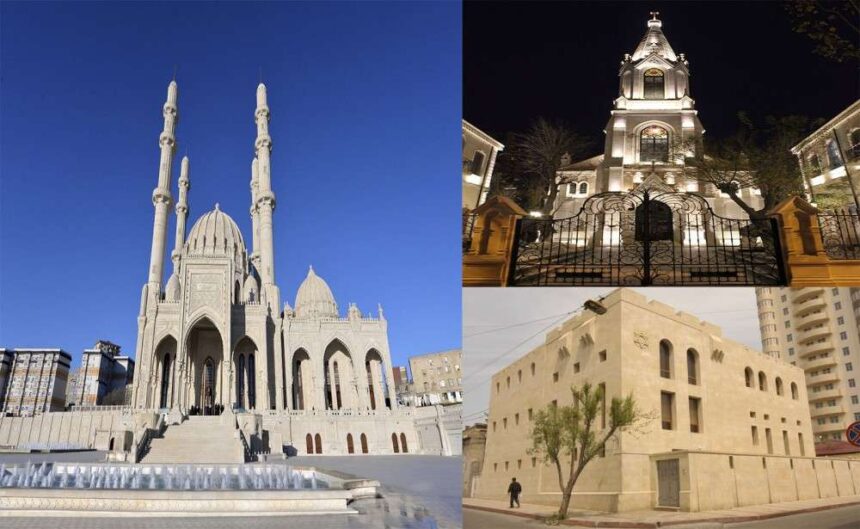
Azerbaijan is a Muslim country in the Caucasus with both Jewish and Christian minorities that have co-existed in harmony. 97% of its population is Muslim, yet the country remains secular.
Situated along the Silk Route at the crossroads between East and West, Azerbaijan has historically welcomed travellers and merchants. That tradition of hospitality and tolerance continues today.
In fact, the 1995 Constitution of Azerbaijan protects religious freedom: “Everyone has the right to freely determine his own approach to religion, to profess individually or together with others any religion or to profess no religion, and to express and disseminate his beliefs concerning his approach to religion.” Muslims, Christians and Jews are represented in all three branches of government and Azerbaijan’s state system of education is also secular.
What is key in Azerbaijan is that the state ensures that all religions are safe and communities are free to follow their own religions without interference or intimidation. Any efforts to spread hatred towards other religions or to restrict interfaith dialogue and harmony are prohibited.
According to a 2022 Report on International Religious Freedom by the U.S. government, 993 registered communities were operating in Azerbaijan by early 2023, of which 956 were Muslim, 26 Christian, eight Jewish, two Baha’i, and one ISKCON (Hare Krishna). The report mentioned that the country has 2,253 mosques, 16 churches (and 26 Christian “prayer houses”), seven synagogues, and 10 religious education institutions.
Pope Francis too praised Azerbaijan as a model for a world divided by violent extremism. Celebrating mass 2016 in Baku’s new catholic church, which was built with the financial help of Muslims and Jews, Francis said: “These good relations assume great significance for peaceful coexistence for peace in the world. They demonstrate that among followers of different religious confessions, cordial relations, respect and cooperation for the common good are possible.” In December of this year, the Holy Sea Foreign Minister is expected to take part in a ceremony of consecration of the place in Baku where the second catholic church will be constructed.
At the 6th World Forum on Intercultural Dialogue held in Baku in May, President Ilham Aliyev described how Azerbaijan’s multicultural and ethnically-diverse society has managed to protect the values of tolerance and mutual respect.
“One of the main reasons for successful development of Azerbaijan as an independent country, I’m absolutely sure, is exactly that. All the people who live in Azerbaijan, representatives of different ethnic groups and religions, live as one family, as great citizens of Azerbaijan, as patriots of our state and statehood. They do everything to strengthen our country and to strengthen the positive trends of cultural dialogue and cultural diversity,” President Aliyev said.
The case of Azerbaijan’s Jews is particularly useful in the present context.
Jews settled in Azerbaijan over two millennia ago and have experienced religious tolerance there as a people. An estimated 12,000 Jews live in the country, many of them in Guba, the only Jewish-majority town outside of Israel and the United States.
“We, the Mountain Jews of Azerbaijan, have been living in this land for about 2,500 years. During this period, the people of Azerbaijan have embraced us and protected us from dangers. If any Jew anywhere in the world feels threatened, they should move to Azerbaijan,” said Melikh Yevdayev, the leader of Azerbaijan’s Jewish community.
This is in stark contrast to Azerbaijan’s neighbour Iran, which is also a Shiite majority country but whose regime has called for the destruction of Israel. Iran’s Islamic leadership has also chosen to export its fundamentalist ideology.
Azerbaijan, on the other hand, has strong ties with Israel and is known for its religious tolerance.
Azerbaijan also has a sizeable Christian population, estimated at 280,000-450,000, constituting 3.1-4.8% of the country’s population. These are mostly Russian Orthodox, Georgian Orthodox or Armenian Apostolic, with smaller Catholic and Protestant communities.
In July, another Christian community was added to this list by the government. The Church of Jesus Christ of Latter-day Saints is now recognised as an official church in Baku.
Since 1997, the Latter-day Saints have participated in humanitarian efforts in Azerbaijan, providing relief aid, wheelchairs, clean water and education projects to various communities. Over 70 humanitarian projects have been supported by Latter-day Saints, sometimes in partnership with other organisations, including the Stirling Foundation.
Since 2015, a more direct, “respectful and cordial” relationship between the church and Azerbaijan officials and religious leaders has developed, with a 2022 pamphlet published by the church encouraging its followers to appreciate commonalities in the commitments of both Latter-day Saints and Muslims.
“Religious tolerance, which I would rather define as mutual respect between representatives of various religious denominations and faiths and their harmonious and peaceful coexistence in our country, is the hallmark of Azerbaijan and a source of pride for all Azerbaijanis, regardless of their ethnic origin or religious background,” said Elchin Amirbayov, Azerbaijan’s Representative to the President for Special Assignments, in a recent interview.
“Our geostrategic position at the intersection of East and West and our ability to absorb and maintain the values of both civilizations allow us to play the role of a living bridge between various cultures and civilizations,” he pointed out.
This “living bridge” illustrates the friendships between Muslims, Jews, Christians and other religious in Azerbaijan. And it is a vital perspective that is needed more than ever in the Middle East. If Azerbaijan’s neighbour Iran and its friend Israel were to both encourage religious tolerance within their own states and in their own foreign policies, these countries would find it easier to end their conflict before it destroys further lives.
At a time of increasing religious tensions, this is sadly easier said than done. But it is certainly a worthwhile message from the Caucasus that the key Middle East players should take to heart.
Dr. Maurizio Geri is a former senior NATO analyst, an Italian Navy Lieutenant reservist and EU Marie Curie postdoctoral fellow on “NATO-EU cooperation on emerging and disruptive technologies in the Energy-Resources-Climate Security nexus”.