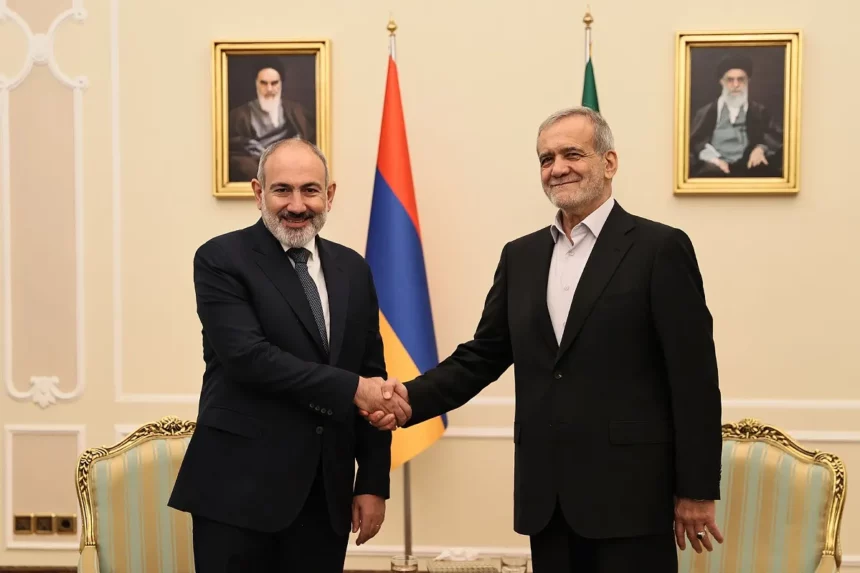
Tehran focuses on one of the clauses of the international agreements signed by Armenia with Russia and Azerbaijan that ended the Second Karabakh War in late 2020, while turning a blind eye to other activities that pose a greater threat to its national security, such as the frequent joint military exercises between Washington and Yerevan, and the activities of the Western monitoring mission in Armenia.
This contradiction reflects a duality in Iran’s stance. While Tehran expresses concern over the Zangezur Corridor—which does not necessarily border Iran—it overlooks genuine security issues that threaten its interests.
Iranian media outlets have discussed the risks Tehran would face if this project were to be implemented and the corridor opened. Particularly, they argue that Iran would lose its strategic advantage of being the connector between Turkey and Central Asian countries and could become dependent on Turkey and Azerbaijan for access to European countries.
In the past, Azerbaijan relied on Iranian airspace and territory to supply the autonomous region of Nakhchivan, located between Iran, Armenia and Turkey, with goods and gas. However, Turkey’s announcement of a new gas pipeline to supply Nakhchivan means that Iran’s geopolitical significance to Azerbaijan is diminishing. Furthermore, the dynamics of bilateral relations are expected to shift in favor of Baku after Azerbaijan reclaimed control over part of its border with Iran. This will ease communication between Azerbaijan and the Iranian Azeris after decades of separation, as this area had been under Armenia’s control, an ally of Tehran, since 1994.
Some of Iran’s concerns about the Zangezur Corridor may be justified, particularly in terms of losing important leverage over both Azerbaijan and Turkey. However, these are not the only concerns in the region, and the issue must be viewed within its broader regional context. Notably, the corridor will be under Russian supervision and control, especially given the longstanding security cooperation between Tehran and Moscow. Russian border guards have been stationed along the Iranian-Armenian border for decades, and this presence has never posed a threat to Iran’s security. Tehran might be using the Zangezur Corridor issue as a pretext to express its dissatisfaction with Russia over issues unrelated to the Caucasus.
The South Caucasus is a battleground for competing international powers such as Russia, Turkey, and the West. Given its geographical proximity and complex history, the region’s national, ethnic, and geopolitical interests intersect with those of Iran, leading to complex calculations in Iran’s policies towards it. Iran seeks to maintain its influence in the face of growing Turkish influence in Azerbaijan and increasing Western support for Armenia. Russia also plays a major role in maintaining the regional balance of power, forcing Iran to coordinate with Moscow on many issues
Tehran is currently facing significant challenges in shaping its foreign policy towards its close neighbor, the South Caucasus. Iran is forced to navigate conflicting interests. On one hand, it aims to enhance its economic and political influence in the region, but international sanctions limit its ability to do so. These sanctions further complicate the regional landscape by undermining Tehran’s ability to compete with other regional powers. On the other hand, Iran struggles to balance maintaining its relations with Armenia while avoiding escalation with Azerbaijan amidst regional tensions, intertwined challenges, and Israel’s increasing influence. Israel is working to strengthen its relations with Azerbaijan, particularly in military and intelligence cooperation, which raises concerns for Iran, as it views this cooperation as a threat to its security.
Additionally, Iran faces a double threat in the strong partnership between Russia and Azerbaijan, with Moscow providing Baku with significant military and economic support, thereby limiting Iran’s room for maneuver. Turkey is also a strong competitor for Iran by supporting Azerbaijan and strengthening its ties with Georgia, expanding its influence in the region. Additionally, tripartite cooperation between Baku, Ankara, and Tbilisi in the energy and other sectors heightens regional tensions and complicates Iran’s efforts to achieve its goals, increasing the risk of armed conflict.
While Iran has enjoyed strong relations with Armenia, it has failed to bring Azerbaijan into its sphere of regional influence, despite their shared religious background. Azerbaijan remains a point of embarrassment for Iran, as more than one Iranian official has boasted about controlling four Arab capitals, yet Iran has been unable to pull Baku into its orbit. The two countries also share deep historical and cultural ties, with Azeris in Iran forming the second-largest ethnic group after Persians. This puts Iran in a difficult position between Armenia and Azerbaijan, as it tries to maintain a balance between supporting Armenians, its traditional ally, and avoiding stirring up Azeri nationalism within Iran.
The regional map of influence has undergone drastic changes, with Iran losing much of its traditional sway in the South Caucasus following Azerbaijan’s victory in the Second Karabakh War. These changes come at a time when Iran’s regional and international standing is far from ideal. In this context, tensions with Moscow reveal a complex diplomatic game that requires Tehran to be highly skilled in maneuvering. While Iran seeks to capitalize on international circumstances to achieve diplomatic gains with the West—potentially including negotiations on the nuclear front—it faces significant challenges in managing its relationship with Russia.
Basel Haj Jasem