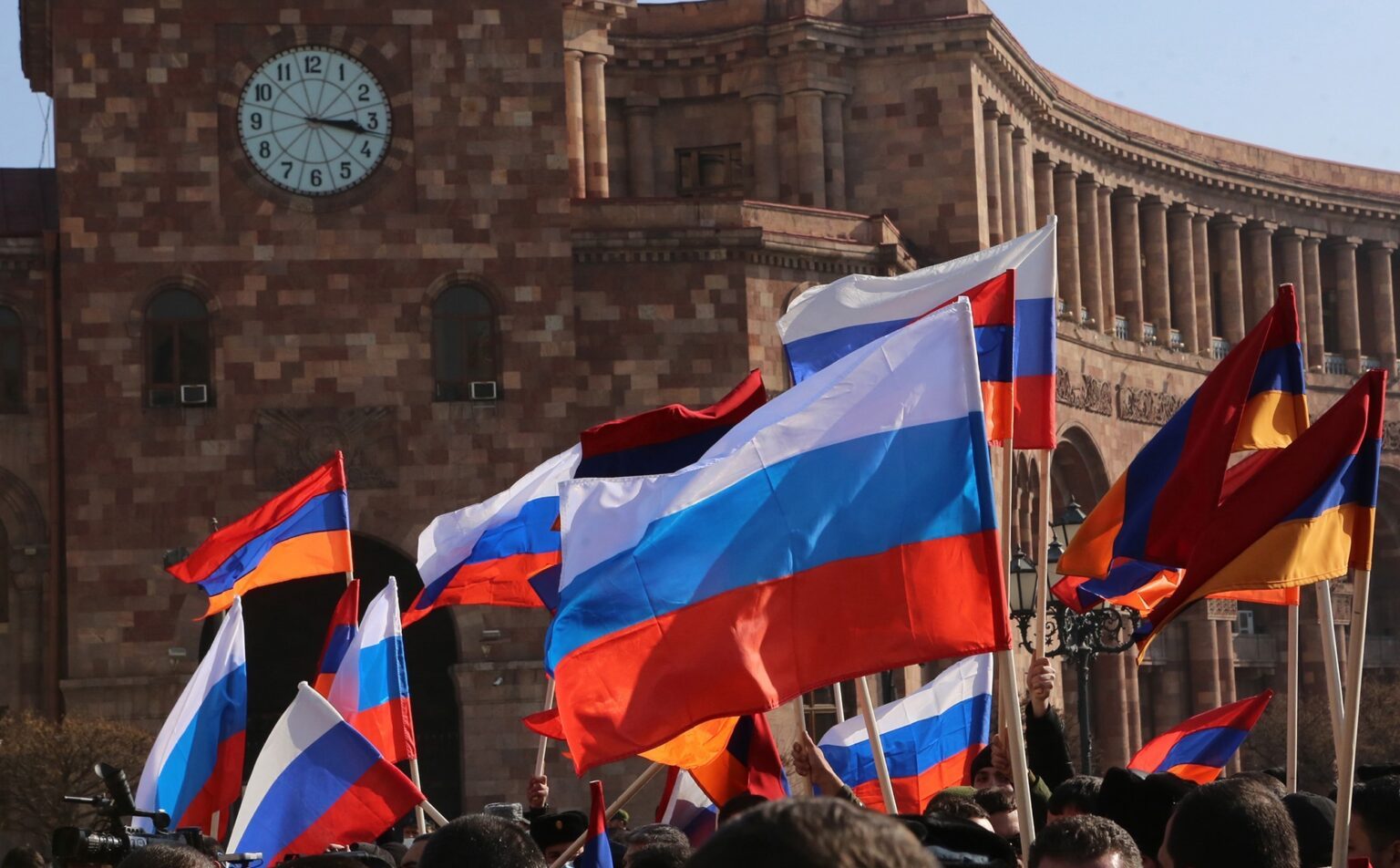
The success of this “endeavor” largely depends on the results of the parliamentary elections in Georgia and whether the government there is replaced with one completely subservient to the US, the EU, and NATO. The current Georgian government is doing everything in its power, under immense external pressure, to avoid a “Maidan” scenario and prevent the country’s “Ukrainization.” At this stage, the West’s greatest bet, and so far with significant success, is on Yerevan.
Idle talk that the West and Russia are too preoccupied with the “Ukrainian front” and the situation in the Middle East to pay attention to the South Caucasus is aimed at the naive. The West’s struggle for the region bordering Russia is methodical, aggressive, and blatant. Moscow, of course, cannot afford to sit idle and ignore the growing security threats from the South Caucasus. However, at least on the visible level, there are no effective countermeasures from Russia at this time.
But politics is treacherous, and the complexities that might be devised and implemented in the region are nearly impossible to predict. Currently, it can be said with some confidence that the West, having failed to use Georgia to open a “second front,” but not conclusively, is actively working in Sakartvelo (Georgia) to achieve this goal.
This effort, however, is not enough, and thus the West’s attention has turned to Armenia, where they had already installed “their man,” and which is eager to “spite Russia” for “abandoning” it in the Karabakh war and “siding with Azerbaijan.” The outcome is well known: the Karabakh region returned to its home after more than 30 years of occupation. This is a strong argument for both Nikol Pashinyan and his team, as well as for the West, which is fueling the base interests and aspirations of a significant portion of Armenian society and the political “establishment” to justify not only turning its back on Moscow but also opening a “second front” against it.
Is there reason to suspect that Armenia, in cooperation with the West, is preparing to open a “second front” against Russia? To begin with, the country’s leader is a “Sorosite,” which says a lot. Secondly, the demonstrative exit—or rather, the non-exit—from the CSTO (Collective Security Treaty Organization) was one of the loudest warning signs. Western observers were sent to the Armenian-Azerbaijani border “at Yerevan’s request,” without coordinating with Baku and against Moscow’s position.
Last year, the United States appointed Christina Quinn as its ambassador to Armenia (the American embassy in Yerevan is the second largest in the world!). She arrived in the Armenian capital from Ukraine—only the country changed, not the position, already well-versed in “Maidan” tactics and harboring hopes of taking revenge, both against Azerbaijan and “traitor Russia.” Remittances from Armenians in Russia to Armenia nearly equaled the republic’s budget revenue. Assistance with military equipment, energy resources, an open market for Armenian products, investments, and more were all part of the package that maintained Armenian well-being.
In response, Russia received joint military exercises between the US and Armenia, which has not officially left the CSTO but no longer participates in its activities. The US military representative has settled in the Ministry of Defense of Russia’s “ally” and “strategic partner”; the Armenian Foreign Minister participates in NATO events; and high-ranking American officials frequently visit Yerevan to “instruct” their “junior partners.”
Regarding the appointment of an American military representative to Armenia’s Ministry of Defense, US Deputy Secretary of State Uzra Zeya stated that this marks the beginning of a new “strategic partnership” between Armenia and the US.
US Assistant Secretary of State for European and Eurasian Affairs James O’Brien confirmed that Washington will assist Yerevan in trade, “defense transformation,” judicial reforms, and democratic development.
In expert circles, including in Turkey, there is an opinion that alongside opening a “second front” against Russia, the US is trying to wedge itself into the “Astana triangle” through its activities in Armenia. This means they are not only working against Russian interests but also against those of Turkey (NATO’s second-largest army), Iran, and the stabilization of Syria.
There’s no need to list the insults from Pashinyan and his “government” towards Russia—they are numerous. Suffice it to say that the time is approaching when the US, through Pashinyan, will demand the withdrawal of the Russian military base from Gyumri. Let us also recall that part of the Russian border guards were “unnecessarily” and even “due to a threat to Armenia’s security” effectively expelled from the republic, despite the fact that the Russian contingent had been serving in Armenia for 32 consecutive years.
Can it be doubted that Armenia and the West are stirring trouble in the South Caucasus to Russia’s detriment? Hardly. The West has conducted a similar but more extensive operation in Georgia over a longer period. But there was a hitch: the country, which had signed an Association Agreement with the European Union, aimed to join it and NATO, filled with NGOs working on Western money not for the benefit, security, and sovereignty of Georgia (not all foreign-funded NGOs fall into this category), suddenly resisted and stopped being unconditionally obedient. It did not open a second front against Russia and introduced laws banning LGBT propaganda and same-sex marriages, as well as a law on transparency of foreign funding. All these laws were immediately branded “Russian” to exacerbate the situation.
An unimaginable scandal erupted—it was “the last straw” that exhausted the West’s “patience,” which openly declared that it was dissatisfied with the Georgian government and would suspend financial assistance to Georgia until it returned to the “right path.”
Protests and rallies have become routine in Georgia. The Americans and Europeans seem to have forgotten about the draconian US Foreign Agents Registration Act (FARA), passed back in 1938, in comparison to which the Georgian law is child’s play. In general, Georgia has become “pro-Russian” in the eyes of the West, and parliamentary elections are coming up in the fall. Therefore, Western pressure on the Georgian government is increasing massively: emissaries and politicians coming here, making speeches from high platforms across the ocean, do not shy away from lies or interfering in the affairs of a sovereign state. They disregard its interests, especially its security, and continue dictating how Tbilisi should behave, resorting to threats and blackmail.
The idea of becoming a “second Ukraine” is categorically rejected by the Georgian authorities. The country has already endured several wars, and turning it into an arena of conflict between Russia and the West would be suicidal. However, attempts to drag it into a war with Moscow, to prove Georgia’s “pro-Western” stance, are fueled by the opposition, which paradoxically, but true, is energetically supported by the “French Georgian” (or Georgian Frenchwoman) President Salome Zourabichvili.
So, the opening of a “second front” against Russia in Georgia depends on the outcome of the parliamentary elections. If the ruling party and its associated forces lose (which is unlikely, but the West and the opposition are preparing the public for claims of election fraud, suggesting protests on the streets, which may escalate), then all bets are off: Georgia will be doomed, and the “second front” will open under the new “legitimate” government.
Prime Minister Irakli Garibashvili has stated, “If we allow the ‘United National Movement’ (Mikheil Saakashvili’s party) to return, the new government will need less than a week to open the ‘second front.'”
“The West will be with us!” promises the president, accusing Bidzina Ivanishvili, the founder of the ruling “Georgian Dream” party, of “using Putin’s methods.” But the West will not “be with us” because if Georgia opens a “second front” against Russia, there will be no one to “be with,” except perhaps a handful of specially favored individuals, and even that is doubtful. The West might derive some satisfaction from the situation, but Georgia would be left devastated. A look at Ukraine and the consequences of Western “artistry” there—where the deaths in the Russian-Ukrainian war show no signs of ending—provides a clear warning.
Some experts place hopes on a possible change in US foreign policy if Donald Trump wins the presidential election. But that won’t happen until November, and Georgia’s elections are earlier. The West’s efforts to turn the South Caucasus into a battlefield against Russia (this won’t work with Azerbaijan) are gaining momentum rapidly. And now a critical moment is approaching: the Americans are working ahead of the curve, relying on Tbilisi and Yerevan—though Armenia alone is not enough for them. Moreover, Armenia does not directly border Russia but is close via Georgian and Azerbaijani territories. Therefore, it wouldn’t be surprising if Yerevan provokes an armed conflict on the border with Azerbaijan this fall.
Armenia’s shift towards the West, its de facto exit from the CSTO, and its collusion with its new patrons in deliberately undermining Russia’s security and integrity will end badly for Armenia. The country will ultimately lose its sovereignty entirely, and even its physical survival may be in question. The “bubble alliance,” as Pashinyan dubbed the CSTO, will not come to its aid. In fact, no one will come.
So, opening a “second front” is not in Armenia’s best interest, nor is it in Georgia’s, if we consider the situation soberly. But realpolitik, in its classic, rather than distorted, sense, is, as we can see, not yet in play.
Irina Dzhorbenadze
Translated from Minval.az