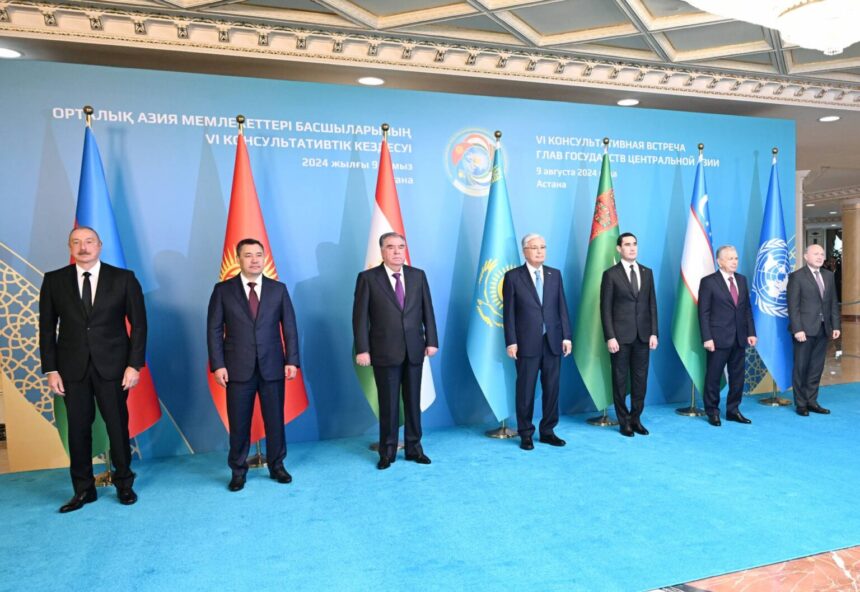
During the summit, the Central Asian “five” leaders signed the “Central Asia 2040” regional cooperation development concept, among other documents.
Additionally, the “Roadmap for Regional Cooperation Development 2025-2027” and the “Action Plan for Industrial Cooperation of Central Asian States 2025-2027” were approved, in which Azerbaijan was designated as a key ally, enhancing the capabilities of Kazakhstan, Uzbekistan, Turkmenistan, Kyrgyzstan, and Tajikistan.
It’s worth noting that there have already been nine summits and high-level meetings within the “Central Asia Plus” format. Over the past two years, the first summits of “Central Asia – Russia” (Astana), “Central Asia – China” (Xi’an), “Central Asia – USA” (New York), “Central Asia – Germany” (Berlin), two meetings of Central Asian heads of state and the European Union (Astana, Cholpon-Ata), the first summit of “Central Asia – Gulf Arab States” (Jeddah), as well as “Central Asia – India” (held online) have been conducted. This year, the first “Central Asia – Japan” summit will be held in Astana.
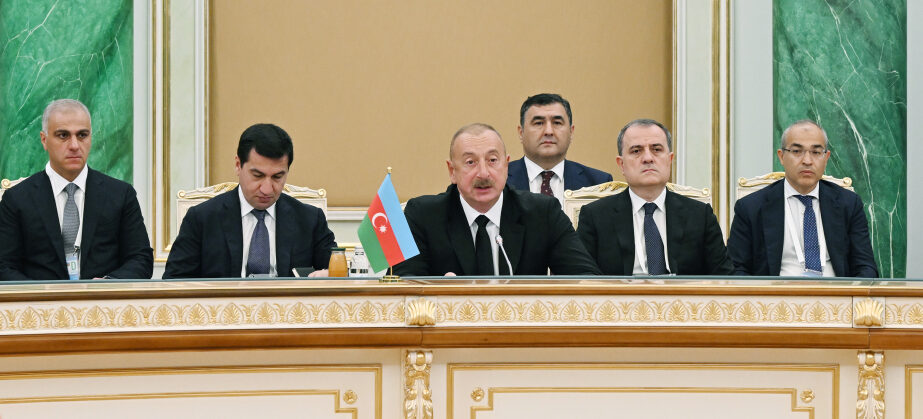
The format that unites Azerbaijan and Central Asia is somewhat a tribute to geography, as Azerbaijan is located on the western shore of the Caspian Sea. However, given Baku’s influence on the Central Asian region, one can speak of a unified socio-economic, geopolitical, and humanitarian space that connects Azerbaijan with the five Central Asian states.
The intensity of this interaction is convincingly evidenced by the sixteen (!) visits of President Ilham Aliyev to the region over the past two years. In turn, the heads of Kazakhstan, Kyrgyzstan, Tajikistan, and Uzbekistan have officially visited Azerbaijan a total of fifteen times.
According to Ilham Aliyev, “Azerbaijan and the Central Asian countries are a single historical-cultural and geopolitical space with increasing strategic importance. Our peoples are united by centuries-old history, culture, religion, and shared values.”
Azerbaijan’s Dimension of Central Asia: “5+1” Format
Azerbaijan’s transportation capabilities and economic resources provide the Central Asian “five” with additional potential, thereby enhancing the region’s qualitative characteristics.
What opportunities does the “5+1” combination with Azerbaijan offer?
Transit Potential
Azerbaijan’s infrastructure is a crucial “gateway” for Central Asia to access markets and goods in the Western Hemisphere. Besides the overloaded Russian ports, there is also a significant shortage of alternative routes. The region’s existing potential needs to be developed in various directions, one of which is the Caspian transit to the Black and Mediterranean Sea ports through Azerbaijan’s railways and highways.
The Baku-Tbilisi-Kars railway is a connecting element of integration and cooperation between Central Asia and Western Eurasia. This year, after modernization, its annual capacity increased from one to five million tons.
Measures have also been completed to increase the capacity of the Alyat trade port from 15 to 25 million tons. Within the “Middle Corridor,” issues related to improving the efficiency of multimodal cargo handling and reducing delivery times from sender to recipient are being addressed. Azerbaijan has joined the mechanisms for managing cargo flows along the “China – Kyrgyzstan – Uzbekistan – Turkmenistan – Caspian Sea – Azerbaijan” route and is also interested in accelerating the construction of the “China – Kyrgyzstan – Uzbekistan” railway and is ready to work jointly in this direction.
Baku Sets the Caspian-Central Asian Economic Connectivity
Let’s analyze the characteristics of economic interdependence factors between Azerbaijan and Central Asian states. By the end of 2023, Azerbaijan’s trade turnover with these countries significantly increased, exceeding $1.605 billion: Azerbaijan-Turkmenistan ($773.9 million, growth driven by Turkmen gas imports); Azerbaijan-Kazakhstan ($529.4 million); Azerbaijan-Uzbekistan ($230 million); Azerbaijan-Kyrgyzstan ($64.9 million, sixfold increase); Azerbaijan-Tajikistan (about $7 million, one and a half times growth).
Three investment funds of various scales were created with Kazakhstan, Uzbekistan, and Kyrgyzstan. Mutual investments amounting to over $1 billion have been preliminarily agreed upon by 2026. Projects in industrial cooperation in the automotive industry, agriculture (creating a cotton cluster with Uzbekistan), and cooperation in aluminum production with Tajikistan (alumina supply) are underway.
Access to Renewable Energy Technologies
On the eve of the summit in Astana, Deputy Minister of Energy of Azerbaijan Orkhan Zeynalov reported that high-level initiatives, including holding the Central Asia and Azerbaijan Energy Investment Forum, are planned within COP29.
Currently, the next steps are being discussed for creating a “green energy” corridor “Azerbaijan – Central Asia – Europe” across the Caspian and Black Seas. Azerbaijan, Kazakhstan, and Uzbekistan have agreed on a project for a strategic partnership in “green energy” and approved technical specifications for the feasibility study of the project. The Italian company CESI was chosen to develop the feasibility study, and an agreement was reached to create a joint venture with the participation of national energy companies.
Recall that in May of this year, a “Memorandum of Cooperation on the Integration of the Energy Systems of Azerbaijan, Kazakhstan, and Uzbekistan” was signed.
Azerbaijan as the Leader of the Turkic World
The Turkic integrative contexts set by Azerbaijan bring Turkey’s interests into alignment with the region’s collective goals, while also, in a certain sense, dictating and shaping Turkish approaches to the region, considering that Baku plays a leading role in the Organization of Turkic States (OTS). As a result, there is a perception in the region of the benefits of cooperating with Azerbaijan. Moreover, demonstrating solidarity with Baku has become an important trend for the entire CIS/EAEU space—from Russia and Belarus to Tajikistan.
In 2023, a secondary school named after Mirza Ulugh Beg was opened in Fuzuli with the support of Uzbekistan, and in 2024, a Children’s Creativity Center named after Kurmangazy will be opened with the assistance and funding of Kazakhstan. This year, in the Aghdam district, the foundation stone for a secondary school to be built with funds from Kyrgyzstan was laid. These are just a few of the most well-known examples.
Coordination on Security Issues
In July of this year, Azerbaijan’s Armed Forces participated in the “Birlik-2024” operational-tactical command-staff exercises held on the Kazakh shore of the Caspian Sea. Additionally, cadets from Central Asian countries continue to be trained in Azerbaijan’s military educational institutions, and there is ongoing interaction between the region’s defense ministries and Azerbaijan’s military department. Speaking at the summit, Uzbek President Shavkat Mirziyoyev proposed developing a new strategic document—The Concept of Regional Security and Stability, which would address all aspects of mutual military support and cooperation in the “5+1” format.
In conclusion, a few words about the vision for the future of Central Asia presented in the programmatic article by Kazakhstan’s President Kassym-Jomart Tokayev, “The Renaissance of Central Asia: Towards Sustainable Development and Prosperity.”
Tokayev outlines a strategy for regional integration along six directions. It is worth noting that the task setting and formulations are more precise and practical than in similar articles by former President Nursultan Nazarbayev written ten to fifteen years ago. Indeed, the situation in the region has changed significantly since then, and the economic dynamics (investments and trade) have increased by tens of percent. This naturally reflects the potential of Central Asian countries. Specifically, Kazakhstan plans to double its economy to $450 billion by 2029.
At the same time, a second leading state has emerged in Central Asia—Uzbekistan under Shavkat Mirziyoyev. President Tokayev does not directly address this, but it is clear that the main “pull factor” in regional construction is the Kazakh-Uzbek economic interaction.
Looking at the figures over the past five years (2018-2023), the volume of mutual trade among Central Asian states has grown from $5.7 to $11 billion (by the end of 2023, the internal turnover of the “five” increased by almost 25 percent). However, half of this flow accounts for trade between Kazakhstan and Uzbekistan, which amounted to $5 billion in 2022. However, in 2023, there was a decline to $4.4 billion, caused by a reduction in the export of passenger cars from Kazakhstan to Uzbekistan. However, in the same year, rail freight traffic between Kazakhstan and Uzbekistan exceeded 31 million tons, an increase of 17.2 percent compared to the previous year.
President Tokayev, of course, understands that the lion’s share of regional integration success is tied to Kazakhstan’s interaction with Russia. The trade of local products, as well as part of the “crisis” transit after February 2022, goes primarily to the Russian Federation, indicating Russia’s desire to create all conditions for strengthening the Central Asian “five.” In comparison, China has no such ambitions or goals for integrating the Central Asian region—Beijing is content with expanding its economic presence in the region.
The sequence of integration formats and organizations mentioned by Tokayev is intriguing. These create a favorable environment for Central Asian countries—strengthening their status as peaceful states, with the “five” actively promoting their ideas and projects in multilateral structures, being founders and members of such successful and influential organizations as the CIS, SCO, CICA, ECO, EAEU, and OTS.
Towards Full Connectivity
A significant part of Central Asia’s socio-economic and trade interaction is formed within the CIS/EAEU space. Therefore, in many regional development issues, Eurasian structures work closely together.
In particular, the Eurasian Economic Commission and the CIS Executive Committee are drafting a joint plan until 2030 for developing transport corridors within the connected integration associations. Within this economic space, points of intersection and the formation of cargo flows along the “North-South” ITC, the “Middle Corridor,” and other regional projects are emerging.
During the Central Asian leaders’ summit, several documents were signed to facilitate the flow of goods produced in the region. Specifically, regarding the unification of regulations, acceleration of customs operations and phytosanitary procedures, and ensuring mutual access to public procurement.
It is gratifying to note that Azerbaijan plays a key role in all these processes and is directly involved through its companies and projects.
Ilgar Huseynov
Translated from haqqin.az