It also reflected poorly on the West, whose “mediating mission” is overtly speculative. The question, however, is how Pashinyan’s “partisan” actions will affect the future of the Armenian-Azerbaijani negotiation process and whether it will delay the signing of a peace treaty between Azerbaijan and Armenia.
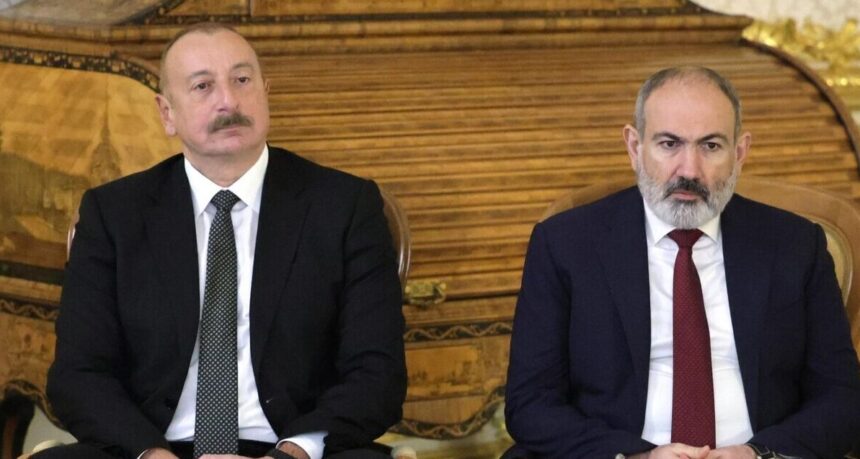
At the fourth summit of the European Political Community in London, attended by 45 leaders of European countries, representatives of NATO, the Council of Europe, the OSCE, and others, a meeting was planned between the President of Azerbaijan Ilham Aliyev and the Prime Minister of Armenia Nikol Pashinyan. Despite the forum’s main topics being the conflict in Ukraine, migration, and energy security, the planned Aliyev-Pashinyan meeting drew significant attention.
However, the meeting, initiated by the UK government, did not take place: Pashinyan refused it. The Armenian Foreign Ministry blamed Aliyev for the failure, with spokesperson Ani Badalyan stating that “the Azerbaijani side rejected it” and that the “proposal” (somehow from Armenia) remained valid. “The Armenian side also confirms its proposal to intensify negotiations at high and highest levels and sign a peace treaty within a month,” said the Armenian Foreign Ministry spokesperson.
If it weren’t for the critical nature of establishing lasting peace between Armenia and Azerbaijan, Pashinyan’s dodging could be laughed off. But the incident demands serious attention as it raises many uncomfortable questions. The peace agreement negotiations between Baku and Yerevan are tough, influenced by non-regional players, and the prospects for signing the document are unclear, despite Yerevan’s claims of being “ready for it.”
The London episode suggests otherwise. Aliyev, at the media forum in Shusha on “Exposing False Narratives: Fighting Disinformation,” reported that work on agreeing on the text continues, but he does not know when the next meeting of the foreign ministers will take place.
“Now,” Aliyev said, “I am less optimistic because, as you probably know, Prime Minister Pashinyan refused to meet with me in the UK. The UK government proposed organizing a meeting between us at an event in Oxfordshire. However, the Armenian side rejected this proposal, which surprised us. Because just four months ago, Chancellor Scholz organized a similar meeting in Munich, where he participated for five or six minutes and then left. The same proposal came from the British government, with the British Prime Minister planning to attend and then leave. But Prime Minister Pashinyan refused.”
Therefore, Aliyev continued, the question arises: “If he does not want to talk to me, what kind of peace agreement can we talk about? If he did not want to talk to the British Prime Minister, why then did he visit London, Oxfordshire? Many questions are very contradictory.”
Contradictions abound, and some are obvious. US State Department spokesperson Matthew Miller stated that achieving a peace agreement requires Armenia and Azerbaijan to make “tough choices and hard compromises.” French President Macron also stirred the pot, telling journalists at the summit that France is supplying weapons to Armenia in response to a request, as Yerevan wants to arm itself in anticipation of aggression.
There is no aggression from Azerbaijan: Baku is patient, but time is not on Yerevan’s side, which, despite verbally recognizing Karabakh as part of Azerbaijan, seems ready for revanchism, fueled from outside. Therefore, delaying the signing of the peace treaty is a strategy. This is likely one of the reasons Pashinyan did not meet with Aliyev, as he had nothing to say.
To sign a peace treaty, as Aliyev reiterated in Shusha, two important conditions must be met. First, Armenia must agree with Azerbaijan to jointly request the OSCE to dissolve the Minsk Group, which has long worked to freeze rather than resolve the conflict peacefully and is currently inactive.
There is no option for its activation for Baku, as France, one of the co-chairs, has acted against Azerbaijan’s interests.
Second, Armenia’s constitution must be amended, as some provisions threaten Azerbaijan’s territorial integrity. The constitution mentions unification with “Nagorno-Karabakh.” Aliyev explained that the requirement to amend the constitution is not an interference in Armenia’s internal affairs. “We do not want to find ourselves in a situation where one day they change their mind (recognizing Karabakh as part of Azerbaijan), and we have to do what we did in September again.” Therefore, “as long as this clause exists, a peace agreement is impossible.”
Pashinyan likely did not want to discuss constitutional changes with Aliyev, possibly advised against agreeing to Baku’s demands by Armenia’s “international partners.” It can also be assumed that geopolitical power centers have not reached a consensus (and likely will not) on opening communications in the South Caucasus, a long-standing issue far from resolution.
Armenia’s weak position in the negotiation process and the need to “make concessions to the victor,” which would provoke significant protest in Armenian society and threaten Pashinyan’s political longevity, currently define its behavior.
On the other hand, Pashinyan has a false belief that “the West will help us,” but no clear idea of how. Because so far, the West has only led the negotiation process into a deadlock with its “support for Armenia.” The West demands much from Armenia while giving almost nothing in return, simultaneously irritating Baku with its unproductive interference. There is no mediator capable of stabilizing the South Caucasus situation with a “cool head” without intrusive actions and plans to seize a piece or the entire “South Caucasian pie.”
The situation is escalating towards a crisis, and Pashinyan, fearing an open conversation with Aliyev, has worsened his country’s position. However, this does not mean the meeting of the two leaders is indefinitely postponed; it is delayed, and the signing of the treaty with preliminary conditions is prolonged. But Armenia has no choice: it must choose between new military escalation and peace on Baku’s terms.
Only time will tell when the “inevitable” for Armenia will come, as too many influential forces are interested in preventing the peace treaty from being signed. It is no surprise that Pashinyan voluntarily handed Armenia over to external management by different power poles, which are fighting for influence in the South Caucasus through its destabilization.
It cannot be ruled out that Pashinyan refused to meet with Aliyev due to “doubts” about the UK as a negotiation platform. It is unlikely that Scholz pressured the UK; it was probably either Macron or the US. The issue is not primitive “jealousy” of Westerners, but rather, frankly, villainy. Because talking is better than not talking, even if a tête-à-tête meeting (regardless of location, as the success lies in independent political will and a sober assessment of the situation, not in “pressing” geography) does not give an immediate effect. And Pashinyan walked away from it.
Running away from Aliyev indefinitely is impossible. Eventually, circumstances will force Pashinyan to request a meeting with the Azerbaijani president. It is possible that Russia is waiting for this moment, as Pashinyan will not dare to approach Baku directly and will attempt to do so through Moscow. This will happen when Pashinyan realizes that Armenia has no security support. This would be logical. Though it would be simpler to go directly to Baku, he fears many reasons: he is too entangled in Western “vectors,” lies to his people, and the “international community.”
Moscow is likely watching Pashinyan’s struggles with some amusement. Pashinyan is neither a friend nor a partner to Russia, despite Russia calling Armenia its partner, which does not stop it from expressing concern and criticizing Yerevan’s destructive behavior. Watching the betrayer struggle and then bow to the betrayed may have a certain sweetness and repulsion.
In short, Pashinyan made a big mistake by not meeting with Aliyev and surrounding himself with Western hangers-on who care about Armenia’s welfare as much as a fish needs an umbrella. Its misfortune is highly desirable because there is no chance to control the South Caucasus through Azerbaijan, and doing so through Georgia has become difficult.
Understanding that without good neighborly relations with Azerbaijan, Armenia has no future will come, but delaying this understanding works against it. It should hurry, but will it, or will it wait for a highly negative outcome, after which – who knows? – it might have to agree to entirely different terms from Baku. And perhaps not just from Baku.
Irina Dzhorbenadze
Translated from minval.az