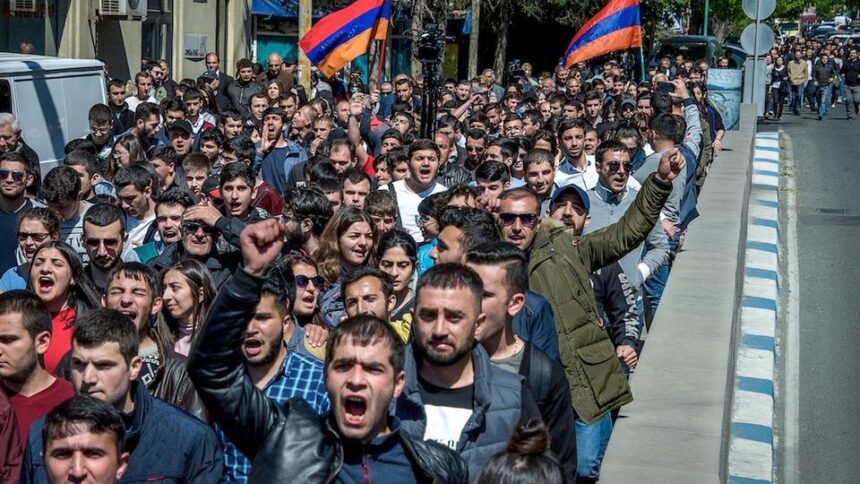
The survey data is of great interest to Azerbaijani politicians and political scientists in that it mirrors the sentiments in Armenian society, which need to be taken into account when developing and implementing further political strategies towards the neighboring state.
The announced figures, in principle, confirmed our expectations. Of those surveyed, only about 10.2% believed that “the Karabakh page should be turned to avoid further problems.” The rest of the respondents—almost 90%, just imagine!—are not ready to part with the virus of Miatsum and still dream of an Armenian or similar flag flying over the administrative buildings in Hankendi after their deserved demolition. Specifically, 21.5% thought that “it is necessary to try to restore Armenian control over Karabakh” (i.e., right now, immediately); 29.5% are convinced that “Armenia should wait for a favorable moment to raise the Karabakh issue again in the future”; and 33.3% of respondents noted that the country should create conditions for “the dignified return of Armenians to Karabakh.” The nuances vary, but the goal is the same—to have an Armenian population in Karabakh again, even without specifying in what capacity and as citizens of which state this population would see themselves in this territory. As long as they are Armenian, that is enough to stroll down the roads of Karabakh again, even without recognizing this territory as part of Azerbaijan.
Additionally, survey participants were asked about their attitude towards their government’s efforts in delimiting the state border with Azerbaijan and the possibility of amending Armenia’s constitution. More than half, 56.9% of those surveyed, had a negative attitude towards the government’s efforts on border delimitation, and 80.3% found it unacceptable to amend the country’s basic law. Only 37.9% of respondents supported delimitation, while the rest found it difficult to answer.
They say sociological surveys are the mirror of society. Evidently, revanchist sentiments persist among the population of Armenia. And public moods are known to be easily shaped through covert (via “the twenty-fifth frame”) and overt (through media) influence. Naturally, the persisting and even strengthening revanchist dreams in Armenian society are nothing but the result of policies by both the government and the non-governmental sector. Interestingly, revanchism unites both the government and the opposition, though the latter feels more liberated and behaves more brazenly, not considering itself bound by certain international obligations. Nonetheless, it should be reminded that in the world, it is generally not of great concern which government signed this or that agreement or assumed an obligation. It is always the head of state who signs, regardless of party affiliation. International treaties, as well as other agreements, are valid and mandatory regardless of who subsequently comes to power. The Armenian opposition, which periodically claims that if it comes to power it will not consider itself burdened by the documents signed by its predecessors, should not forget this. And it will indeed be obliged! However, let it come to power first, and then we will talk about what it can and cannot do.
Moreover, the results of the survey in Armenia once again confirmed Baku’s thesis that without serious guarantees, peace with Armenia is impossible or, at least, unstable. Under the current conditions, there are no guarantees that after peace is concluded, Armenia (and indeed the West too) will not attempt to raise the Karabakh issue again. They will have in their hands the unchanged (and therefore still valid) resolutions, declarations, and other decisions reflected in the country’s constitution. Azerbaijan must see these guarantees, and for this, Armenia is simply obliged—yes, obliged—to remove from its legislative acts, including the constitution, everything that somehow connects it with Karabakh. After all, if Yerevan keeps asserting that the constitution is an internal matter, then in Azerbaijan it is rightly reminded that Karabakh is not an internal matter of Armenia, but an internal matter of Azerbaijan! How can we ignore the fact that a reference in the Armenian constitution leads to our Karabakh and the “Miatsum” of December 1, 1989? Refusal to remove such elements from Armenia’s laws, including the country’s basic law, testifies to the insincerity of the current government’s assurances about “recognizing Karabakh as part of Azerbaijan.”
What if tomorrow the open revanchists among the Serge-Kocharyan supporters come to power instead of the current covert revanchists? What then? The peace treaty seems to be signed, but loopholes in the Armenian legislation, it turns out, remain?
No, this will not do. Baku’s position is unchanged—one of the conditions for signing the peace treaty is the complete cleansing of the constitution from all these cunning loopholes.
We are witnessing the West fueling Yerevan’s revanchist aspirations. In Armenia, they should think and act soberly, taking into account the painful lessons of the past. Armenian politicians should not rely on anyone. Peace in the region is possible only if and after all doubts in Azerbaijan about the sincerity of Armenian assurances are eliminated. Otherwise, if our country once again feels a real threat, it will be impossible not only to talk about peace but also to avoid the Azerbaijani people’s reaction, including preventive measures.
And believe me, Azerbaijan has long been ready to present Armenia with the bill. Since 1828.
Zukhrab Dadashev
Translated from minval.az