Executive Summary:
- The United States has expressed that it is willing to support the peace process between Azerbaijan and Armenia, highlighted in US Deputy Secretary of State James O’Brien’s recent visit to the two countries.
- Washington views the peace process between Baku and Yerevan as a wider geopolitical issue as prolonging the process could prompt other powers to use the conflict to act in their own interest.
- US diplomats propose an initiative of economic connectivity via transit routes passing through Azerbaijan and Armenia to the surrounding region as a proposed motivator for a quick peace between Baku and Yeravan.
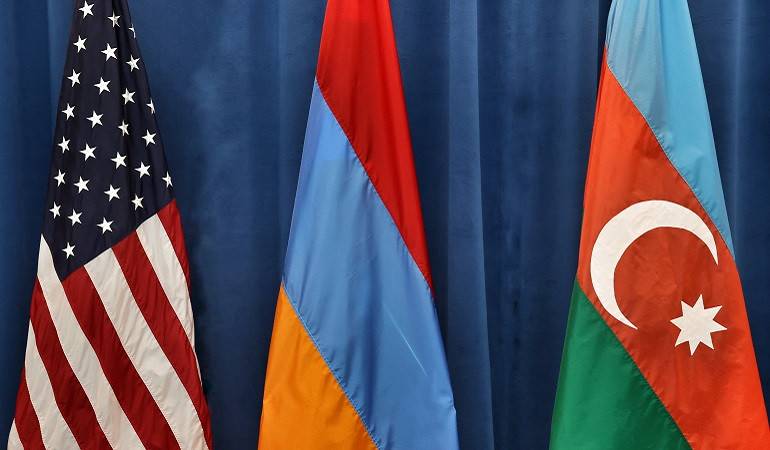
On June 20, during a phone call with Azerbaijani President Ilham Aliyev, US Secretary of State Antony Blinken called upon the Armenian and Azerbaijani governments to conclude a peace agreement “without delay” (US State Department, June 20). He stressed Washington’s willingness to support the peace process “in any way useful to the parties.” During his recent trip to the South Caucasus in late June, US Deputy Secretary of State James O’Brien reiterated these messages to the respective governments of Azerbaijan and Armenia. The United States views peace between the two countries in a larger geopolitical perspective, characterizing it as vital to reducing wider regional dependency on Washington’s foes.
Before visiting Azerbaijan, O’Brien presented this position before the US House of Representatives Foreign Affairs Committee. He stated that the countries of Central Asia “now export to the world either through China or Russia. To find an alternative, they have to go through Azerbaijan.” The US official added that the road through Azerbaijan and Armenia (also known as the Zangezur Corridor) can provide an alternative, and a “potentially much larger” one, to the existing route through Georgia. He emphasized the need for a peace treaty between Armenia and Azerbaijan to operationalize the new road. “We are clear with President Aliyev that it is time for peace, and it is not only the issue of Azerbaijan but the entire region and Central Asia,” O’Brien concluded (Radar.am, June 27).
On July 2, Blinken underscored the importance of the Armenian-Azerbaijani peace treaty for connectivity across the South Caucasus during a conversation on US foreign policy at the Brookings Institution. He pointed out that a peace agreement can create “a tremendous opportunity for economic connectivity, for economic growth, for connecting countries both east, west, north, and south. Azerbaijan has a critical role to play in that” (Azertag; US State Department, July 2). Earlier, in November 2023, O’Brien had said that the transit corridor through Armenia should be built with the “involvement and consent” of Yerevan while pointing out that the “transit corridor created some other way, by force or involvement of Iran will … be met with a strong reaction” (YouTube.com, November 15; see EDM, November 27, 2023).
These statements indicate that the United States does not support Azerbaijan and Iran’s Aras Corridor project. They also demonstrate that Washington opposes the involvement of the Russian Federal Security Service’s (FSB) Border Guard Service in the Zangezur Corridor as a potential party to exercise “control over transit” as envisioned by the trilateral statement between Russia, Armenia, and Azerbaijan of November 10, 2020 (President.az, November 10, 2020; see EDM, January 10, April 15). In May, Armenian Prime Minister Nikol Pashinyan reiterated his opposition to the involvement of Russia. He declared that while the November 2020 statement stipulates that “the monitoring of transport communication” is provided by Russia, it “does not in any way mean that Russia should be on the ground. … One of the ways to exercise this monitoring is that, for example, Armenia may regularly report that communication is secured; that is, the agreement is fulfilled” (News.am, May 7).
The potential implications of a peace treaty and the confrontational way in which negotiations have proceeded further complicate the peace process. US officials acknowledge that it is not only a matter of Armenian-Azerbaijani relations but the situation is also viewed externally as an issue that can critically impact larger rivalries between the United States and its geopolitical foes, most directly Russia, China, and Iran.
Against this backdrop, Washington seeks to draw Armenia and Azerbaijan closer to the West. On June 28, during his visit to Baku, O’Brien stated that the United States had invited both countries to the North Atlantic Treaty Organization (NATO) summit in Washington from July 9 to 11 (Azertag.az, June 28). He added that “we expect them both to attend it at the foreign ministerial level,” expressing his hope that the two ministers can use this opportunity to meet on the sidelines of the summit (Azertag.az, June 28). As of July 8, both Armenia and Azerbaijan had sent representatives to Washington for the summit (Eurasianet, July 8; News.az, July 9).
In parallel, peace negotiations between Armenia and Azerbaijan are proceeding well in some areas while facing obstacles in other, potentially more critical, areas. In the wake of the historic progress toward the delimitation and demarcation of their interstate border in April, Baku and Yerevan reported that the talks have constructively continued in this direction (Azatutyun.am, July 1). This progress, however, has not proceeded according to plan. The Armenian and Azerbaijani government commissions on border delimitation were supposed to agree on the regulations of their joint work and produce a common document by July 1, but they have only been able to exchange drafts of the regulations, in part due to discontent over the land dispute in Armenia (Azertag, April 19).
The existence of territorial claims in the Armenian Constitution against Azerbaijan and the failure of the two sides to agree on a timeframe for revisions to exclude these claims have been significant obstacles to the signing of a peace agreement. While it was reported in May that Pashinyan directed the Council on Constitutional Reforms to draft a new constitution by the end of 2026, it is unclear whether work has already commenced on the revisions (See EDM, June 25). On July 1, Aliyev reiterated that Azerbaijan is not planning to sign a peace treaty with Armenia until Yerevan makes the proper constitutional changes (Azertag, July 1). Some recent reports have claimed that Armenia is not planning to change the constitution at least until the end of 2026. If true, a comprehensive peace treaty is unlikely to be signed between the two countries any time soon.
Washington’s persistent calls for an immediate peace treaty between Armenia and Azerbaijan highlight the significant geopolitical stakes involved. The United States sees this peace not merely as a regional matter but as a strategic pivot point that could shift the balance of power and connectivity in the South Caucasus and Central Asia, especially regarding transit and energy connectivity. Framing the Armenian-Azerbaijani peace process as such a critical issue inevitably complicates the treaty process, prompting other powers, including Russia and Iran, to act to protect their interests. Despite progress in some areas, such as border delimitation, significant obstacles remain, particularly the issue of Armenia’s constitution. While the United States continues to offer support and avenues for dialogue, the road to a comprehensive peace agreement remains fraught with challenges.