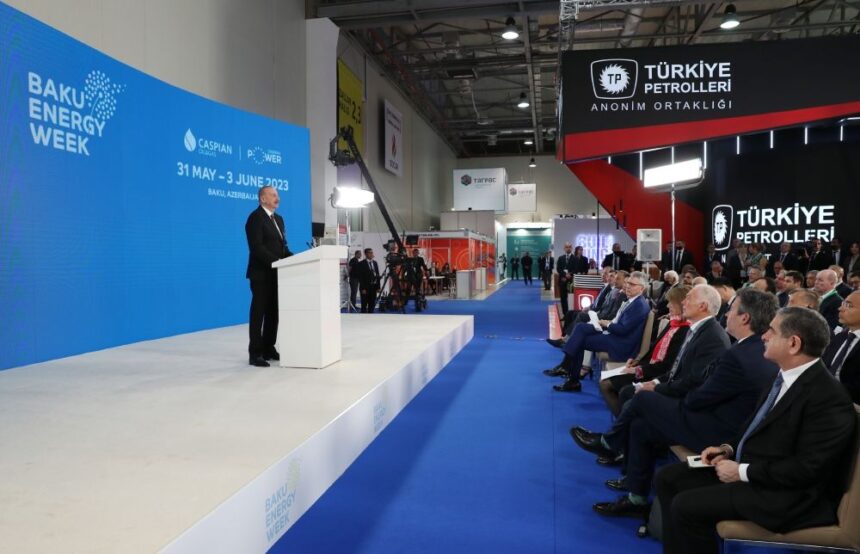
President Ilham Aliyev particularly noted in his speech: “Six out of eight countries receiving Azerbaijani gas are European countries. And the geography of our supplies will undoubtedly expand. We are currently in active negotiations with several other countries to ensure their energy security, as they require Azerbaijani gas. As we have repeatedly said, national security cannot be separated from energy security. Import-dependent countries are, of course, looking for the most reliable and long-term partners and contracts. They find exactly that in Azerbaijan. Our word is as valuable as our signature.”
Many foreign guests also spoke about energy security. Christina Lobillo Borrero, Director of the European Commission for Energy Policy Strategy and Coordination, has already announced an increase in gas supplies from Azerbaijan amid the European Union’s plans to abandon Russian gas.
Undoubtedly, many experts took note of the welcoming message from US President Joe Biden. The current occupant of the White House noted that “Azerbaijan remains an important pillar of global energy security, especially for Europe,” emphasizing that “as Azerbaijan prepares for the next chapter of its energy history,” he is “encouraged by the increased attention and commitment to clean energy and methane emissions reduction,” adding that “the significant potential of Caspian wind energy could lead to Azerbaijan’s export of clean energy surpassing that of oil and gas in the future.” He also mentioned that regional stability and interconnectedness are priorities for the US, and a peace agreement between Baku and Yerevan would transform the South Caucasus and fundamentally change Azerbaijan’s role in the region.
Strictly speaking, this is not the first welcoming message from a US president in the history of Baku Energy Week. However, Biden’s address stands out for its depth of understanding and multifaceted nature. Additionally, it is very warm and friendly.
There is no doubt: Biden’s message continues the trend that the expert community, including Minval.az, has been talking about since the visit of Hikmet Hajiyev, assistant to the President of Azerbaijan, to the US: Washington is moving closer to Baku, ready to “thaw the ice” and “gather the stones” after they have been scattered. This trend continued in Biden’s congratulatory message on the occasion of Azerbaijan’s main state holiday, Independence Day. Of course, such congratulations are a protocol step, but diplomacy is the art of nuances. The text of Biden’s message left no doubt: the US is aiming to expand cooperation with Azerbaijan. The trip of US Ambassador Mark Libby to Shusha was also part of this chain.
It is clear that it is not the role of presidents to talk about commercial specifics and possible American investments, for example, in Caspian wind energy. But it is obvious that Biden’s letter is an indicator of political decisions made in Washington, without a doubt. Many capitals will perceive this message as a “green light.” Some experts view, for example, the welcoming message from Georgian President Salome Zourabichvili in this context.
How American business will respond to Biden’s message remains to be seen. But there is no doubt about one thing. This message appeared amidst another series of public outbursts by Armenian lobbyists – in the European Parliament, the US Congress, and other structures. Among other things, they demanded sanctions against Azerbaijan, including in the energy sector. Just over a month ago, on April 27, US Congresswoman Dina Titus promised to prepare and introduce a bill on sanctions against Azerbaijan. The European Parliament even called for suspending the energy partnership memorandum signed in Baku by European Commission President Ursula von der Leyen. In Armenia, they even found “experts” who claimed that sanctions against Azerbaijan were quite realistic!
But now, Biden’s warm and friendly message, emphasizing the importance of Azerbaijani hydrocarbon supplies to Europe and the potential for wind energy development in the Caspian, once again shatters the hopes of the Armenian lobby. There will be no sanctions against Azerbaijan, no matter how much they rant about mythical “ethnic cleansing of Armenians in Artsakh.”
And all this is very reminiscent of events 30 years ago. Amendment 907 was still in full force. Armenian lobbyists were loudly proclaiming that they would not allow Azerbaijani oil to be paid for with Armenian blood. Armenian terrorist groups openly threatened oil companies that dared to invest in Azerbaijan.
But on September 20, 1994, the “Contract of the Century” was signed in Baku. And the continuity of US policy, especially when it comes to oil, is serious. So the proponents of “sanctions against Azerbaijan” are once again left out in the cold. Or rather, they have not realized that they have been out in the cold for 30 years.
Nurani
Translated from minval.az