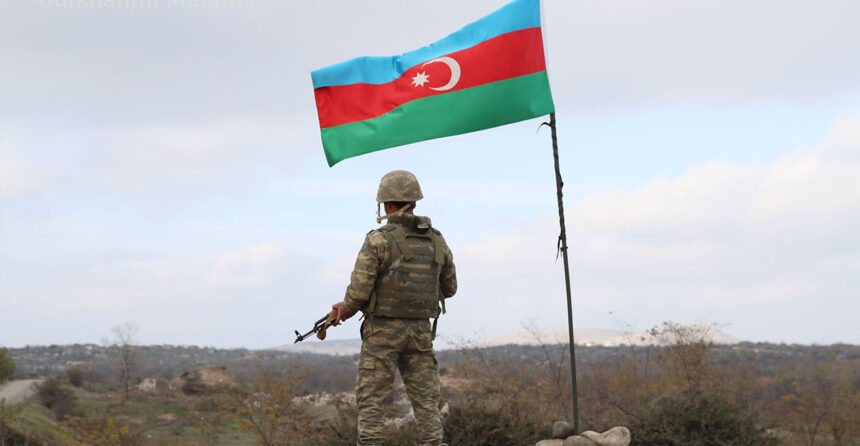
Some people even compare the current situation in the conflict-torn region to the current status-quo in Ukraine’s separatist region of Donbass or Georgian South Ossetia in the period between 1999 and 2008 when the Russian peacekeeping mission had been on the ground. However, although the presence of armed Russian militaries on the territory of Azerbaijan poses some new risks indeed, there are several significant factors that make the new situation in Nagorno-Karabakh qualitatively different from the former two cases.
First of all, despite all the apparent similarities and parallels, the Nagorno-Karabakh conflict differs in one very important sense from the other so-called “post-Soviet conflict”: unlike them, it has been waged between two, so to speak, “minor republics” of the Soviet Union, while in Abkhazia, South Ossetia, Transnistria or Donbass “parent republics” had to deal with a varying degree of Russian involvement. The same thing cannot be said about Nagorno-Karabakh: though Moscow had been clearly closer to Yerevan than to Baku, its role in the Armenian victory in the First War is often exaggerated. The recent war also demonstrated that Russia’s strategy has rather been to try to “go with the flow” of the conflict dynamics in order to retain its influence over the parties rather than to set its own agenda. The conflict between Azerbaijan and Armenia, while re-ignited and exacerbated by the awkward and contradictory Soviet policies, has its roots in the events of the early 20th century and has been more bitter and intense than its post-Soviet half-brothers. Thus, it would be a big overstatement to suggest that Moscow holds all the levers of the conflict. Even though the Russian role in the conflict has now increased, its dynamics ultimately depends on the Azerbaijani-Armenian standoff. A reconciliation process between Azerbaijan and Armenia is the primary precondition to its resolution. Moreover, while Yerevan had decided that an increasingly intransigent stance against a stronger and richer rival was the best option to secure their puppet regime in Nagorno-Karabakh, the presence of Russian peacekeepers can bring unexpected outcomes: relieved from the self-imposed duty of a security guarantor, Armenia can become much more receptive to reconciliation with its long-term rival.
Secondly, unlike Donbass, Abkhazia and South Ossetia, Nagorno Karabakh does not share a border with Russia, which significantly increases the cost of maintaining a large peacekeeper force and, even more importantly, decreases her capacity to use it as a tool of pressure on Azerbaijan. Since Georgia has been keeping its territory closed for Russian military transit close since 2008, the only viable land connection with Karabakh will pass through the territory of Azerbaijan, which of course puts the garrison under threat of blockade if Moscow takes openly provocative steps against Baku. The latest military conflicts in the post-Soviet space have shown that speed is the key and each day matters a lot: in 2008, Moscow’s ability to quickly deploy forces in South Ossetia enabled it to resolve the issue without too much cost and avoid too serious international pressure, and it was a similar story with the annexation of Crimea in 2014. Moreover, Baku also differs from Tbilisi in Kyiv in one significant way: in Turkey, it has a trusted and tested military ally which gave real support in the latest war and, quite importantly, is not currently viewed in Moscow as an unequivocal rival, in contrast to the West which was supposed to stand behind Georgia and Ukraine. During the fighting, Ankara made it clear several times that it was not going to leave the conflict resolution at Russia’s exclusive disposal, and by doing several concessions in Syria and Libya has demonstrated that keeping its stake in the Nagorno-Karabakh resolution process is a matter of principle. The outcomes of the war mean that Ankara has turned into a full-fledged player on the ground in the South Caucasus, and, even if her hopes to establish military presence in Karabakh itself do not fully materialize, she will from now on be present in Azerbaijan in whatever form on a permanent basis.
Moreover, there are reasons to suggest that this time Russia, contrary to common suggestions and fears, may be willing to initiate a peace process rather than “freeze” the new status quo. In his latest interview, President Putin, argued for the need to resolve the conflict once and for all and, to the surprise of many, lent unequivocal support to Prime Minister Pashinyan, explaining it with the need to preserve stability in Armenia and guarantee the comprehensive implementation of the 10 November statement. The messages sent by the Armenian leader about the opening of the roads and framing the Karabakh agenda as “defining the status” rather than seeking outright independence, also attest to his understanding of the need to achieve a deal. Given that Pashinyan’s security now hinges on Russian guarantees, it is highly likely that his statements right now are at least coordinated with Moscow. There have been also indirect signals, for example the idea of establishing an “Azerbaijan-Armenian business council” put forward by Grant Ogasyan, a billionaire from St. Petersburg who has invested in a number of politically important projects, most notably being the first real estate dealer to enter the Crimean market after the Russian annexation. His offer must have been made with the tacit support of the Kremlin.
But why should Moscow change its policy which has been visibly quite successful in terms of securing her leverage over the both countries? In his Anatomy of the conflict published earlier this year, British researcher Laurence Broers explains the mechanism which had been ensuring the status-quo as “pivotal deterrence”, whereby each party did not believe it could resort to a war without adverse consequences for herself. However, with its success Azerbaijan has just broken this mechanism, so trying to re-introduce it can hardly be efficient. Moscow knows very well that her previous policy, while tying both Baku and Yerevan to Moscow, also created a strong distrust towards Moscow among the both societies, each viewing her as “my enemy’s friend”, and thus undermined her structural leverage over the region. The popularity of pro-Western figures like Pashinyan was partly connected to this phenomenon. Thus, by launching a peace process Russia can acquire stronger legitimacy, prevent Turkish influence over Baku from growing stronger (which will inevitably happen if the no-peace-no-war limbo situation over Nagorno-Karabakh holds) and decrease the likelihood of Armenian attempts to build strong military partnerships with some outside powers in the hope to take revenge.
Finally, direct comparisons of the current situation in Nagorno-Karabakh to South Ossetia, where the UN-mandated Russian peacekeeper mission had been deployed until the 2008 war, do not take into account that the world order has profoundly changed since then. The unipolar system which presumed stability and clearly defined rules of the game, has gone for good. The independence of Kosovo and the annexation with Crimea, together with the rise of populism in the Western countries, crisis of Atlantism and the increasingly assertive regional powers, such as Turkey, bring us to a new world where alliances are situational and flexible, local conflicts become more common and multilateralism and international law are being pushed to the back seat as the driving forces of politics. Hence, it is wrong to conclude from the statement that the current status in the region will be set in stone and lay the foundation for Russia’s permanent military presence in Nagorno Karabakh. Rather, Azerbaijan along with some new challenges has received plenty of opportunities and it is now up to Baku to choose an optimal post-war policy to maximize its security and achieve lasting peace.
Murad Muradov graduated with a Bachelor of Arts degree in International Relations from the Academy of Public Administration of the Republic of Azerbaijan (2011), a Master of Arts in Diplomacy and International Affairs from the Azerbaijan Diplomatic Academy (2013) and a Master of Science in Comparative Politics from the London School of Economics (2015).