Azerbaijan plays a key role in supplying Türkiye with natural gas, while Türkiye serves as Azerbaijan’s gateway for energy exports to European markets. In the field of military cooperation, the two countries have progressed to the building of an alliance and mutual defense treaty, making Azerbaijan the first post-Soviet states to enjoy a defense treaty with a NATO member.
To keen observers of the South Caucasus, it is no secret that Turkish and Azerbaijani leaders, as well as much of their population, define their relations as being “one nation, two states.” It would probably not be an overstatement to say that the cooperation level that exists between the two states is a rare occurrence in the world.
Statements of the heads of the two states help us better understand the essence and depth of these relations. Azerbaijan’s President Ilham Aliyev has stated that: “Türkiye is not only our friend and partner but also a brotherly country for us. Without any hesitation whatsoever, we support Türkiye and will support it under any circumstances”.[1] As for Türkiye’s President Recep Tayyip Erdogan, he noted that “we continue our efforts to strengthen our relations and cooperation in all areas within the framework of the motto ‘one nation, two states.'”[2]
What do these words mean in practice? Since 1992, Türkiye and Azerbaijan have consistently developed deep and multifaceted ties in a variety of areas, but at a closer look, it is possible to identify two main priority areas: military cooperation and energy, along with a common stance on many international and regional issues. Türkiye’s support for Azerbaijan, unlike other alliances in various corners of the world, was rarely of a declarative nature and often manifested itself in practical measures. For example, after Armenia occupied the Kelbajar region of Azerbaijan in early 1993, as a sign of solidarity and support for Azerbaijan Türkiye closed its border with Armenia.[3] Since then, the border between the two countries has remained closed.
This is not to say that there have never been any disagreements between the two countries. Negotiations on energy matters have frequently proven feisty. But nothing compares to the so-called “Zurich Protocols,”[4] which were signed between Türkiye and Armenia in 2009. The protocols provided for the normalization of relations between Türkiye and Armenia, including the opening of the border and establishment of diplomatic relations. However, Azerbaijani leaders considered that these protocols did not take into consideration the interests of Azerbaijan. The negotiations and subsequent signature of the protocols caused discontent in Baku, and brought Turkish-Azerbaijani relations to a historic low. As a result, Ankara linked the implementation of the protocols with the liberation of the territories of Azerbaijan that were under Armenian occupation at that time.[5] Since that time, Ankara generally coordinates with Baku its stance on and contacts with Armenia. Paradoxically, this crisis ultimately served to strengthen political ties and intensify dialogue at the highest level.[6]
Military Cooperation: The Building of an Alliance
In the field of military cooperation, Ankara and Baku signed an agreement on cooperation on military education back in August 1992, at the height of the First Karabakh War.[7] Thus, Azerbaijan became one of the first post-Soviet states to establish cooperation on military education with a NATO member state. On June 10, 1996, the parties signed another agreement on “military education, as well as technical and scientific cooperation in the military field.” Presently, thousands of officers who graduated from Turkish military academies serve in the Azerbaijani army. According to the former chief of the general staff of the Turkish army, Hulusi Akar, in 2015, the number of Azerbaijani military personnel who received military training in Türkiye was over 7,000.[8] Intensive long-term military cooperation between Türkiye and Azerbaijan has allowed Azerbaijan to bring its army close to NATO standards.
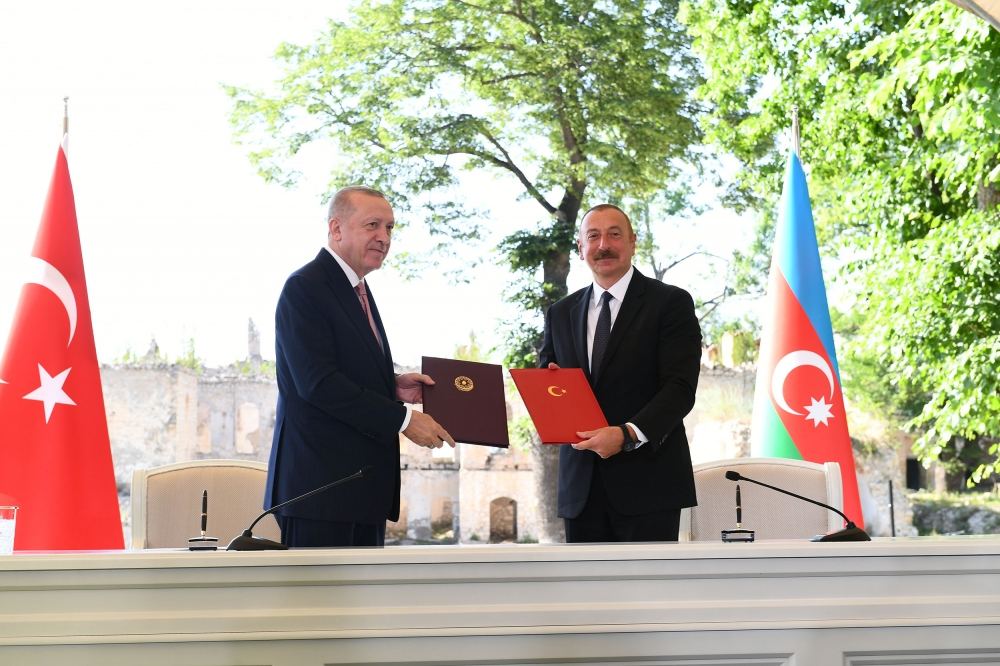
In 2010, the two countries signed a Joint Declaration on the establishment of the Council on high-level strategic cooperation between Azerbaijan and Türkiye.[9] At that time, this step was considered a transition to a new level of allied relations between Azerbaijan and Türkiye. The second paragraph of the agreement on “Strategic Partnership and Mutual Assistance” stipulates the provision of military assistance if one of the signatories is subject to an external attack.[10] Eleven years later, these same provisions were reaffirmed in the Shusha Declaration, which took the relationship one step further. The signing of this document on June 15, 2021, was a landmark event in relations between Baku and Ankara.[11]According to some experts, the declaration “cemented” the Azerbaijani-Turkish Alliance.[12] The declaration covers a wide range of issues, including regional security-related issues. The Shusha Declaration is the first document signed between Türkiye and Azerbaijan that uses the word “alliance,”[13] and it amounts to a mutual defense treaty between the two countries.[14] Thus, Azerbaijan became the first post-Soviet state to effectively be provided with the security umbrella of a NATO member.
The military agreements between the two countries on one hand facilitate deeper military-technical cooperation; on the other hand, they enhance Türkiye’s role and influence in the South Caucasus, and provide Türkiye with a basis for extending this influence further to Central Asia.
Corporations that are now essential actors in the Turkish defense industry began to show interest in Azerbaijan in the 1990s. Back in 1998, one of the most significant actors in the Turkish military industry, ASELSAN, opened its office in Baku.[15] Today, Azerbaijan is not just a buyer[16] of Turkish military industry products worth hundreds of millions of dollars but also a partner of major Turkish defense industry developers and manufacturers.[17] It is no coincidence that after the Turkish government created the positions of “defense industry cooperation attachés” at the Turkish embassies, the first such attaché, Ilker Türköz, was appointed to Azerbaijan.[18] Every year, Azerbaijan and Türkiye conduct joint military exercises both in Türkiye and in Azerbaijan. During these exercises, the two militaries practice scenarios and mechanisms for joint operations.
The Azerbaijani military also frequently participates in international military exercises held in Türkiye. One of the largest joint exercises took place in Azerbaijan shortly before the second Karabakh war in July-August 2020, with the participation of Turkish F-16s and ground forces of both countries.[19] During the 44-day war, several Turkish F-16s remained in Azerbaijan as what President Aliyev termed a deterrent in the event “aggression committed from outside” against Azerbaijan.[20] This statement likely referred to deterrence against a possible Russian or Iranian intervention to assist Armenia in the war.
Türkiye, through its various high-ranking representatives, also expressed its support for Azerbaijan during the hostilities in the Tovuz area in July 2020, preceding the 44-day war. For example, Ismail Demir, the head of the Turkish Defense Industries Presidency, following a meeting with the Azerbaijani military, stated that: “With all its technology, capacity and experience, Türkiye’s defense industry is at Azerbaijan’s disposal, from armed unmanned aerial vehicles to missiles and electronic battle systems.”[21]
After the Second Karabakh War, military and military-technical cooperation between Türkiye and Azerbaijan continued to expand. It is noteworthy that President Erdogan and Turkish commandos participated in the Baku victory parade on December 10, 2020.[22] In 2022, Baykar Makina, the manufacturer of world-famous Turkish Bayraktar drones, opened its branch in Azerbaijan.[23] Furthermore, Azerbaijani specialists are actively involved in developing and producing Turkish weapons.
In September 2023, Türkiye expressed its full support for what Baku termed an “anti-terror operation” carried out against Armenian separatists and the Armenian Armed Forces’ units in the area of temporary deployment of the Russian peacekeeping contingent.[24]
Economic Relations
Along with the military and the military-technical component of Azerbaijani-Turkish cooperation, the economic component currently focusing on energy is also a strategically important aspect of the relationship. Türkiye is Azerbaijan’s leading trading partner, with trade between the two countries exceeding $5 billion in 2021.[25]
According to 2021 data, Azerbaijani investments in Türkiye exceeded $20 billion.[26] Concerning Azerbaijani investments in Türkiye, it is worth emphasizing that a significant share is made into the energy sector of Türkiye. For example, Azerbaijani investments in the STAR refinery made Azerbaijan the greatest single investor in modern Turkish history, with an initial value of $6.3 billion.[27] Thanks to these investments, the Azerbaijani company SOCAR has become one of the major actors in the Turkish energy market. Through SOCAR, Azerbaijan also supplies natural gas to Türkiye, thereby reducing Türkiye’s dependence on Russian and Iranian gas. In March 2020, Azerbaijan became the largest natural gas exporter to Türkiye, surpassing Russia and Iran for the first time in history.[28] Azerbaijan in February 2023 announced plans to increase gas exports to Türkiye by 19 percent and bring their volume to 10 billion cubic meters during 2023.[29]
In addition to being a buyer of Azerbaijan’s natural resources, Türkiye is also an important transit country for Azerbaijani oil and gas to reach world markets. The main export oil pipeline, Baku-Tbilisi-Ceyhan, and the gas pipeline, Baku-Tbilisi-Erzurum, pass through Türkiye. Azerbaijan also has access to the Turkish transport infrastructure through the Baku-Tbilisi-Kars railway. Gas from Azerbaijan is delivered to consumers in Europe through the TAP and TANAP gas pipelines, in the development of which Türkiye played an important role. Against the backdrop of the Russian invasion of Ukraine, Azerbaijani gas, and Türkiye as a transit country, have acquired a particular role in ensuring the EU’s energy security.
For quite some time now, Azerbaijan has been taking steps to realize its potential as a producer and exporter of green energy generated from renewable sources. Azerbaijan intends to export this energy to Europe through Georgia via a cable to be laid under the Black Sea.[30]
In June 2023, the Azerbaijani Ministry of Energy signed a memorandum of understanding with Nobel Energy Management on the construction of a 400MW solar power plant in Nakhchivan and the subsequent export of electricity to Turkey.[31] In 2023, a memorandum on the transit of electricity generated from renewable sources was signed between the ministries of energy of the two countries.[32] Also, Türkiye and Azerbaijan, along with Georgia, are considered the gateway to Central Asia. Delivering energy from Central Asia to the West via Azerbaijan, Georgia, and Türkiye could play a crucial role in ensuring the EU’s energy security and, in parallel, reducing Russia’s influence in Central Asia. The model of cooperation between Türkiye and Azerbaijan is also an important example for the Turkic states of Central Asia. Türkiye is trying to play a more active role in this region both within the framework of the Organization of Turkic States and on a bilateral basis.[33]
Against the backdrop of active military and economic cooperation, the solidarity of Türkiye and Azerbaijan on foreign policy issues is increasingly noticeable. One of the notable examples, which was actually difficult to foresee even a year ago, is the visit to Azerbaijan of the president of the self-proclaimed Turkish Republic of Northern Cyprus, Ersin Tatar. Mr. Tatar had a busy schedule in Baku, but the culmination of this schedule Tatar’s meeting with the President of Azerbaijan, Ilham Aliyev.[34] This can be considered a significant milestone in the solidarity between Baku and Ankara; it is worth recalling that, at the moment, the TRNC is recognized only by Türkiye.
Although the main fields of cooperation between Türkiye and Azerbaijan are defense and energy, the two states also actively support each other in humanitarian issues, for example, during natural disasters. When severe forest fires in the summer of 2021 engulfed forest areas in various regions of Türkiye, Azerbaijan was among the first to respond and sent its firefighters and equipment to help extinguish fires. Despite modest capabilities and forest fire threats in Azerbaijan itself, Azerbaijani firefighters and rescuers became the largest group among those who arrived in Türkiye to help put out the fires.[35]
In February 2023, after a powerful earthquake hit eastern Türkiye and caused massive casualties and destruction, Azerbaijani rescuers became one of the first foreign rescuers to arrive in Türkiye, but Azerbaijan did not limit itself to sending rescuers and humanitarian aid. Azerbaijan decided to actively join the reconstruction efforts as well. At the initiative of the Azerbaijani government, a residential complex with 1,000 apartments is being built in the Turkish city of Kahramanmaraş, which will include a school, a mosque, and other necessary infrastructure elements.[36] The presidents of both countries connected via video call to the groundbreaking ceremony for the complex from Baku, where they attended Teknofest.
While Azerbaijani construction companies work in the earthquake zone in Turkey, large Turkish companies are actively involved in restoration works in the liberated territories of Azerbaijan in Karabakh. Turkish companies are involved in the construction and restoration of road infrastructure,[37] and in order to facilitate and speed up reconstruction works, Azerbaijani authorities use the Turkish tender system,[38] which also contributed to the increase in the number of Turkish construction companies operating in Karabakh.
Conclusions
September 2023 turned out to be particularly momentous in Türkiye-Azerbaijan relations. During the meeting of the two Presidents in Nakhchivan, the foundation of the Iğdir-Nakhchivan gas pipeline was laid, and a protocol of intent for the construction of the Kars-Nakhchivan railway was signed.[39] These steps were essentially intended to reduce the dependence of Nakhchivan and, ultimately, of Azerbaijan in general on Iranian gas supplies and transit facilities. Since the restoration of its independence, Azerbaijan has not had direct and continuous land communication with Nakhchivan; land communication was carried out through the territory of Iran. Also, Nakhchivan’s autonomy was fully dependent on gas supplies from Iran. This was certainly used by Iran as leverage in relations with Azerbaijan. Supplying Nakhchivan with Azerbaijani gas via Türkiye and connecting Nakhchivan to the Turkish railway network and the Baku-Tbilisi-Kars railway will, on the one hand, lead to a decrease in the importance of Iran, and on the other hand, to an increase in the cooperation and interdependence between Türkiye and Azerbaijan.
Considering the turbulent situation in the world, it is reasonable to expect the two countries getting even closer in the military and economic spheres, and actively pursuing coordinated policies in the regional geopolitical arena.
[1] “Azerbaijan Supports Turkey ‘without Any Hesitation,’” September 3, 2020, https://www.dailysabah.com/politics/diplomacy/azerbaijan-supports-turkey-without-any-hesitation.
[2] Diyar Guldogan, “Azerbaijan’s Recent Victory in Karabakh ‘Matter of Pride’: Turkish President Erdogan,” September 25, 2023, https://www.aa.com.tr/en/world/azerbaijans-recent-victory-in-karabakh-matter-of-pride-turkish-president-erdogan/3000640.
[3] “Relations between Türkiye and Armenia,” n.d., https://www.mfa.gov.tr/relations-between-turkiye-and-armenia.en.mfa.
[4] “Zurich Protocols,” n.d., https://www.mfa.gov.tr/site_media/html/zurih-protokolleri-en.pdf.
[5] Vladimir Socor, “US Conflict Resolution Policy Backfires in Yerevan,” April 27, 2010, https://jamestown.org/program/us-conflict-resolution-policy-backfires-in-yerevan/.
[6] “Turkey to Coordinate Armenia Rapprochement with Azerbaijan,” September 27, 2021, https://www.dailysabah.com/politics/diplomacy/turkey-to-coordinate-armenia-rapprochement-with-azerbaijan.
[7] “Azərbaycan və Türkiyə Arasında Hərbi Əməkdaşlıq Inkişaf Etdirilməlidir,” March 11, 2011, http://anl.az/down/meqale/525/2011/mart/162438.htm.
[8] Rufiz Hafizoglu, “Chief of General Staff Hails Level of Co-Op between Azerbaijani, Turkish Armed Forces,” October 6, 2015, https://en.trend.az/azerbaijan/politics/2440789.html.
[9] “Relations between Türkiye and Azerbaijan,” n.d., https://www.mfa.gov.tr/relations-between-turkiye-and-azerbaijan.en.mfa.
[10] “‘Azərbaycan Respublikası və Türkiyə Respublikası Arasında Strateji Tərəfdaşlıq və Qarşılıqlı Yardım Haqqında’ Müqavilənin Təsdiq Edilməsi Barədə Azərbaycan Respublikasinin Qanunu,” December 21, 2010, https://e-qanun.az/framework/21158.
[11] “Shusha Declaration on Allied Relations between the Republic of Azerbaijan and the Republic of Turkey,” June 21, 2021, https://coe.mfa.gov.az/en/news/3509/%20shusha-declaration-on-allied-relations-between-the-republic-of-azerbaijan-and-the-republic-of-Türkiye.
[12] Fuad Shahbazov, “Shusha Declaration Cements Azerbaijani-Turkish Alliance,” June 23, 2021, https://jamestown.org/program/shusha-declaration-cements-azerbaijani-turkish-alliance/.
[13] Ruslan Rehimov, “Landmark Shusha Declaration between Türkiye, Azerbaijan Turns Year-Old,” June 15, 2022, https://www.aa.com.tr/en/world/landmark-shusha-declaration-between-turkiye-azerbaijan-turns-year-old/2614301.
[14] “Azərbaycan Respublikası Ilə Türkiyə Respublikası Arasında Müttəfiqlik Münasibətləri Haqqında Şuşa Bəyannaməsi,” June 16, 2021, https://president.az/az/articles/view/52122.
[15] “Azərbaycan və Türkiyə Arasında Hərbi Əməkdaşlıq Inkişaf Etdirilməlidir.”
[16] “Türkiye’nin Azerbaycan’a Silah Ihracatı Yüzde 600 Arttı,” December 3, 2020, https://www.yenisafak.com/ekonomi/turkiyenin-azerbaycana-silah-ihracati-yuzde-600-artti-3587900.
[17] Tapdıq Fərhadoğlu, “Azərbaycan və Türkiyə Birgə Pilotsuz Uçuş Aparatları Istehsal Edəcək,” April 28, 2023, https://www.amerikaninsesi.org/a/7069283.html.
[18] “Türkiyə Xarici Ölkələrdə Ilk Dəfə Azərbaycana Müdafiə Sənayesi Müşaviri Təyin Edib,” September 6, 2023, https://report.az/xarici-siyaset/turkiye-xarici-olkelerde-ilk-defe-azerbaycana-mudafie-senayesi-musaviri-teyin-edib/.
[19] “Azərbaycan-Türkiyə Təlimləri Mediada: Ermənistana ‘Göz Dağı,’” July 29, 2020, https://www.bbc.com/azeri/region-53574476.
[20] “If There Is Aggression Against Azerbaijan, Aggressor Will Collide with F-16,” October 26, 2020, https://www.turan.az/ext/news/2020/10/free/politics_news/en/129152.htm.
[21] Gokhan Ergocun, “Turkey, Azerbaijan Discuss Defense Industry Cooperation,” July 17, 2020, https://www.aa.com.tr/en/turkey/turkey-azerbaijan-discuss-defense-industry-cooperation/1913897.
[22] “Azerbaijan Celebrates Nagorno-Karabakh Victory, Erdogan Attends,” December 10, 2020, https://www.aljazeera.com/news/2020/12/10/azerbaijan-celebrates-nagorno-karabakh-victory-erdogan-attends.
[23] Shawn Johnson, “Turkiye’s Baykar Makina Set up Office in Azerbaijan,” December 27, 2022, https://biz.crast.net/turkiyes-baykar-makina-set-up-office-in-azerbaijan/.
[24] “Turkey Supports ‘Steps Taken by Azerbaijan’ in Nagorno-Karabakh,” September 20, 2023, https://www.aljazeera.com/news/2023/9/20/turkey-supports-steps-taken-by-azerbaijan-in-nagorno-karabakh-erdogan.
[25] “Economic Relations between Türkiye and Azerbaijan,” n.d., https://www.mfa.gov.tr/economic-relations-between-turkey-and-azerbaijan.en.mfa.
[26] “Economic Relations,” n.d., https://ankara.mfa.gov.az/en/content/99/economic-relations#:~:text=Approximately%202%2C000%20companies%20with%20Azerbaijani,-oil%20and%20gas%20sector.
[27] Turan Gafarli, “Turkey’s Stance on the Recent Escalation between Armenia and Azerbaijan,” September 2020, https://researchcentre.trtworld.com/wp-content/uploads/2020/11/Turkey-Azerbaijan-Armenia.pdf.
[28] Gafarli.
[29] “Azerbaijan to Boost Gas Exports to Turkey by 19% to 10 Bcm in 2023,” February 3, 2023, https://www.reuters.com/business/energy/azerbaijan-boost-gas-exports-turkey-by-19-10-bcm-2023-2023-02-03/.
[30] Mateusz Kubiak, “Azerbaijan Set to Become a Green Energy Supplier to the EU,” January 5, 2023, https://jamestown.org/program/azerbaijan-set-to-become-a-green-energy-supplier-to-the-eu/.
[31] “The Use of Renewable Energy Resources in Azerbaijan,” June 14, 2023, https://minenergy.gov.az/en/alternativ-ve-berpa-olunan-enerji/azerbaycanda-berpa-olunan-enerji-menbelerinden-istifade#:~:text=On%2017%20December%202022%2C%%2020the,the%20approval%20of%20the%20agreement.
[32] “Azərbaycan və Türkiyə Bərpa Olunan Enerjinin Ötürülməsi Sahəsində Sənəd Imzalayıb,” August 25, 2023, https://renewables.az/public/news/azerbaycan-ve-turkiye-berpa-olunan-enerjinin-oturulmesi-sahesinde-sened-imzalayib-2023-09-25-200209.
[33] Ali Hajizade, “Turkey in Central Asia, It Is Not Just About Schools and Construction,” April 20, 2021, https://thegeopolitics.com/turkey-in-central-asia-it-is-not-just-about-schools-and-construction/.
[34] “Ilham Aliyev Received President of the Turkish Republic of Northern Cyprus Ersin Tatar,” October 14, 2023, https://president.az/en/articles/view/61573.
[35] “Muğla’da Orman Yangını Söndürme Çalışmalarına Destek Veren Azerbaycanlı Itfaiyeciler, Trabzon’da Coşkuyla Karşılandı,” August 21, 2021, https://www.trtavaz.com.tr/haber/tur/avrasyadan/muglada-orman-yangini-sondurme-calismalarina-destek-veren-azerbaycanli-itfaiyec/611bcb2901a30a075ca49f49.
[36] “Azerbaycan’ın Yapacağı 1000 Konutun Temeli Atıldı,” n.d., https://www.hurriyet.com.tr/ekonomi/azerbaycanin-yapacagi-1000-konutun-temeli-atildi-42259075.
[37] “Azerbaycan Karabağ’da Yol Projesini Türk Şirket Yapacak,” n.d., https://insaatelemani.com/azerbaycan-karabagda-yol-projesini-turk-sirket-yapacak.
[38] “Karabağ’ın Inşasında Türkiye Modeli,” January 21, 2021, https://www.trthaber.com/haber/azerbaycan/karabagin-insasinda-turkiye-modeli-548259.html.
[39] “Azərbaycan-Türkiyə Sənədləri Imzalanıb,” September 25, 2023, https://azertag.az/xeber/azerbaycan_turkiye_senedleri_imzalanib_yenilenib_video-2761876.
Ali Hajizade is an analyst of Middle Eastern affairs.