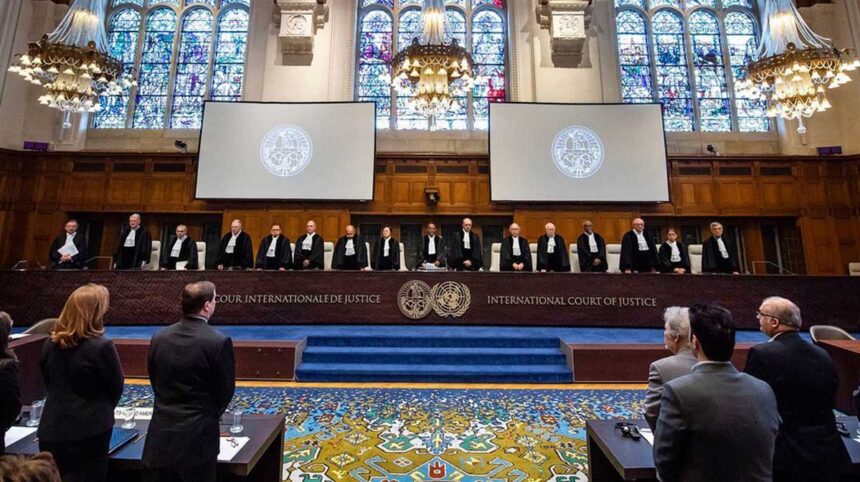
The International Court of Justice will hold public hearings on the preliminary objections raised by Azerbaijan regarding the Court’s jurisdiction in the case concerning Application of the International Convention on the Elimination of All Forms of Racial Discrimination (Armenia v. Azerbaijan) from 15 to 19 April 2024 (ICJ, March 22). The war between Armenia and Azerbaijan in September 2020 in the Karabakh region formed the background for these disputes (CFR, March 20). On 21 April 2023, Azerbaijan raised preliminary objections to the jurisdiction of the Court and, in accordance with Article 79bis, paragraph 3, of the Rules of Court, the proceedings on the merits were therefore suspended, pending a decision of the Court on these preliminary objections (ICJ, May 1, 2023).
Establishing jurisdiction for the International Court of Justice involves several key factors. Firstly, consent of the parties is paramount; both disputing states must agree to submit their case to the ICJ for resolution, either through special agreements, compromissory clauses in treaties, or by mutual consent after a dispute arises (ICJ, March 24). In this case the consent is derived from compromissory clause in the CERD. Additionally, the subject matter of the dispute must fall within the ICJ’s jurisdictional scope, encompassing cases concerning international law, including treaties, customary international law, and general principles recognized by civilized nations.
The International Court of Justice (ICJ) has previously adjudicated three disputes under the CERD, namely Georgia v. Russia (2008), Ukraine v. Russia (2017), and Qatar v. UAE (2018) (ICJ, October 15, 2008, November 8, 2019, February 4, 2021). Over time, the Court has formulated several principles regarding the implementation of the CERD in relation to the Court’s jurisdiction. In this particular case, the jurisdiction of the Court would be derived from two specific clauses, namely Article 36.1 of the ICJ statute and Article 22 of the CERD. Article 36.1 of the statute mentions that “the jurisdiction of the Court comprises all cases which the parties refer to” (ICJ, March 24). According to the Article 22, in the event of a disagreement between two or more states parties about the interpretation or implementation of the Convention, which remains unresolved through discussion or the processes explicitly outlined in the Convention, the ICJ may be asked for a resolution (CERD, March 24). Armenia and Azerbaijan are also CERD members and have not expressed any reservations with regard to Article 22 (UN Treaties, March 24). The procedures pertaining to complaints to the CERD Committee are outlined in Articles 11-13 (CERD, March 24). These provisions outline the establishment of an ad hoc conciliation committee with the aim of achieving a mutually agreeable resolution, or alternatively, the release of recommendations by the Chairperson of the CERD Committee.
The dispute between Armenia and Azerbaijan concerns allegations of racial discrimination, hatred, and ethnic cleansing directed against individuals of Armenian or Azerbaijani ethnic or national origin (ICJ, September 16, 2021). These allegations directly implicate the provisions of the CERD, which aims to eliminate racial discrimination in all its forms (ICJ, September 23, 2021). As a result, the subject matter of the dispute falls within the scope of the ICJ’s jurisdiction over this case. In initiating proceedings before the ICJ, Armenia invoked the provisions of the CERD and sought a resolution to the dispute based on the obligations outlined in the Convention. While Azerbaijan raised preliminary objections to the jurisdiction of the Court, the consent of both parties to submit their dispute to the ICJ for resolution, as derived from their membership and commitments under the CERD, reinforces the Court’s jurisdiction over the case.
The ICJ have addressed the procedural preconditions of negotiations and Articles 11-13 as contemplated by the CERD. The preliminary objection of Russia in the case of Georgia v Russia was upheld by the Court due to the failure to meet the procedural preconditions, specifically the negotiations and/or Articles 11-13 procedures (ICJ, October 15, 2008). In the matter of Qatar v. UAE, the UAE claimed that the case was still being considered by the CERD Committee (ICJ, November 8, 2019). Consequently, the UAE requested the Court to reject jurisdiction based on lis pendens(ongoing litigation). Nevertheless, throughout the oral sessions, the United Arab Emirates (UAE) abandoned this standpoint. In the case of Ukraine v. Russia, it is evident that Ukraine has taken into account the errors made by past litigants and has engaged in multiple rounds of negotiations with Russia prior to initiating legal procedures before the Court (ICJ, February 4, 2021). Consequently, the Court was tasked with determining the adequacy of discussions or the cumulative nature of Articles 11-13. The Court determined that the aforementioned procedures were considered alternative due to the fact that both negotiations and Articles 11-13 procedures aim to achieve a mutually agreed settlement. Furthermore, the objective and purpose of the CERD necessitate a prompt resolution, “without any delay,” with regards to matters pertaining to racial discrimination.
In the legal proceedings of Armenia v. Azerbaijan and Azerbaijan v. Armenia, it is mutually acknowledged by both parties that they have engaged in multiple correspondence and negotiation since December 2020. However, despite these efforts, no mutually agreed settlement has been achieved, prompting the parties to approach the Court. According to the legal precedent established in the case of Georgia v. Russia, the term “negotiation” is defined as a sincere endeavor made by one of the parties involved in a dispute to initiate conversations with the other party, with the intention of reaching a resolution to the disagreement (ICJ, April 1 2011, para. 157). Furthermore, in order to satisfy the prerequisite for negotiation in the compromissory clause of a treaty, it is necessary for these negotiations to pertain to the subject matter of the treaty that includes the compromissory clause (para. 161). Based on the precedent set in the Ukraine v. Russia case (ICJ, November 8, 2019, paragraphs 114-121), where negotiations lasted for two years and involved diplomatic correspondence and face-to-face meetings, and specifically referenced the CERD, it is probable that the Court would concur that the necessary conditions outlined in the treaty were met in the ongoing cases involving Armenia and Azerbaijan.
The ICJ’s decision on jurisdiction in the Armenia-Azerbaijan case holds immense implications beyond legal proceedings. It could set a precedent for addressing ethnic discrimination disputes under international law, potentially offering justice to affected communities and deterring future violations. However, while the ICJ’s involvement is crucial for accountability, lasting peace necessitates diplomatic engagement and reconciliation efforts beyond legal adjudication (Armenpress, March 20). Interestingly, Armenian Prime Minister Nikol Pashinyan indicated readiness to mutually withdraw interstate lawsuits against Azerbaijan from international courts, contingent on the establishment of a stable and lasting peace and the readiness to sign a peace treaty. He emphasized that this step could be considered logical if it contributes to peace, but without such assurance, Armenia would not abandon its legal actions.
In conclusion, considering the consent of the parties, the subject matter falling within the ICJ’s jurisdictional scope, and the procedures outlined in the Convention including the extensive negotiations and diplomatic efforts undertaken by both Armenia and Azerbaijan since December 2020, it appears highly probable that the ICJ will assert jurisdiction over the current dispute concerning the CERD. Furthermore, the readiness expressed by Armenian Prime Minister Pashinyan to mutually withdraw interstate lawsuits opens a potential avenue for the resolution of this conflict outside the courtroom.
Javid Rahimli is an international Lawyer and research assistant at Institute for Corporate Responsibility at George Washington University.