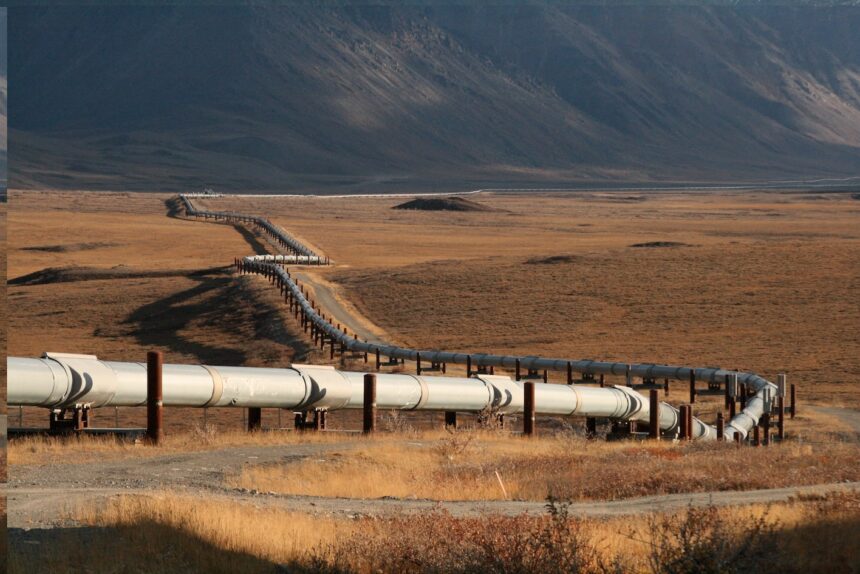
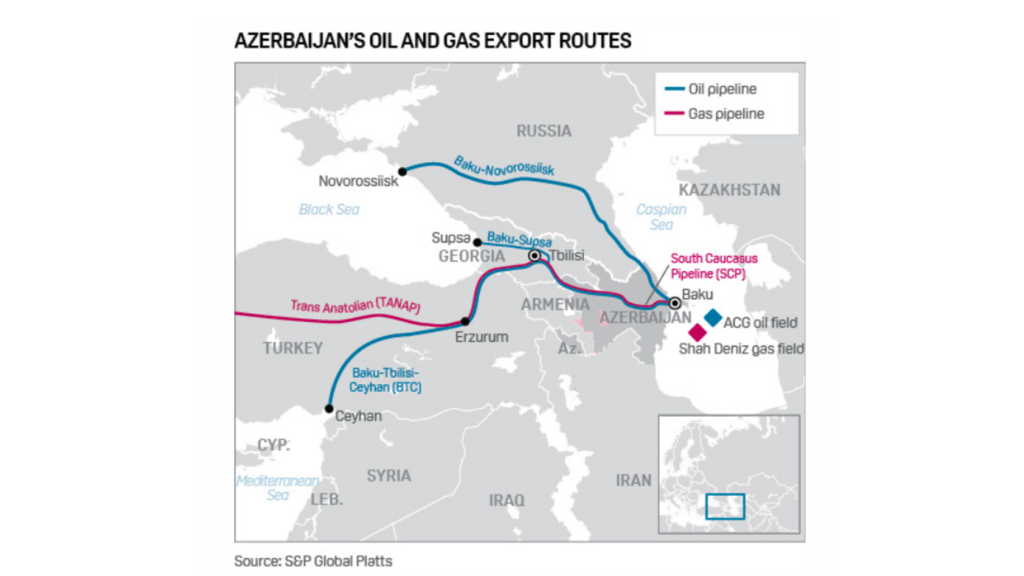
Azerbaijan is exploring options to re-open the Baku-Supsa oil pipeline that would give itself and other countries in Central Asian a way to export oil that avoids crossing Russian territory, connecting the Caspian and Black Seas.
According to the OPEC report from April, global oil demand is expected to reach 2.2mn barrels per day this year and 1.8mn barrels next year. Analysts predict that by 2024, demand will hit 104.46mn barrels per day and increase to 106.31mn by 2025.
In Azerbaijan, according to the country’s Ministry of Energy, 7.3mn tonnes of oil, including condensate, were produced in the first quarter of 2024, which is 5.2% less compared to the same period in 2023 (7.7mn tonnes).
Meanwhile, the US Energy Information Administration (EIA) forecasts an increase in production in Azerbaijan. They estimate that by 2025, production will reach 0.64mn barrels per day, starting from 0.60mn barrels in 2024. Production is expected to be 0.62mn barrels in the first quarter of 2025, increasing to 0.64mn in the second quarter, reaching 0.66mn in the third quarter, and decreasing to 0.65mn in the fourth quarter.
These figures highlight that “black gold” remains an important asset. This also indicates the need for expanding oil pipeline infrastructure to maintain and increase production levels.
Kazakh oil
In March 2023, the State Oil Company of Azerbaijan (SOCAR) announced the start of transit of Kazakh oil through the Baku-Tbilisi-Ceyhan (BTC) pipeline.
The first batch of oil from Kazakhstan’s Tengiz field was delivered to the Sangachal terminal from the port of Aktau on the tanker “President Heydar Aliyev” on March 23. A few days prior, Kazakhstan conducted its first test shipment of 6,900 tonnes of crude oil from the Kashagan field on the tanker “Academician Khoshbakht Yusifzade” to Baku. The next shipment from the port of Aktau on the tanker “Shusha” occurred on March 27 last year. Transportation via the BTC began under an agreement between SOCAR and KazMunayGas for the transit of 1.5mn tonnes of oil annually. For this purpose, in 2022, SOCAR upgraded the pipeline network at the Sangachal Terminal.
According to KazTransOil, in January of this year, 287,000 tonnes of oil were exported from the port of Aktau, of which 116,000 tonnes were directed to the port of Baku — this is double compared to last year and almost half of all export volumes.
Due to the rising geopolitical tensions Kazakhstan is actively diversifying its hydrocarbon export routes. Currently, some 80% of Kazakh exports run thorugh the Caspian Pipeline Consortium (CPC) pipeline that runs over Russian territory and ends at the Russian Black Sea port of Novorossiysk. However, Astana would be happy to have some alternative routes that bypass Russia altogether. After reaching an agreement on exports via the main BTC pipeline, the pumping volume increased 5.5 times to 1.392mn tonnes in 2023.
Magzum Mirzagaliyev, the CEO of KazMunayGas, believes that the launch of the Baku-Supsa pipeline will alter both the economic and geopolitical balance in the region again. The pipeline is currently out of service, but reopening the route is being discussed at the initiative of the Azerbaijani side. Restoring pumping through this route will increase the volumes of Kazakh oil transited through Azerbaijan to Europe and will prevent the mixing of different grades of oil.
Two major differences
In mid-March of this year, Georgian media, citing Minister of Economy Levan Davitashvili, reported on the potential resumption of oil transportation through the Baku-Supsa pipeline by the end of 2024.
“The Azerbaijani side plays a key role in the use of this pipeline, which has been operated since 1999 for the transportation of Azerbaijani oil. Negotiations are currently underway for the transit of Kazakh oil, which differs in type from Azerbaijani oil. We expect to resolve the main issues and start pumping this year, hoping to transfer more than a million tonnes per year in the future,” Davitashvili noted.
However, the resumption of pumping faces technical problems due to differences in the quality characteristics of the oils. Azerbaijani Azeri Light oil is light, while Kazakh oil is significantly heavier, affecting the cost of the final product when mixed. Experts are confident that these problems can be resolved.
For the Baku-Tbilisi-Ceyhan pipeline, oil of a similar grade is needed, such as Turkmen oil. Kazakh oil is rich in sulphur, and if its share in the BTC exceeds the agreed volumes, the cost of the final product will drop. To match the standards of high-quality Azerbaijani oil, excess sulphur must be removed from Kazakh oil. Additionally, oil from the Kashagan field contains a high amount of hydrogen. Restarting the Baku-Supsa pipeline will solve these problems without extra costs, preserving the quality of Azerbaijani oil and reducing Kazakhstan’s expenses for oil purification.
Baku-Supsa pipeline
The Baku-Supsa pipeline, used for transporting oil from Azerbaijan’s Chirag field, has been operational since the spring of 1999. However, in March 2022, due to military actions between Russia and Ukraine which led to a reduction in the number of tankers in the Black Sea, Azerbaijan decided to redirect all its oil exports through the Baku-Tbilisi-Ceyhan route.
Key moments in the history of the pipeline began on March 8, 1996, when Azerbaijan President Heydar Aliyev and Georgia President Eduard Shevardnadze signed an agreement in Tbilisi for its construction. Three parties—Amoco, SOCAR, and the Georgian government—agreed on the transportation of Azerbaijani oil from the “Azeri,” “Chirag,” and “Gunashli” fields. The pipeline was officially inaugurated on April 17, 1999, at the Supsa terminal. This route was the first to bypass Russian territory and allowed Azerbaijan to significantly reduce transportation costs compared to the Baku-Novorossiysk route.
The pipeline, stretching 837 km, has a capacity of more than 7mn tonnes of oil per year (about 145,000 barrels per day). Initially, the pumping volume was 6mn tonnes, while only 2.5mn tonnes per year were pumped through Baku-Novorossiysk.
The Baku-Supsa pipeline has experienced several stoppages: in 2006 for repairs that lasted nearly two years; and in 2008 for a month due to the war in Georgia. The Georgian segment passed near the occupied territories and part of the pipeline is controlled by separatists. Pumping was suspended for the third time in March 2022.
In 2016, British Petroleum invested $150mn in upgrading the pipeline, enhancing its environmental standards.
The second wind for the Baku-Supsa pipeline
The Ministry of Energy of Azerbaijan intends to resume pumping oil through the Baku-Supsa pipeline in 2024, but will need more complex preparatory measures than simply opening a valve. Preliminary steps include increasing the capacity of connecting pipelines at terminals and expanding the tanker fleet.
 Kazakhstan also faces a number of challenges. Specifically, to transport up to 5mn tonnes of oil per year via Baku-Supsa, plus another 3mn tonnes via Baku-Tbilisi-Ceyhan, it is necessary to improve the technical condition of the Kazakh terminal and the interconnector with the Sangachal terminal. Additionally, due to the dropping sea level in the Caspian, dredging work will be required on both sites. The upgrade also needs to be coordinated with the pipeline owners, including BP and ACG shareholders, as well as establishing new transit tariffs, and more.
A long-term contract for the use of Baku-Supsa would be beneficial for Azerbaijan, as diversifying supply routes increases strategic stability. Azerbaijan is not only exporting its oil but is also becoming a transit point for Kazakh oil, and in the future, gas transit to Europe may be possible. The implementation of this plan will depend on successfully resolving technical challenges and the availability of commercial requests for oil shipments at the Supsa port. According to experts, the pipeline itself can be launched at any time.
The exact timing of the re-start is determined by a complex geopolitical situation. Western countries are keen on the route as it puts more oil assets out of Russia’s reach and strengthen Europe’s energy security. The outcome of the Russia-Ukraine conflict could also significantly affect regional political dynamics and, consequently, the operating conditions of the Baku-Supsa pipeline, depending on what happens.
Seymur Mammadov