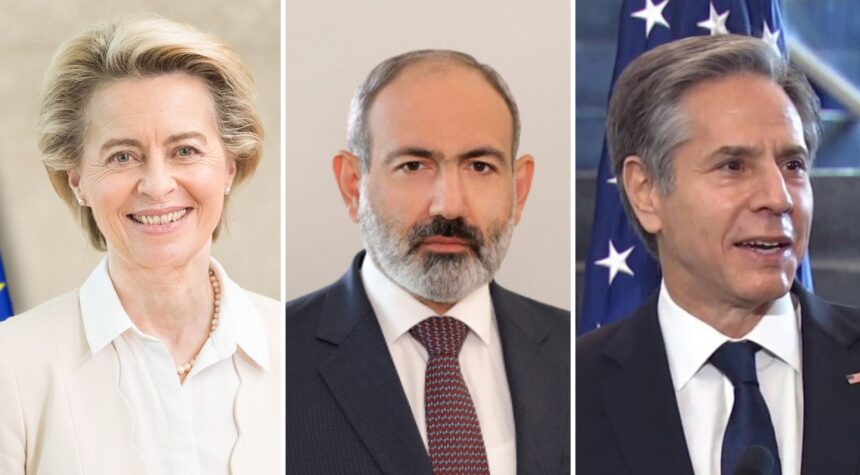
On 2 April, Azerbaijan’s Defense Ministry stated that the Armenian armed forces units periodically subjected to fire the Azerbaijan Army positions in the Nakhchivan direction of the interstate border. This followed the news spread by the Azerbaijani side concerning Armenia’s consolidation of military equipment and troops along the border region over the past several days. While both the Armenian government and the monitoring mission of the EU that deployed to the Armenia-Azerbaijan border since the late 2022 denied this information, the growing tensions on the ground are visible to the naked eye. These tensions have been further strained since the announcement of a trilateral meeting of Armenian Prime Minister Nikol Pashinyan, European Commission’s President Ursula von der Leyen, and the United States’ Secretary of State Antony Blinken that is set to take place in Brussel on 5 April. The meeting has been negatively viewed in Azerbaijan and criticized for drawing “geopolitical dividing lines” in the South Caucasus and fueling local conflicts.
Azerbaijan has insisted on this position despite the fact that both the European Commission and Department of State of the United States asserted that the meeting would focus on economic issues and, as such, would not include the questions related to the Armenia-Azerbaijan peace process.
Considering that today security issues dominate the agenda both for Armenia and the West in the context of the Ukraine war and unprecedented confrontation between Russia and the West, these assertions are not convincing; Quite the contrary, there is enough reason to expect that all the economic and humanitarian issues on the agenda will be assessed through the lens of Armenia’s efforts to weaponize it against Azerbaijan and can cause the stagnation in the Armenia-Azerbaijan peace process.
Therefore, President Ilham Aliyev of Azerbaijan countered the claims of Antony Blinken during their phone call on April 3 and reiterated that the trilateral meeting “would ultimately escalate tensions and create new dividing lines instead of fostering peace and cooperation in the South Caucasus.” Referring to his own sources, President Aliyev stated that the meeting’s agenda includes military support to Armenia as well as joint military exercises which will accelerate the arms race in the region and stir up tensions undermining regional stability.
Moreover, the context of the meeting and regional geopolitical situation backs the assessment of President Aliyev whose foreign policy has been traditionally based on maintaining balance between the West and Russia and striving to keep geopolitical rivalries at bay. The balance of power in the wider region, which has been supportive of Baku’s balanced approach until recently, has been, however, changing due to Russia’s war against Ukraine. The attempt of Armenia, Russia’s ally within the Collective Security Treaty Organization (CSTO) and the Eurasian Economic Union (EAEU), to move closer to the Euro-Atlantic space by breaking away from Russia’s orbit is the most noticeable manifestation of this power shift in the region.
Azerbaijan is also concerned that the geopolitical struggle between global powers will end up with a major instability in the region. On a larger scale of geopolitics, Russia does not seem willing to give up the South Caucasus, the region which is of a critical importance for the country’s national security and connectivity with Iran, India, Middle East and the South Asia. In case, of a Russian action, as experience manifests, Western support frequently comes as only verbal one, without much substance to the security and wellbeing of the to the post-Soviet states, just as it happened in Georgia in 2008.
The trilateral meeting on 5 April hardly promises any good to the Armenia-Azerbaijan peace process either. In his phone call with Secretary Blinken, President Aliyev specifically mentioned “lack of inclusivity” as part of his criticism of the meeting. Indeed, it is the first such a meeting ever between the Armenian Prime Minister and the Western leaders in this format and raised many questions and concerns in Baku. This gains even further momentum as both the Armenian leaders and Western officials have continuously accused Azerbaijan of plans and preparations to invade Armenia. These accusations continue being made despite the Azerbaijani government has denied the existence of such intentions many times. In Baku, this is seen as a deliberate effort to fabricate a nonexistent threat under the guise of Azerbaijan, thereby justifying increased military assistance to Armenia and bolstering Western presence in the country. Previously Armenia used its military alliance with Moscow to prolong its occupation of Azerbaijani territories, and now Yerevan seems to be attempting to promote its move towards the West for undermining Azerbaijan’s standing in the region.
That said, in light of the escalating tensions and deepening mistrust, it is evident that the upcoming trilateral meeting between Armenia, the European Union, and the United States has become a focal point of contention in the South Caucasus. Despite assurances of its economic focus, the broader geopolitical implications cannot be ignored, especially amidst the backdrop of the Ukraine crisis and Russia’s assertive stance in the region. The emergence of “dividing lines” in the region may further complicate the situation in the South Caucasus and lead to a geopolitical crisis with much more severe consequences for the peoples of the region.
Dr Vasif Huseynov, is a Senior Advisor at the Center of Analysis of International Relations (AIR Center) and Adjunct Lecturer at Khazar University in Baku, Azerbaijan.