Diplomacy comes in various forms—economic, cultural, sporting. The term “gunboat diplomacy” has entered the annals of world history, along with the more pejorative “pillow diplomacy,” which blends sensationalism with political pretense. Unfortunately, there also exists a form of diplomacy that relies on provocation.
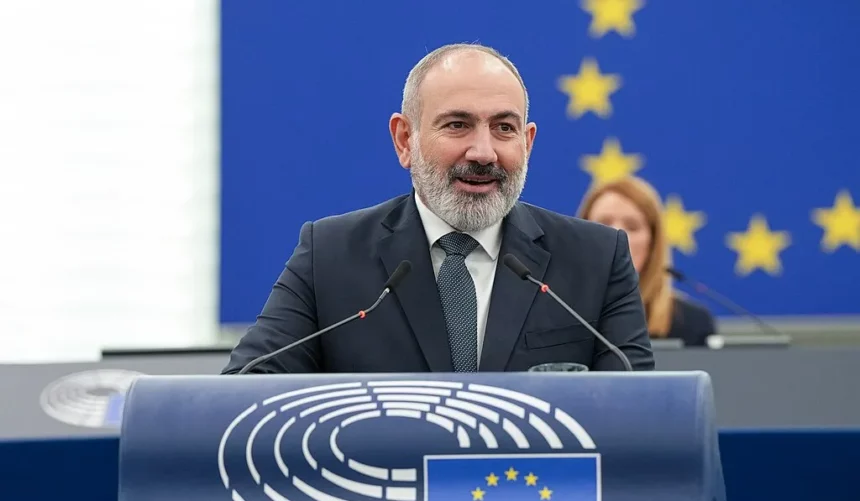
The scheduled meeting on April 5th between Armenian Prime Minister Nikol Pashinyan, U.S. Secretary of State Anthony Blinken, and European Commission President Ursula von der Leyen represents precisely such a case. While this meeting is being particularly actively promoted in Yerevan, its occurrence has also been confirmed in Washington. Armenian authorities assure that the discussion will focus on cooperation and development issues, while representatives of the State Department in Washington assert that the meeting is aimed exclusively at establishing stability and peace in the region. However, the actual agenda includes the conclusion of a sort of military pact. This, given the local specifics, will certainly not contribute to either peace or stability—in reality, the U.S. and Europe are pushing the South Caucasus towards new instability and new tragedies.
Let’s analyze this point by point.
First, it’s necessary to briefly step away from the strictly “Armenian” theme and recall the extremely cynical statement by Josep Borrell regarding support for Ukraine: “This is not a question of generosity, not a question of supporting Ukraine because we love the Ukrainian people. It is in our own interest, as well as in the interest of the U.S. as a global player.” In other words, it’s preferable for Ukrainians to die for the interests of the European Union rather than French, Spaniards, or Germans. And if tomorrow the “own interests” of the European Union require an agreement with Russia at the expense of Ukraine, there will always be plenty of those willing to repeat the “diplomacy of Daladier” in European offices and corridors.
Similarly, the newly acquired protectors of Yerevan are far from primarily concerned with the fate of Armenia itself. Even the Armenian voices in elections are far from a priority. Armenia is being counted on as an anti-Russian bastion, to open a “second front” against the Kremlin, and what will happen to Armenia as a result is hardly a question of primary importance.
Moreover, such games will not be viewed favorably from Baku. In Yerevan, various spokesmen and spokeswomen may assure that the April 5th meeting is not directed against “third countries,” but this is nothing more than an excuse for the particularly naïve.
Clearly, the conclusion of a “military pact” is just part of a plan to remilitarize Armenia and prepare Yerevan for a forceful revenge. This revenge involves military pressure on Azerbaijan and a new invasion. It seems that certain circles in the West simply couldn’t “digest” Azerbaijan’s victory in Karabakh, the liberation of its territories from Armenian occupation, and the defeat of Armenian aggressors.
Many indirect signs suggest that after the 44-day war, the West was preparing a “Kosovo scenario” in Karabakh. Again, not out of sympathy for the “long-suffering Armenian people”—they were trying to maintain the possibility of “conflict manipulation.” To keep both Azerbaijan and Armenia on the “Karabakh hook,” to have a “gray zone” in a very sensitive region, which could be pumped full of weapons—Karabakh seemed a very attractive “instrument.” And perhaps it is here that the key to understanding many of the West’s moves in the Karabakh field lies. Over the three years—from the Patriotic 44-day war to the local anti-terrorist operations on September 19-20, 2023, which put an end to the illegal junta—Western politicians and institutions led an open campaign against Azerbaijan and our country’s president under the pretext of responding to a “humanitarian disaster” in Karabakh, while it was easy for any sane person to establish that there was no “humanitarian disaster” in Karabakh at all.
This trend also includes generous funding in Azerbaijan for various media structures and informational, or rather, propagandist resources, whose activities were aimed at destabilizing the situation and pushing highly dubious “peacekeeping” ideas in society. And let’s not forget the illegal trips of European politicians to Karabakh, like Eleni Theocharous or Valérie Pécresse. And when all this “mouse fuss” did not work, anti-Azerbaijani circles in Western countries moved on to the preparation of outright plans for external invasion.
Yes, the West prefers to act through the hands of Armenia. The very Armenia that eagerly took on and continues to take on the role of an instrument in someone else’s game. Often, simultaneously for two opposing camps. It’s enough to recall the 1980s, when everyone played on Armenian separatism in Karabakh, and the leaders of this separatism sought alliances with everyone. Some aimed to use this conflict to securely “tie” both Armenia and Azerbaijan to Moscow, others to shake the USSR with its help (which eventually succeeded), others to “promote democracy,” and others to test emergency mechanisms. And Armenian leaders were ready to serve everyone. The blood and tragedy this turned into for the South Caucasus hardly needs reminding.
A century ago, Armenian leaders were used against the Ottoman Empire. And in Armenian ultranationalist circles, they still pray to the “Woodrow Wilson Plan,” according to which part of the territory of Turkish Eastern Anatolia was to be turned into so-called “Western Armenia.” The idea burst, but now enthusiasts for redrawing borders in Washington are trying to launch another plan in the region—equally cynical and equally dangerous. Dangerous not only for Azerbaijan but for the entire region.
Against this dangerous backdrop, the silence of Armenia’s traditional allies—Iran and Russia—is surprising. Tehran cannot ignore the very dangerous trends. On one hand, the authorities of the Islamic Republic of Iran are categorically against the presence of “non-regional forces.” But on the other, the Iranian ambassador in Armenia acts hand in hand with his French colleague—in essence, in the interests of the West. How does this correlate with Iran’s recent statements that the penetration of non-regional forces is a “red line”? And why is Russia silent? The very Russia that reacts very sharply to the penetration of Western structures into post-Soviet states? Armenia is openly flirting with the EU, showing Russian border guards the door, and all this could end with the withdrawal of the Russian base from Gyumri, but there’s no noticeable reaction from Moscow.
However, let Russia and Iran defend their own interests. Azerbaijan, loudly, clearly, and openly, draws its red lines. The official representative of the Ministry of Foreign Affairs of Azerbaijan, Aikhan Hajizade, has already issued a warning: “Considering the revanchist sentiments in Armenia, such an openly pro-Armenian public stance by Washington and Brussels may create a dangerous illusion in Armenia that the EU and the U.S. are going to support Armenia in its possible new provocations against Azerbaijan. In such a case, the EU and the U.S. will share responsibility for any possible destabilizing actions by Armenia.”
This warning should be heeded.