One of the most important factors threatening the environmental health of the South Caucasus is Armenia’s disposal of industrial waste, particularly from the Kajaran mine and the Metsamor Nuclear Power Plant, considered one of the most dangerous nuclear power generators in the world.
Toxic waste from the Metsamor plant continues to be discharged into the environment despite completing its planned lifespan in 2005. Additionally, the non-standard operation of mines in the region significantly jeopardises the environmental cleanliness of the South Caucasus and the health of its inhabitants.
The Metsamor plant, which directly endangers the health of people in Iran, Azerbaijan, Türkiye, Georgia, and Armenia, is recognised as the world’s most unsafe reactor.
The European Union has been demanding the closure of the plant, situated just 32 km from the Armenian capital, Yerevan, due to its location within an active seismic zone and its outdated technology. However, Armenian authorities have thus far responded negatively to this request.
Academic research on the Metsamor plant suggests that it should be shut down due to its positioning along the Mount Agri faultline, its potential to contaminate groundwater with radiation, and its propensity to induce environmental pollution.
Recent reports and statements in the Iranian and Azerbaijani media allege that the adverse impacts of these power plants and mines are beginning to manifest. What are these allegations, and what threats do they entail?
Aras River pollution
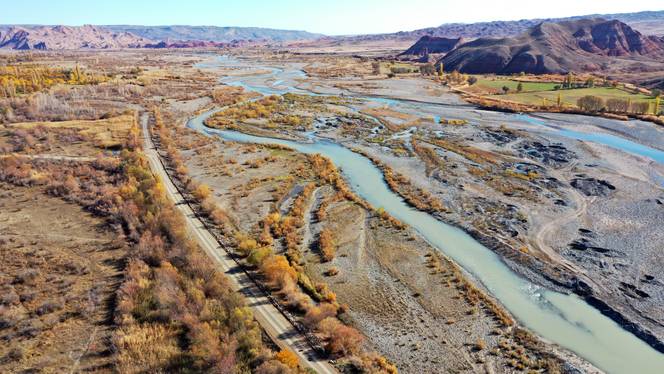
The Aras River, originating in Türkiye’s Bingol Mountains and traversing through the borders of Iran, Azerbaijan, and Armenia before merging with the Kura River and flowing into the Caspian Sea, plays a significant role in sustaining the natural ecosystem of the South Caucasus.
The river directly impacts the health of 20 million people, most of them in rural and urban settlements in the provinces of west and east Azerbaijan, Ardabil, and Gilan in Iran, as well as some habitations in the southern regions of Azerbaijan and Armenia.
However, contamination of this river by Armenia has led to major complications in the vast region.
The initial official statement regarding Armenia’s pollution of the Aras River was made by the Iranian Parliament (Islamic Shura Council of Iran) in early 2015.
The Iranian Parliament’s Environmental Commission expressed concerns over the discharge of waste from Armenia’s aluminium and copper factories, as well as radioactive waste from the Metsamor Nuclear Power Plant, into the Aras River.
Iranian authorities have asserted that Armenia’s pollution of the river not only poses an environmental threat but also correlates with an increase in cancer cases among the local population.
In a 2020 study, the Iranian Environmental Agency identified 59 different metal species in the water and 61 in the sediments of the Aras River. These metals were found to be consistent with those originating from Armenia’s copper mines.
It is further alleged that industrial and mining waste discharged from Armenia’s Meghri region into the Aras River not only threatens food security by degrading the area’s agricultural land but also jeopardises the region’s drinking water supply and agriculture. The concentration of metals such as aluminium, manganese, arsenic, lead, boron, copper, molybdenum, and sulfur in the Aras River water exceeds both global and Iranian standards.
This underscores the problematic nature of utilising the water of the Aras River, which is crucial to the region’s drinking water supply and agricultural practices.
Academic research conducted in Iran asserts that lead is the most hazardous metal present in the Aras River.
According to the US Clean Water Act, the level of lead in drinking water should be zero, while as per Iranian standards, this value is determined to be ten micrograms per 1 litre. Analyses of the Aras River water revealed that the lead concentration in the Kordasht region reached 140.84 micrograms per litre, surpassing Iranian standards by 14 times.
In ecotoxicological studies, lead and its compounds are classified among the most dangerous pollutants and are considered second-class hazardous metals. The elevated level of lead in the Aras River signifies the severity of the situation.
However, according to a study published in the 38th issue of the Journal of Border Studies by the Border Police Commander of the Iranian Police Organization, nuclear contamination is also present in the water of the Aras River.
This contamination primarily stems from the discharge of toxic waste from the Metsamor Nuclear Power Plant.
No necessary steps
After the Iranian public’s attention was drawn to the threats posed by the Metsamor Nuclear Power Plant and the issue of Aras River pollution, Ali Salajegheh, the head of the Iranian Environmental Organization, announced that radioactive substances are present in the water of the Aras River but have not reached a dangerous level.
As recently as January 30, Mohammadreza Bahramen, Deputy Chairman of the Iranian Chamber of Commerce, criticised the Iranian authorities’ handling of this problem, revealing that waste from Armenia’s copper mine was being dumped into the Aras River while the Iranian government turned a blind eye.
In other words, the issue of Aras River pollution, which was long denied by Iranian authorities, has recently been acknowledged and verified by official sources. However, the lack of significant steps in addressing this matter increases the risk of further escalation.
Indeed, according to the statement issued by the head of the Iranian Environmental Organization, the most recent effort to address the Aras River pollution problem was limited to a decision made in January 2024 between Iran and Armenia to establish three working groups.
It is indicated that the primary task of these proposed working groups will be to facilitate discussions on the issue between the two countries.
However, considering the health issues of the local population stemming from the pollution of the Aras River, it is evident that merely discussing the problem will not suffice for resolution.
Put differently, in terms of environmental cleanliness in the South Caucasus and the health of the region’s inhabitants, it appears imperative that the pollution of the Aras River be addressed promptly.
Indeed, according to certain claims reported in the Iranian press, the elevated incidence of stomach cancer among individuals residing along the banks of the Aras River is attributed to the river’s pollution and could lead to even more dire consequences.
Nevertheless, this significant issue has yet to become a focal point for Iranian authorities.
The threat posed by the Metsamor Nuclear Power Plant extends beyond environmental pollution.
Experts draw parallels between the situation at the Metsamor Nuclear Power Plant and that of the Chernobyl plant, suggesting that without the necessary precautions, a disaster akin to the Chernobyl incident in the South Caucasus is not an unlikely scenario.
Consequently, Türkiye has consistently advocated for the closure of this power plant in recent years.
However, Armenia remains resistant to this proposition, while Iran, adhering to a now ingrained state reflex, opts not to intervene unless a problem escalates into a domestic security concern.
From Iran’s perspective, the pollution of the Aras River has yet to evolve into a significant internal security issue and is thus disregarded. In essence, the South Caucasus is gradually being propelled towards an environmental catastrophe.
Ata Şahit