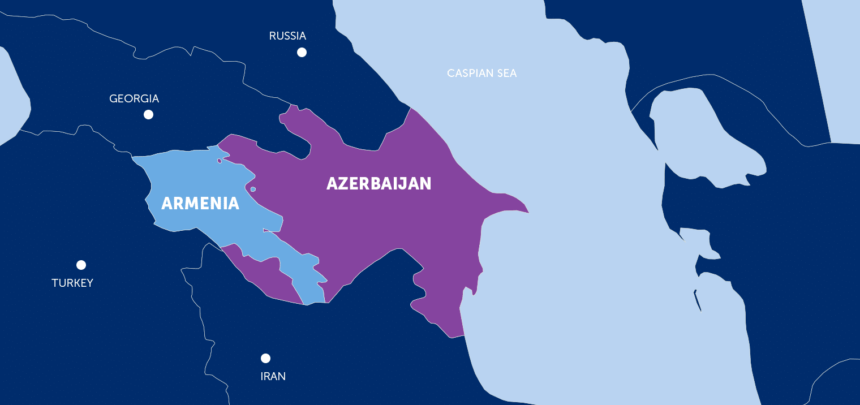
The ruptures caused by military clashes between Armenia and Azerbaijan in recent years, as well as the impact of Russia’s invasion of Ukraine, are not the only major and complex changes unfolding across the region. Indeed, while many processes in the international system are clearly currently refracting through the geopolitics of the South Caucasus, there are also several distinctly regional processes underway.
Is Russia leaving the South Caucasus?
After Azerbaijan regained control over the entire Karabakh region and the departure of the local Armenians living there, it appears Russia’s previously strong regional influence has waned in Armenia and Azerbaijan. Of course, Moscow’s influence in the region has been decreasing since the breakup of the Soviet Union. However, Russia still has a presence in the region and seems unlikely to give this up any time soon.
Trade turnover between Armenia and Russia for 2023 amounted to $ 7 billion 306 million, which is 43% more than in 2022. Last year mutual trade turnover reached $ 5 billion. Trade turnover between Armenia and other EAEU countries in 2023 increased by 39 percent and amounted to $ 7.8 billion.
Trade turnover between Azerbaijan and Russia in 2023 amounted to $ 4.358 billion, which is 17,5%more than in 2022. Moscow and Baku are currently discussing an option of reversing supplies of Russian oil to Azerbaijan.
The trade turnover between Georgia and Russia increased in 2022 as well. According to the Russian Chamber of Commerce and Industry, trade turnover between Russia and Georgia in 2022 increased by 50%. After Türkiye ($ 2.8 billion), Georgia’s second largest trading partner in 2022 was Russia ($ 2.5 billion). though the trade turnover decreased by 3% in 2023 (almost $ 2.5 billion).
All those data shows how the region’s economies still depend on relations with Russia. On the other hand, the sanctions on Russia over its invasion of Ukraine have strengthened interdependence between the South Caucasus republics and Russia. After the start of the invasion and following Western sanctions, the value of economic relations with the South Caucasus and Central Asia has increased for Russia.
Some of Yerevan’s recent political activities, such as the accession of Armenia to the Rome Statute and joint military drills with the United States, increased Moscow’s irritation with Yerevan. Armenia conducted joint exercises with the US Army (Eagle Partner 2023) in September, and has increased its military purchases from India and more recently France; it intends to increase its security relations with the West. Yet it is still a member of the CSTO and there are still Russian military bases on Armenian territory.
Despite Baku’s intentions to end the presence of Russia’s peacekeepers in Karabakh, their hope that Russian troops would duly leave because the majority of the local Armenian populations had been displaced from the region, has not come true. The Russian MFA stated that «the presence of the Russian peacekeeping contingent in Karabakh is in demand, and it will also be necessary in the future.» According to the Russian MOD, Russian peacekeepers continue to carry out tasks on the territory of Karabakh and there are eighteen Russian military posts. Moreover, having legally gained strategic control over the Caspian Basin in 2018, Moscow can use its Caspian Flotilla to press Baku if such a need arises. Considering the concentration of Azerbaijan’s population, and how its economic and political life resides in Baku, the possibility of such a scenario increases. Despite military purchases from Russia decreasing in recent years, Russian military equipment remains the cornerstone of Azerbaijan’s military capabilities. Russia’s share in Armenian arms and equipment is higher than that of Azerbaijan.
Regarding Georgia, the uncertain prospects of NATO membership, the presence of Russian troops in Abkhazia and South Ossetia and recent reports that Russia is going to build a permanent Navy base in Abkhazia (port of Ochamchira) indicate that Russia’s military presence in the country is unlikely to end anytime soon. While, in comparison to Sevastopol Bay, the proposed port poses greater challenges in terms of navigation, weather conditions, and size for a naval base, building one in Abkhazia will enhance Russia’s control over the seashores of Georgia and its sea ports. However, it will require considerable time for construction. In such a situation, Russia may have a tool to influence China, Türkiye, and the West if they wish to use Georgian ports.
Do transport corridors matter for the region?
The main international transport routes in the region, the western route of the International North-South Transport Corridor (INSTC) and the East-West Transport Corridor (the Middle Corridor) of the BRI are geoeconomically important for the development of the region. Realization of the INSTC is a strategic goal for Moscow and supported by Iran and India. Another project, the Middle Corridor, is supported by China and the EU. The EU plans to invest 10 billion euros in the Middle Corridor. Azerbaijan is the main regional participant for both projects. Georgia is another of the region’s countries through which the East-West Corridor passes.
In the western route of the INSTC, Azerbaijan’s transport hub was initially seen as an intersection of the north-south and east-west corridors. Moscow considers the prospectives of the INSTC in relation to the BRI. Indeed, whether these two mega transport projects will connect or compete may determine the development of the INSTC. Therefore, Moscow promotes connectivity between the two projects, and it is also supported by Baku. Moreover, Moscow is considering re-opening routes between Armenia and Azerbaijan to have railway access to Armenia and Türkiye and to control the railway connection between Azerbaijan and its enclave Nakhichevan which can connect to Türkiye by Russian border guards. Türkiye also supports this project, but Iran has concerns.
Is it regionalization of international politics in the South Caucasus?
Russia supports the regionalization of international relations in the South Caucasus. The Russian regionalization policy aims at intensifying dialogue, coordination, and interaction with the main regional powers and a given region’s countries. Understanding its economic and now military problems, Moscow prefers to cooperate with Türkiye and Iran to deter or challenge the Western economic and security projects in the region. In this respect, the «3+3» format initiated by Ankara (Russia, Iran, and Türkiye + Armenia, Azerbaijan, and Georgia) can be a platform for regional cooperation. However, the interests of Russia, Türkiye, and Iran do not always coincide in the South Caucasus. Although Baku and Yerevan support this format, Tbilisi’s concerns over Russian troops in its occupied territories challenge Georgia’s involvement in the «3+3» format. However, there is increasingly a new conflict of interests. Moscow’s project, the pipeline supply of Russian oil to India through Azerbaijan and Iran, is not welcomed by Ankara.
Despite the increase of Chinese economic cooperation in recent years and the fact that one of the routes of the west-east transport project pass through the region, the South Caucasus is not as important as Central Asia for Beijing. Moreover, China’s relations with Russia, Iran, and Türkiye are strengthening.
Considering the possibility of the West’s presence and influence in the region, the EU’s economic relations with the region’s three countries should be stressed. The West displays interests in the peace process between Armenia and Azerbaijan and recently Georgia’s long-awaited EU candidate status has been granted by Brussels. Although the United States does not have a military presence in the South Caucasus and is not as economically involved as the EU, its access to the Caspian Basin and Central Asia, its closeness to Iran and Russia, and the growing economic presence of China, may increase the region’s geopolitical value for Washington. However, for the United States to exert effective influence in the region, it needs Türkiye’s involvement. But whether Ankara will support its western allies in NATO or try to balance between the West, Russia, Iran, and China to get geoeconomic benefits from the region is another open question.
Who controls the South Caucasus?
For now, the geopolitical image of the region can be described as such: Russia has not left and is not going anywhere anytime soon; Türkiye’s influence is increasing, especially over Azerbaijan and Georgia to a lesser extent; there are no changes in Iranian involvement, although its relations with Armenia are increasing; despite recent diplomatic intentions by the West over the peace process between Armenia and Azerbaijan, there do not seem to be essential changes in the US or the EU’s involvement since the end of the 2010s; and China has vital economic cooperation with the region, although there are no indications of Beijing’s involvements in the security issues of the South Caucasus. The most visible trend in the region is the support of Moscow, Ankara, and Tehran for the regionalization of international relations to challenge the West’s strategic involvement in the South Caucasus. Another historical trend is the maneuvering of the region’s three countries to balance between regional and great powers given their current level of influence on Armenia, Azerbaijan, and Georgia. Currently, the balance of power among the regional and great powers involved in the South Caucasus still favor’s Russia and secondly, Türkiye. The West can influence the geopolitical processes in the South Caucasus mainly by increasing its economic and security relations with the region’s countries, and it’s also brokering initiatives between Armenia and Azerbaijan. There are also possibilities for situational cooperation such as the recent security cooperation between Armenia and France, and the agreement between Azerbaijan and Iran to build routes to Nakhichevan through Iranian territory. Obviously, processes in the international system will affect the geopolitical image of the South Caucasus. And while the strengthening of cooperation between the three countries may increase the region’s resistance in the face of regional and global challenges and external threats, the current relations between Armenia and Azerbaijan make it impossible, at least for now.
Nurlan Aliyev is Ph.D. in philosophy and security studies. Lecturer in the University of Economics and Human Sciences in Warsaw. He is the author of «Reassessing Russia’s Security Policy».