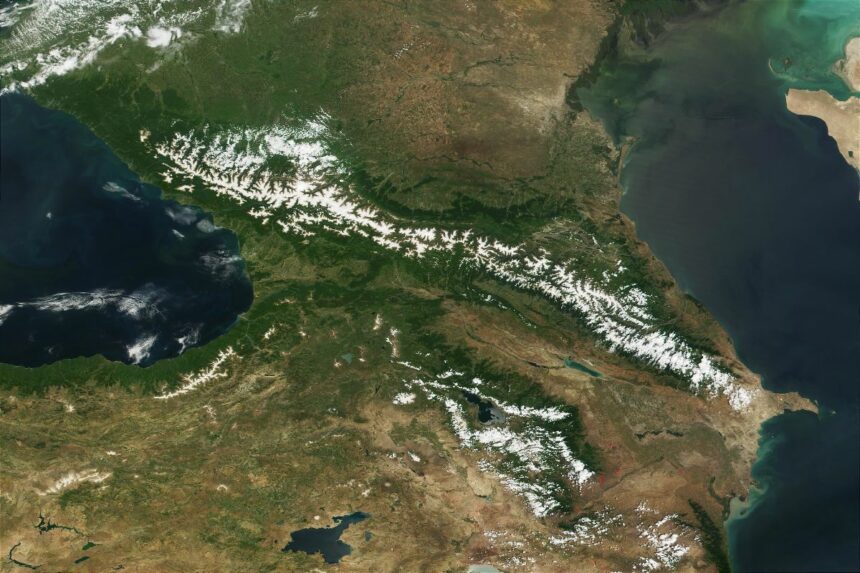
The important geopolitical position, geographical location, rich natural resources, energy reserves and other features of this region have made the South Caucasus an important element of modern geopolitical processes.
The main factors influencing the security environment of the South Caucasus are the following: ethno-political conflicts in the region, extreme ethnic heterogeneity (diversity) of the region, conflicting interests of the external actors in the region, complex geographical location, as well as its rich natural and energy resources. Analysis of these factors that we have listed allows us to clearly understand the root causes of the security problems of the South Caucasus region.
“Frozen” ethnopolitical conflicts in the region can be considered as one of the main elements of increasing security risks in the South Caucasus. The protracted conflicts over Abkhazia and South Ossetia remain unresolved till now and they are capable of creating serious threats to regional security. In recent years, in terms of conflict resolution, an important event has occurred that has a positive impact on the security situation in the region, namely the end of the Armenian-Azerbaijani conflict around Karabakh. In 2020, Azerbaijan liberated its lands (Karabakh and surrounding territories) from occupation during the Second Karabakh War. The war and the processes that took place after that put an end to the largest armed conflict in the region.
However, due to a number of serious problems remaining between the two countries, a final peace agreement between Baku and Yerevan has not been signed yet. And this fact causes spreading rumours over the possibility of a new military escalation between the parties. Let us add here the important point that the failure to sign a final peace agreement, which is the sources of possible new conflicts serves for the interests of certain external actors that want to keep the influence over the states of the region.
The high level of ethnic diversity in the South Caucasus is another element that has a serious impact on the regional security situation. The region is home to dozens of ethnic groups, and the Caucasus as a whole is seen as a mosaic of ethnic communities speaking Caucasian, Indo-European and Turkic languages. However, the three main ethnic groups of the South Caucasus republics are Azerbaijanis, Georgians and Armenians. Azerbaijanis, the main ethnic group of the Republic of Azerbaijan, contain 91.6% of the total population, while other peoples contain 8.4%. There is more ethnic diversity in Georgia. Georgians represents about 83.8% of the country’s population, with the rest consist of other ethnic groups, including Azerbaijanis (6.5%). Compared with Georgia and Azerbaijan, ethnic composition of Armenia radically differs. Armenia is known as a largely homogeneous country. Thus, only 3% of the population of the Republic of Armenia belongs ethnic minorities, and 97% are Armenians, and with such an ethnic composition, Armenia can be considered one of the few mono-ethnic states in the world. The reason behind this monoethnicity is the fact that Azerbaijani population has been ethnically cleansed from Armenia throughout the 20th century.
Among the factors (geopolitical, economic, socio-moral, etc.) characterizing the relations between the countries of the region (Azerbaijan, Georgia, Armenia), the security aspect occupies a special place. Over the past thirty-two years, relations between the two South Caucasus republics – Azerbaijan and Armenia are in state of war. This fact can be noted as the biggest negative factor affecting the regional security situation.
Although the Karabakh conflict, which arose due to Armenia’s territorial claims against Azerbaijan, has ended, due to the lack of peace deal between the two countries, lasting peace in the region has not been achieved, and this increases the risks of new conflicts, as we mentioned earlier. Regarding the nature of relations between Georgia and Armenia, the main determinants are the following: proximity, economic and trade interests, geographical, religious and cultural proximity, historical ties, regional geopolitical conjecture, the existence of an ethnic Armenian community in Georgia. The main points that have a negative impact on Georgian-Armenian relations are the fact that Armenia has long been a strategic ally of Russia in the region, as well as the secret separatism of the ethnic Armenian community living in Georgia (Javakheti region).
Here it is appropriate to recall the opinion of the famous American political scientist S. Cornell in his book titled Small Nations and Great Powers: In Georgia, Armenia is viewed as a “Trojan horse” for the Russians in the Caucasus. This situation leads to a deterioration in Yerevan-Tbilisi relations and strengthening Azerbaijan-Georgia relations both at the bilateral level and within GUAM. However, recent contradictions in Armenian-Russian relations and the increased orientation of Yerevan towards the West also played a positive role in Tbilisi-Yerevan relations. It should be noted that during the last visit of the Prime Minister of Armenia to Georgia, an agreement on strategic partnership was signed between the two countries. Let us add one more point: the implementation of different foreign policy strategies by the states of the region and the extremely low level of institutionalization within the region play a large role in the formation of a weak security system in the region.
The main external actors which have interests (geopolitical, economic, etc.) in the South Caucasus can be named the following: Russia, Iran, Türkiye, the USA, the European Union. In addition to the mentioned states, countries with interests in the region also include Saudi Arabia, China, Pakistan, Japan and India. However, these states have relatively weak influence in the region. In a historical context, we can evaluate Russia, Iran and Türkiye as traditional players in the region, and the United States and the European Union as relatively new players. Russia, Iran and Türkiye have more vital interests in the South Caucasus than other power centers, and therefore, the processes taking place in this region seriously affect the national security of the troika (Russia, Iran and Türkiye). On the backdrop of the new geopolitical realities that emerged in the region after the Second Karabakh War and the war in Ukraine, the politics and conflict of interests of external actors in the South Caucasus significantly affect the security architecture of the region.
To conclude, it should be noted that the main factor determining the regional security situation in the South Caucasus is its strategic location. In general, situated at the crossroads of Eurasia, surrounded by the Caspian and Black seas, rich natural resources characterize the complexity of security dynamics in and around the South Caucasus region.
Dr. Matin Mammadli is a leading advisor at the Baku-based Center of Analysis of International Relations