
As Azerbaijan and Armenia head into 2024, the hopes are high that these two South Caucasus nations will finally achieve peace. The protracted conflict that led to two bloody wars is close to being over due to the fall of the separatist regime in Karabakh, recognized as a part of Azerbaijani territory. Historical analysis of mediation efforts suggests that the presence of a separatist regime was the root cause preventing Baku and Yerevan from achieving peace.
Recent transformations in the South Caucasus illustrate that the abovementioned argument was logical. After the separatist movement ceased to exist, Azerbaijan and Armenia achieved two important agreements. First, Yerevan supported Azerbaijan’s bid to host the COP29 climate summit in Baku. Then, about a week later, the nations exchanged prisoners at the border in December 2023.
These two agreements suggest a higher level of trust between the countries, a significant shift from a zero-sum thinking prevalent during the previous decades. The abovementioned transitions, alongside the comments made by top officials from Azerbaijan and Armenia, illustrate that Baku and Yerevan are close to making a breakthrough in bilateral relations.
While these positive signals are encouraging, one question needs to be addressed to ensure that the nations maintain long-lasting peace in the future. What will guarantee successful post-conflict peacebuilding in the South Caucasus? After all, the lack of peace between Azerbaijan and Armenia is one problem. Once the agreement is reached and signed, it is essential to create incentives for both countries to maintain peace.
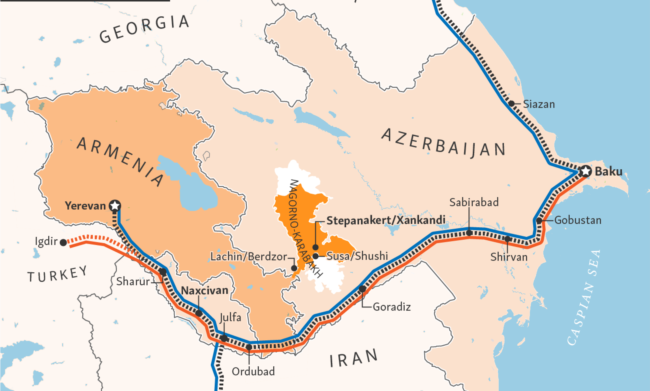
The opening of a Zangezur corridor, a transport route linking mainland Azerbaijan with its exclave of Nakhchivan via the territory of Armenia, can increase the likelihood of stable peace in the South Caucasus. The key argument is simple: thanks to the Zangezur corridor, Azerbaijan and Armenia will have a chance to engage in a joint project, decreasing the possibility of renewed hostilities.
We may examine the theoretical explanation of this idea to gain better insight and improve the predictive power of the argument. The economic interdependence theory posits that international trade and cooperation forge relationships between nations by offering access to goods and services that the countries cannot produce independently.
The fundamental premise of the theory suggests that economically interconnected countries are less likely to engage in armed conflicts and more likely to cooperate, as the losses caused by a confrontation outweigh potential benefits. The core idea applicable to the case of Azerbaijan and Armenia is that economic cooperation will pacify the political hostilities between the sides.
Based on the theoretical insights, launching the Zangezur corridor will incentivize Azerbaijan and Armenia to foster more meaningful relations grounded in mutually beneficial cooperation. After all, Baku and Yerevan never had any economic relations, which could have aided the situation that the nations found themselves in during the previous three decades. Commencing transport and economic cooperation will introduce a level of predictability in the relationship between the states, thus curbing the development of a potential conflict dynamic.
Nevertheless, there is a somewhat biased perception of a Zangezur corridor in Armenia, with some arguing that the corridor’s launch will negatively impact national interests. Such an argument, however, is flimsy because Azerbaijan and Armenia will not have a deterrent against future conflicts, and conflict dynamics may reappear should the corridor remain a concept. Becoming mutually dependent and intertwined in economic cooperation will improve the opportunities for future cooperation between the states. Should the corridor be launched, Baku and Yerevan will have more to lose from restarting hostilities.
Another criticism of the Zangezur corridor in Armenia revolves around the idea that this route will link Azerbaijan and Türkiye, thus making these countries more powerful relative to Armenia. While this observation is logical, it can be categorized as a fallacy. Proponents of this argument criticize the transport route on the premise that it will make the position of Baku and Ankara stronger vis-à-vis Yerevan, discarding the benefits that Armenia will reap. Perceiving the transport route in terms of comparing relative power gain between Armenia and Azerbaijan is an incorrect approach because such thinking decreases the likelihood of long-lasting peace, overlooks a credible solution to existing problems, and does not give Baku and Yerevan a platform to develop bilateral relations. Furthermore, Azerbaijan’s backup plan is to launch an alternative route via Iran, the implementation of which has already commenced. Therefore, another link between Baku and Ankara will be created regardless of Yerevan’s decision, making the argument irrelevant.
Otherwise, Armenia risks remaining isolated in the region. To this day, its borders with Azerbaijan and Turkey are closed, which means that Yerevan can move its goods and services only in northern and southern directions to Georgia and Iran, respectively. The lack of transport flexibility prevents Armenia from fulfilling its economic potential. Continuation of this policy will decrease Yerevan’s relative power vis-à-vis Baku and Ankara, which opponents of the Zangezur corridor fear.
Looking at the issue from this angle suggests that preventing the launch of the corridor will endanger Armenian interests, as remaining in isolation means fewer opportunities for cooperation. Meanwhile, Azerbaijan will enjoy more diverse opportunities for transport. This problem will put Armenia at a comparative disadvantage.
Other benefits of the corridor
The benefits of a Zangezur corridor are not limited to Azerbaijan and Armenia. It is vital to understand that the international trade system is in a very challenging situation. Mainly, trade between European states and Asian countries is hindered due to political developments in other regions.
The war in Ukraine led to a severe sanctioning of Russia, which became an unpredictable partner in the eyes of most European governments and companies. Consequently, trade with China and other Asian markets via Russian transit is unavailable. Another trade route via Iran is also impossible to utilize for similar reasons: the unpredictability of the Iranian regime and sanctions.
With two main routes linking Europe and Asia out of the equation, there is only one feasible possibility: the Middle Corridor, which aims to connect the continents through a network of railways and other modes of transport. This initiative involves several countries, including Azerbaijan, Georgia, Turkey, and Central Asian countries. Should Azerbaijan and Armenia agree on the Zangezur corridor’s opening, Yerevan will become a participant in this project, earning a place in the international trade and transport architecture. Consequently, the transit of goods via the Zangezur corridor will significantly streamline international trade by reducing the transit price and shortening the time in transit.
Furthermore, the opening of the corridor will enable Armenia to attract investments to develop transport infrastructure, which will positively impact its security. Both developments are crucial to Armenia, and decision-makers in Yerevan should consider the benefits of launching the transport route. Introducing the Zangezur corridor into the international trade system will increase the globalization of Azerbaijan and Armenia. Increased globalization of Baku and Yerevan will make the “exit cost,” i.e., betraying the agreement and slipping back into hostility, very costly from an economic and political perspective, thus contributing to the security of the South-Caucasus. Potential costs will include political pressure, as well as diminished trust in a side that betrays the agreement.
In conclusion, there are several benefits of launching a Zangezur corridor. Should Azerbaijan and Armenia agree, the transport corridor will pacify regional conflict dynamics, significantly decreasing the possibility of renewed hostilities. Additionally, Baku and Yerevan will have a joint project to work on, which will deepen the trust between the parties. Consequently, the two South Caucasus nations will find it easier to work on other joint projects in the future. Finally, launching a Zangezur corridor will significantly impact global trade, making the South Caucasus a vital transport hub and providing further incentives for peaceful dialogue among the regional states.
As a result, Azerbaijan and Armenia need to search for an opportunity to launch the Zangezur corridor, which can become a practical blueprint for peacebuilding in the South Caucasus.
Emin R. Sevdimaliyev is an analyst with a diverse skill set acquired during his career in national and international organizations, diplomatic service, and press. His interests include analyzing changes in power dynamics between state actors